...

DataGardener

DataGardener

Lending Data Platform for UK Brokers and Lenders

Please enter the lender’s name and select the charge status to discover how many companies have charges registered with the selected status and lender.

Total Charges: -
×

Download Report

By submitting this form, you agree to our Privacy Policy

Want to See What DataGardener Can Do?

Download our brochure and explore the full platform in two pages.

See How the DataGardener Lending Data Platform Works

Watch how brokers and lenders use DataGardener to identify refinance opportunities, analyse borrower risk and find new lending prospects.

For Lenders

How Lenders Identify Refinance Opportunities Using Lending Data

For Brokers

How Finance Brokers Use the DataGardener Lending Data Platform

Understand Your Target Market & Discover Ideal Prospects!

Set your ideal client criteria. Our technology and real-time market data analysis deliver a detailed report with actionable insights.

Why Do You Need a Lending Data Platform?

Lend with clarity and confidence. A lending data platform helps you analyse trends, evaluate borrowers, and uncover the right opportunities with reliable data.

Outsmart Competitors

Gain access to exclusive data your competitors don’t have, giving you a clear edge in the lending market.

Find Opportunities Faster

Search over 17M+ company accounts in under 30 seconds and focus on high-value leads using advanced filters.

Minimise Risks

Track charge statuses, classifications, and financial timelines to make confident lending decisions.

Customised Insights

Use our Sniper Approach with filters for industry, region, and turnover to target the right clients precisely.

Connect with Decision-Makers

Access detailed contact information, including emails, LinkedIn profiles, and phone numbers, to act quickly.

Turn Data into Intelligent Decisions

Interactive dashboards and real-time insights help you visualise trends and confidently act on opportunities.

Smart AI Features

Smarter AI solutions designed to help you secure finance, assess opportunities, and discover actionable data with ease.

The same signals are now available as lending intelligence for AI agents through DataGardener MCP.

Secured AI

Find companies with invoice finance, asset finance, or property loans; see the lender, renewal dates, and filter outstanding ones.
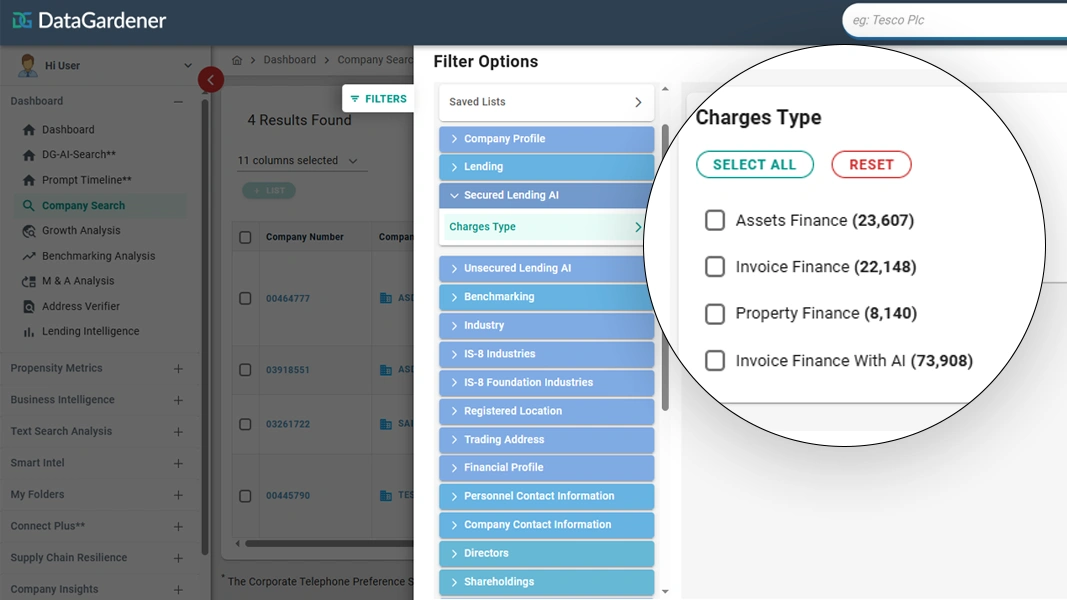
Secured AI Lending Intelligence

Unsecured AI

Identify companies with unsecured borrowing (invoice finance, hire purchase, operating leases) to target for refinance.
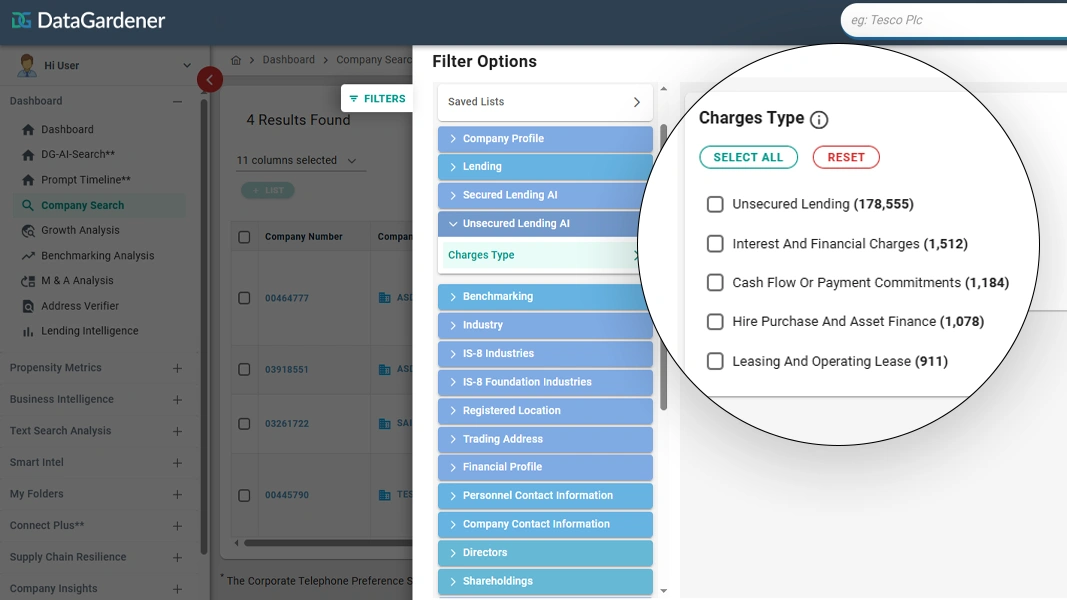
Unsecured AI Lending Intelligence

Text Search AI

Scan 12m+ company filings for hire purchase, invoice discounting, operating leases, equipment leases and view amount, lender, secured/unsecured, and start date.

Allica bank case study

DataGardener helps us identify refinance opportunities early, giving us a real edge in winning business.

Conrad Ford
Chief Product & Strategy Officer

Key Benefits of the DataGardener Lending Data Platform

Unlock powerful insights, streamline decision-making, and drive sustainable growth with smart AI-driven solutions.

Understand Lending Market Trends

Gain a comprehensive view of the lending landscape by analysing charge types, lender involvement, and financial trends.

Get Fresh Leads in 30 Seconds

Quickly identify potential borrowers or businesses of interest with advanced search and filtering tools.

Stay Updated with Real-Time Charge Status

Monitor outstanding, fully satisfied, or partially satisfied charges with up-to-date insights at your fingertips.

Track Every Charge

View charge descriptions, codes, creation dates, durations, and associated lenders all in one place.

Analyse easily with Smart Dashboards

Clearly visualise and analyse data with intuitive dashboards that make financial intelligence easy to understand.

Connect Directly with Key Contacts

Retrieve essential contact details like email addresses, LinkedIn profiles, and phone numbers to streamline outreach.

Dominate the Right Markets

Identify high-activity lending regions and focus your strategy where borrowing demand is strongest, helping you prioritise markets with the greatest opportunity.

Stay Ahead of competitors

Understand which lenders are active in key sectors and regions so you can refine your strategy, position your offering better, and win more deals.

Discover Opportunities Faster with Smart Search

Scan millions of company accounts in seconds to uncover businesses that match your lending criteria, helping you move from research to outreach faster.

Discover our plans and start using Lending Intelligence

How the DataGardener Lending Data Platform Works

All Your Lending Insights in One Place: Charge Types, Status, Lenders, and Actionable Intelligence.

Identify charge types icon

Identify Charge Types

Track charge status icon

Track Charge Status

Lenders & Details

Discover Lenders & Details

Track charge status icon

Review & Act on Data Intelligence

Case Study

Reducing Budget for Prospecting

“Our client, a fully licensed UK bank specialising in SME financial support, needed to find customers with large assets and high interest rates while entering the asset finance market. Using DataGardener’s API integrations and Lending Intelligence Tool, they identified high-value customers and gained insights into competitors’ activities.


The Monitor Plus feature allowed them to track customer events and identify clients needing renewals. They also found new clients with fully satisfied charges, minimising risks. As a result, our client successfully identified valuable customers who used only 15% of their budget and remained competitive.”

– Tarun Kumar, CEO DataGardener

Case study QR code
Scan the QR code to read the full Case Study or Click Here

Trusted By Leading UK Businesses

Find out which leading organizations are using our data to succeed.

Frequently Asked Questions (FAQ’s)

What is a lending data platform?
A lending data platform gives UK lenders and commercial finance brokers searchable company financials, registered charges, lender details, director and ownership data, and borrower risk indicators in one place. It helps them find businesses that may need funding and judge credit risk before they lend. Unlike a single credit report, it lets you search across the whole market, not just check one company at a time. What it brings together:
  • Company financials. Filed accounts and performance trends, such as turnover, profit, cash and net assets.
  • Registered charges. Secured borrowing with its type, status (Outstanding, Fully Satisfied or Part Satisfied), lender and creation date.
  • Borrowing in company filings. Hire purchase, invoice discounting and operating or equipment leases found in the accounts.
  • People and ownership. Directors and persons with significant control (PSCs).
  • Risk indicators. Credit and financial health signals to support underwriting.
  • Contact details. Emails, phone numbers and LinkedIn profiles for outreach.
Who uses one:
  • Lenders and origination teams looking for new SME borrowers
  • Credit and underwriting teams assessing borrower risk
  • Commercial finance brokers building prospect lists
How DataGardener helps: DataGardener’s Lending Intelligence covers 17M+ UK companies and can scan 12m+ company filings for borrowing such as hire purchase, invoice discounting and leases. Lenders and brokers can search, assess and contact prospects from one platform.
How does a lending data platform help lenders and brokers?
A lending data platform shortens the route from research to outreach and makes credit decisions better informed. Lenders and brokers can filter the UK market by sector, region, turnover and financial health, review each company’s borrowing, and contact decision-makers without switching between tools. What it helps you do:
  • Find new prospects faster. Filter companies by sector, region, turnover and financial health instead of searching manually.
  • Assess borrower risk. Review financial trends, existing charges, lenders and director information on one profile.
  • Identify refinance opportunities. Spot outstanding charges that are ageing and recently satisfied charges that suggest a business may be ready to borrow again.
  • Understand the market. See which lenders are active in which sectors and regions, and where borrowing demand is strongest.
  • Reach decision-makers. Get emails, phone numbers and LinkedIn profiles so outreach can start straight away.
  • Keep your pipeline moving. Export lists to Excel or CSV, or push them into your CRM.
How DataGardener helps: DataGardener users can search company accounts in under 30 seconds across 17M+ UK companies, filter by charge status, lender and creation date, and use Monitor Plus to track charge events. Export to Excel or CSV, or connect to HubSpot or Salesforce so prospects flow straight into your CRM.
What data is included in a lending data platform?
A lending data platform typically includes filed financial accounts, outstanding and satisfied charges with lender names and dates, credit and risk indicators, director profiles, persons with significant control (PSCs) and financial trends. Together this data shows how a business is performing, how it is already funded, and who is behind it. Data you should expect to find:
  • Financial accounts. Turnover, profit, cash, net assets and liabilities, plus the trend over several filed years.
  • Charge type (such as invoice finance, asset finance, property or debenture), status, lender, creation date, duration, description and code.
  • Borrowing disclosed in filings. Hire purchase, invoice discounting and operating or equipment leases, with amount, lender, secured or unsecured status and start date where available.
  • Credit and risk indicators. Signals that help rank borrowers and support underwriting.
  • Directors and PSCs. Who runs the company, who controls it, and their wider directorships.
  • Contact data. Verified emails, phone numbers and LinkedIn profiles of decision-makers.
Why it matters: Financials show whether a company can afford to borrow, charges show who already has security over its assets, and people data shows who to speak to and whether to ask for a personal guarantee. How DataGardener helps: DataGardener combines these datasets across 17M+ UK companies and 12m+ company filings, and adds verified contact data, with 2.05M+ emails and 1.3M+ phone numbers, so a prospect list is ready for outreach as well as analysis.
Why do commercial finance brokers use a lending data platform?
Commercial finance brokers use a lending data platform to find companies likely to need finance and to reach the right person quickly. Filtering by financial performance, sector and region replaces slow manual research, so brokers spend their time on qualified conversations rather than cold lists. What brokers use it for:
  • Finding companies that need funding. Signals such as turnover growth, ageing charges and recently satisfied charges point to businesses that may be looking for finance.
  • Building targeted prospect lists. Filter by sector, region, turnover, company size and financial health to match a lender’s criteria.
  • Matching prospects to products. Fast growth can suggest invoice finance, new equipment can suggest asset finance, and an ageing mortgage charge can suggest a refinance.
  • Checking borrower health. Review accounts, existing secured debt and director information before approaching a company.
  • Contacting decision-makers. Verified emails and phone numbers mean outreach can begin the same day.
  • Tracking leads. Keep prospects, notes and follow-ups in one pipeline through CRM integration.
How DataGardener helps: DataGardener combines these filters, signals and contacts across 17M+ UK companies, with 2.05M+ emails and 1.3M+ phone numbers. HubSpot and Salesforce integration keeps leads and follow-ups in a single pipeline.
How do lenders find SME borrowers in the UK?
Lenders find SME borrowers by filtering UK company data for businesses that match their credit appetite, then prioritising those showing a need for funding. The most effective approach combines firmographic filters (sector, region, size) with financial health and borrowing signals, so origination teams contact companies that are both creditworthy and likely to borrow. Filters that define your target market:
  • Sector by SIC code, and region or postcode area
  • Turnover band and employee count
  • Company age (many lenders require 2–3 years of trading)
  • Financial health: net assets, cash, profitability trend
  • Existing secured borrowing (registered charges) and who the lender is
Signals that a company may need funding now:
  • Turnover growth over the last 2–3 filed accounts
  • New property or land purchases
  • Public-sector contract wins that need working capital
  • Charges created several years ago that may be up for renewal
How DataGardener helps: Lending Intelligence lets origination teams apply all of these filters across 17M+ UK companies in one search, then export the list to Excel or CSV, or push it into HubSpot or Salesforce. Verified contact data means the list is ready for outreach the same day.
How can I find UK businesses whose loans may be coming up for refinancing?
Use the Companies House charge register. Every secured loan to a UK company is registered as a charge, showing the lender, the date it was created and whether it is still outstanding. Companies with outstanding charges created several years ago are strong refinancing prospects, especially when their finances have improved since. What to look for:
  • Charge age. Outstanding charges created 3–5 years ago often match the end of typical term loans and asset finance agreements.
  • Who the lender is. Borrowers whose lender has left a sector or tightened criteria may be looking for an alternative.
  • Improved finances. Higher turnover or net assets since the charge was created means the business may qualify for better terms.
  • Multiple charges. Several lenders on one company can signal a consolidation opportunity.
  • Recently satisfied charges. A paid-off loan can mean the business is ready to borrow again.
How DataGardener helps: You can filter by existing charges (lender, creation date, status) alongside financial health, sector and region. That turns the charge register into a refinancing pipeline of creditworthy businesses, found before their borrowing renews.
How do I check if a UK company can afford a business loan?
Start with the company’s latest filed accounts, then look at its existing debt, payment history and directors. Affordability depends on whether the business generates enough cash to cover repayments after its existing obligations, so trends over 2–3 years tell you more than a single year. Step by step:
  • Read the accounts. Turnover, profit, cash, net assets and current liabilities. Note that many small UK companies file abridged or micro-entity accounts without a profit and loss statement, so balance-sheet trends matter more for them.
  • Calculate key ratios. Current ratio (current assets ÷ current liabilities), gearing (debt ÷ equity) and, where profit figures exist, interest cover and debt service coverage.
  • Check existing secured debt. Outstanding charges show who else has security over the assets.
  • Check adverse records. CCJs, previous insolvencies, overdue filings.
  • Check the people. Directors’ track record and who the persons with significant control (PSCs) are.
How DataGardener helps: Financials, charges, risk indicators, director history and ownership sit on one company profile, so underwriters can complete these checks in minutes rather than pulling filings one by one.
How can lenders spot early warning signs of default in a loan book?
Watch for changes, not static scores. Most UK business defaults are preceded by visible public-record events weeks or months earlier: late filings, new debts, legal action and changes in management. Lenders who monitor these events across their portfolio can act while there are still options to restructure. The strongest early warning signs:
  • Late filings. Overdue accounts or confirmation statements at Companies House.
  • New CCJs. County Court Judgments show unpaid debts that went to court.
  • New charges with other lenders. Extra secured borrowing can signal cash pressure.
  • Director resignations. Especially several at once, or the finance director.
  • Falling net assets or cash in the latest accounts.
  • Ownership changes. New PSCs or a change of controlling shareholder.
  • Gazette notices. Proposals to strike off or winding-up petitions.
  • Registered office or auditor changes without a clear reason.
How to act on them: Rank alerts by exposure size, review the borrower within days, and agree a playbook (contact, request management accounts, tighten covenants, or restructure). How DataGardener helps: Monitoring sends automated alerts when these events hit companies in your portfolio. Rules can be tailored by exposure, sector and product type, so credit teams see the alerts that matter first.
How do I check a director's history before approving a business loan?
Review every company the director has run, past and present, and look for patterns of failure, disqualification or links to companies with unpaid debts. For SMEs, the directors’ track record is often as predictive as the company’s own accounts, and it informs whether to ask for a personal guarantee. What to check:
  • All appointments. Current and past directorships, and how long each lasted.
  • Outcomes of past companies. Dissolutions, liquidations and administrations, and how soon they followed the director’s appointment.
  • Search the Insolvency Service’s disqualified directors register.
  • Personal insolvency. Check the Individual Insolvency Register for bankruptcies and IVAs.
  • Links to adverse records. Other companies they run with CCJs or overdue filings.
  • Who really controls the business. Persons with significant control (PSCs) may differ from the directors.
  • Recent changes. A director appointed just before the application deserves a closer look.
Red flags: several failed companies in a short period, “phoenix” patterns (a new company in the same trade soon after a failure), or frequent resignations. How DataGardener helps: Directorship history, ownership structure and previous insolvencies appear on one profile, linked across all of a director’s companies, so you can assess the people behind a loan in one view.
What is a company charge, and what does "satisfied" mean?
A company charge is security a UK company gives a lender over its assets. It must be registered at Companies House within 21 days of being created, otherwise it is void against a liquidator or administrator. A charge marked “satisfied” means the debt has been repaid and the lender has released the security; “outstanding” means the loan is still in place. Types of charge:
  • Fixed charge. Over specific assets such as property, vehicles or equipment. The company can’t sell them without the lender’s consent.
  • Floating charge. Over changing assets such as stock and receivables. The company can trade them freely until the charge “crystallises”, for example on insolvency.
  • A document that often combines fixed and floating charges over most of the company’s assets.
Charge statuses you’ll see:
  • Outstanding – the secured debt still exists.
  • Satisfied – repaid in full and released (filed on form MR04).
  • Part satisfied – some assets released or part of the debt repaid.
Why lenders care: Charges show who else has a claim on the assets and in what order, and their dates and lenders reveal a company’s borrowing history. How DataGardener helps: Charge data for every UK company is searchable by lender, date and status, and you can be alerted when a company registers or satisfies a charge.
What tools help UK commercial finance brokers find borrowers?
Brokers use UK company data platforms to find businesses that fit a lender’s criteria and show signs of needing finance, then reach the decision-maker directly. The best tools combine company search, funding signals and verified contact details, so a broker can go from a lender’s appetite to a qualified call list in one place. What a broker’s toolkit should cover:
  • Company search by lender criteria. Sector, region, turnover, trading age and financial health.
  • Funding-need signals. Turnover growth, existing and ageing charges, new property purchases and public-sector contract wins.
  • Decision-maker contacts. Directors’ names plus verified emails and phone numbers.
  • CRM integration. So leads, notes and follow-ups stay in one pipeline.
  • Alerts when a prospect files new accounts or registers a charge.
Matching prospects to products:
Signal Likely product
Fast turnover growth, high receivables Invoice finance
New equipment or vehicles Asset finance
Property purchase or ageing mortgage charge Commercial mortgage or refinance
Public-sector contract win Working capital or contract finance
How DataGardener helps: Lending Intelligence combines these signals with verified contact data (2.05M+ emails and 1.3M+ phone numbers) and HubSpot, Salesforce or Zoho integration, so brokers can build, contact and track prospects in one workflow.
What is the best lending intelligence software for UK SME lenders?

The best lending intelligence software covers the full credit lifecycle: finding borrowers, assessing them and monitoring them after the loan is made. Traditional credit reference tools focus mainly on scores and reports for a single company. Lending intelligence platforms add origination search, borrowing signals and portfolio monitoring, which matters for lenders growing an SME book.

Criteria to compare:

  • Coverage. All UK registered companies, not just active or larger ones.
  • Depth of data. Financials, charges, CCJs, directors, PSCs, ownership and property.
  • Origination search. Can you build target lists by sector, size, region and borrowing signals?
  • Underwriting view. Are financials, charges and director history on one profile?
  • Monitoring. Automated, configurable alerts across your portfolio.
  • Integrations. CRM connectors and an API for your loan origination system.
  • Contact data. Verified, GDPR-compliant emails and phone numbers for outreach.
  • Pricing and support. Clear pricing, onboarding and training.

How DataGardener compares: DataGardener’s Lending Intelligence covers all three stages across 17M+ UK companies, with financials, charges, director and PSC data, automated monitoring, CRM and API integrations, and a dedicated account manager on every plan. Book a demo to test it against your own lending criteria.

How much does a UK lending intelligence platform cost?
UK lending intelligence platforms are usually sold as subscriptions, priced by product, number of users and integrations. DataGardener’s plans, including Lending Intelligence, start from £478 per month, with the final price depending on the product and number of users. Monthly and annual plans are available. What drives the price:
  • Number of users on the platform
  • Products included (Lending, Business or Procurement Intelligence)
  • Integrations such as CRM connectors or API access
  • Custom data requests for specific datasets
  • Contract length (monthly or annual)
Included in every DataGardener plan:
  • Access to 17M+ UK companies
  • Verified financials and credit data
  • Director and PSC information
  • GDPR-compliant contact data (2.05M+ emails, 1.3M+ phone numbers)
  • Export to Excel or CSV
  • A dedicated account manager and monthly training
Add-ons: CRM integrations (HubSpot, Salesforce, Zoho), API integrations and custom data requests. Can I try it first? There is no self-serve trial, but you can book a free 30-minute personalised demo on live UK company data.