

A company with 12 employees does not buy, borrow or procure like one with 1,200. Yet too many commercial teams still build target lists around broad SIC codes and a postcode, then wonder why conversion rates stall. When you find companies by employee count, you introduce a practical measure of operational scale into every targeting decision.
- For sales teams, employee range helps identify firms with the likely budget, buying committee and resource need for your proposition.
- For lenders, it adds useful context to affordability and growth potential.
- For procurement and compliance teams, it helps distinguish a local specialist from a supplier capable of supporting a national contract.
Employee count is not a perfect proxy for commercial strength. A highly automated manufacturer may employ fewer people than its turnover suggests, while a labour-intensive business may have a large workforce but tight margins. Used alongside financial, sector and risk data, however, it is one of the fastest ways to make a UK company search more commercially relevant.
Why employee count changes the quality of your company search
Headcount gives a clearer indication of business maturity than a company name or industry label alone. A growing 20-person professional services firm may be ready for its first formal CRM, finance platform or outsourced HR provider. A 250-person organisation is more likely to have multiple stakeholders, established procurement processes and a longer sales cycle. Both could sit in the same sector. They are not the same opportunity.
This matters when pipeline targets are under scrutiny. If your sales team needs organisations with enough internal complexity to justify an enterprise service, filtering for micro businesses creates noise. Equally, excluding smaller firms can be a costly mistake when your offer is designed for agile, owner-led businesses that move quickly.
Employee count can also reveal where your message needs to change. A small employer may respond to time saved, reduced admin and predictable monthly cost. A larger employer may care more about governance, integration, data security, contract management and measurable operational impact. Better segmentation produces better outreach because the commercial context is already built into the list.
How to find companies by employee count for a real buying case
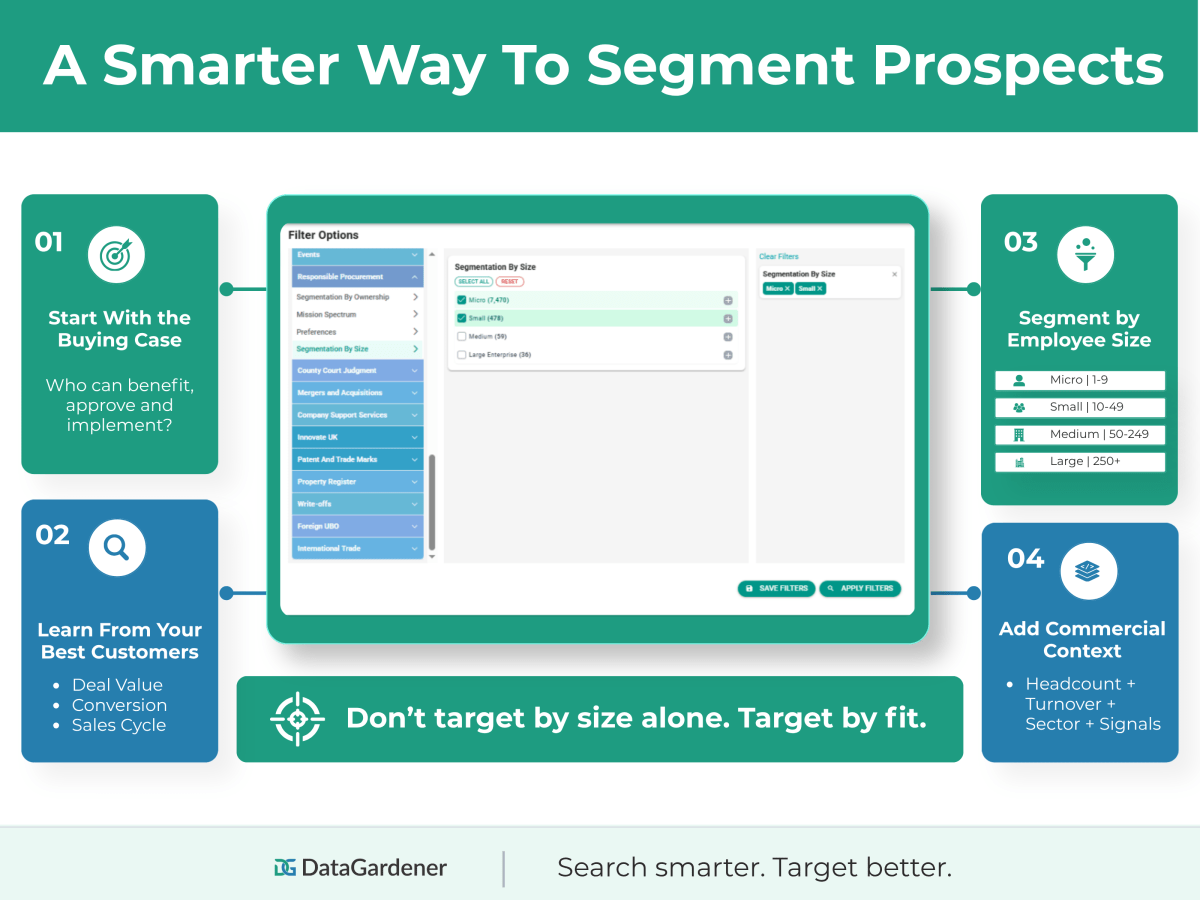
Start with the commercial question, not an arbitrary headcount band. Ask what size of organisation can realistically benefit from your offer, approve the spend and implement the solution. Then test that assumption against your existing customers.
Look at your strongest accounts by employee range. Are your highest-value customers concentrated between 50 and 249 employees? Do smaller firms convert faster but generate lower annual contract value? Do businesses with 500 or more employees take longer to close but expand across departments? These patterns should shape your prospecting criteria.
A useful starting point is to divide the market into practical operating groups:
- Micro businesses, typically 1 to 9 employees, where owner-led decisions and limited specialist resource are common.
- Small businesses, typically 10 to 49 employees, where teams begin to formalise systems and supplier relationships.
- Medium-sized businesses, typically 50 to 249 employees, where growth, process complexity and cross-functional buying become more visible.
- Larger organisations, typically 250 or more employees, where procurement, compliance and multi-stakeholder approval are often central to the sale.
Those brackets are only a starting point. A £10 million turnover technology firm with 35 staff may be a stronger target than a 150-person business in a low-margin sector. The right approach is to use employee count as a qualifying layer, then add the evidence that matters to your commercial model.
Add filters that reflect how your customers actually buy
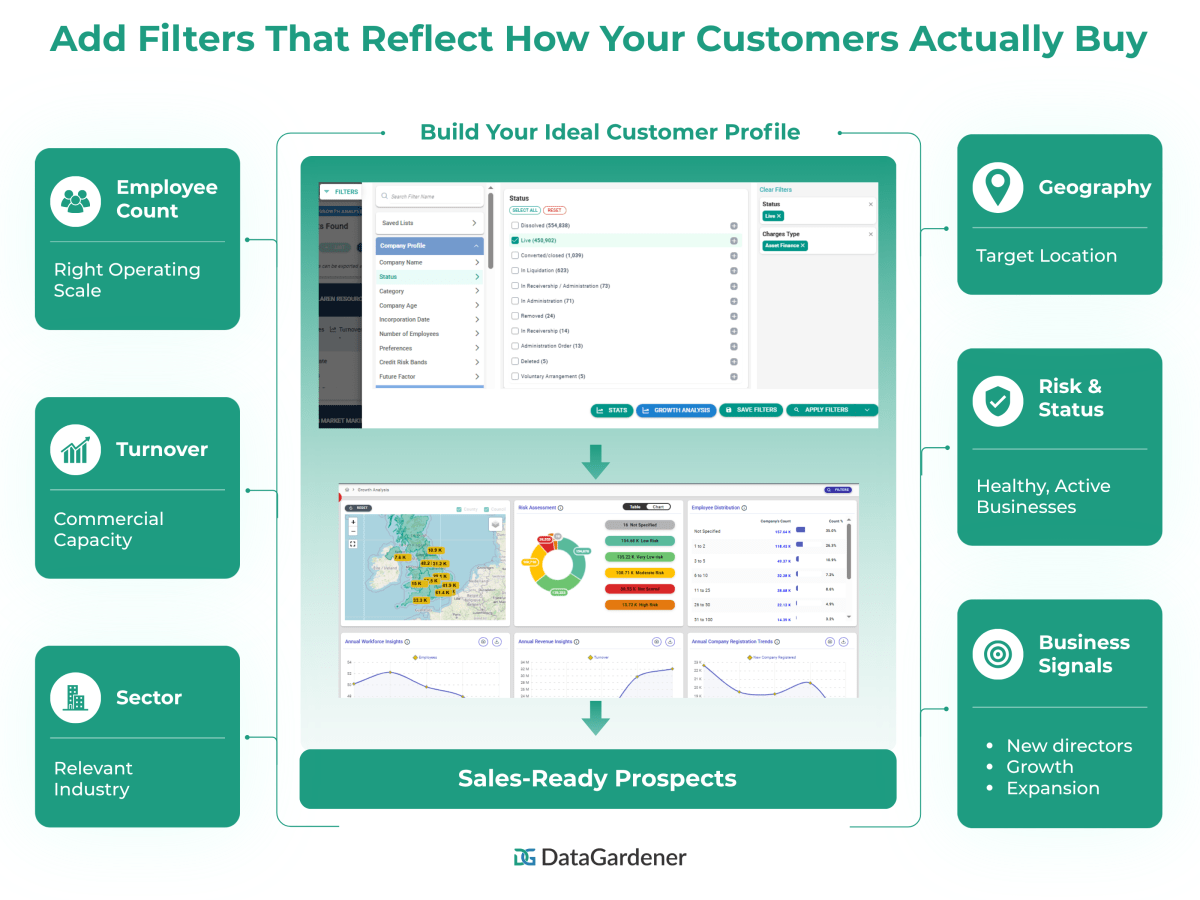
The difference between a generic list and a working pipeline is the combination of filters. For example, an asset finance provider may target UK manufacturers with 20 to 200 employees, a specified turnover range, low or moderate risk indicators and recent growth signals. A facilities supplier may focus on multi-site employers in a defined region, excluding businesses that are dormant, insolvent or too small to require a contracted service.
For a B2B software provider, the profile may be more specific: companies with 50 to 500 employees in professional services, logistics or construction; directors appointed in the past 12 months; healthy filing history; and evidence of expansion. A new finance director or operations lead can signal a review of systems, suppliers and costs. Headcount tells you whether that change is happening inside an organisation of meaningful scale.
DataGardener enables teams to search UK companies using employee ranges alongside sector, turnover, geography, risk, directorship changes, ownership and other operational criteria. That means less time cleaning broad datasets and more time working accounts that fit the brief.
Use employee count differently across commercial teams
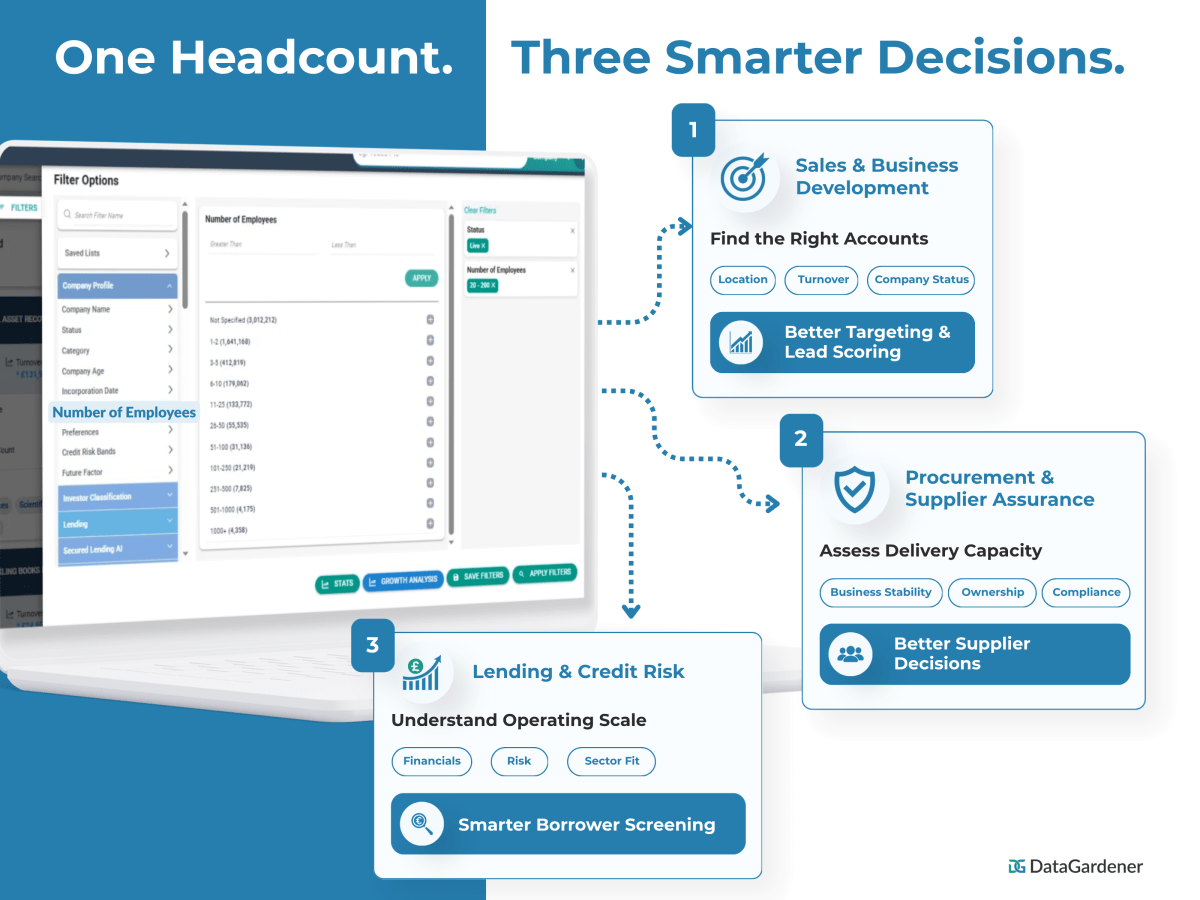
The same data point supports different decisions. Treating it as a single sales filter leaves value on the table.
Sales and business development
Sales leaders should use employee count to balance territory potential and salesperson capacity. A representative tasked with winning mid-market accounts needs a defined universe, not every company in a broad sector. Combining headcount with location, turnover and company status gives managers a defensible target market and a cleaner way to allocate accounts.
It also improves lead scoring. A 100-person business in your ideal sector, with recent director activity and stable financial indicators, should not receive the same priority as a two-person business with no visible need for your service. Scoring is most effective when it reflects fit, timing and likely value rather than volume alone.
Lending and credit risk
Lenders and brokers need context before assessing an application or approaching a new borrower segment. Employee count can indicate operating scale, but it should never replace formal affordability, filing, adverse event and payment-risk checks. A headcount figure may be estimated, lagged or affected by seasonal labour, outsourcing and group structures.
Used carefully, it helps identify portfolio opportunities. A lender specialising in established SMEs might screen for firms with 10 to 100 employees, positive financial movement and a sector fit with its lending appetite. The next step is a fuller assessment, not an automatic decision.
Procurement and supplier assurance
For procurement professionals, headcount can help assess whether a potential supplier has the capacity to deliver. A supplier with five employees may be an excellent specialist partner for a defined project, but not suitable as the sole provider for a time-critical nationwide contract. Conversely, selecting only large suppliers can reduce competition and overlook capable regional businesses.
The question is not simply, “How many people do they employ?” It is, “Do they have sufficient operational capacity, financial resilience, relevant experience and governance for this requirement?” Employee count is one piece of supplier due diligence, alongside ownership, financial performance, compliance records and trading status.
Watch for the data traps that weaken decisions
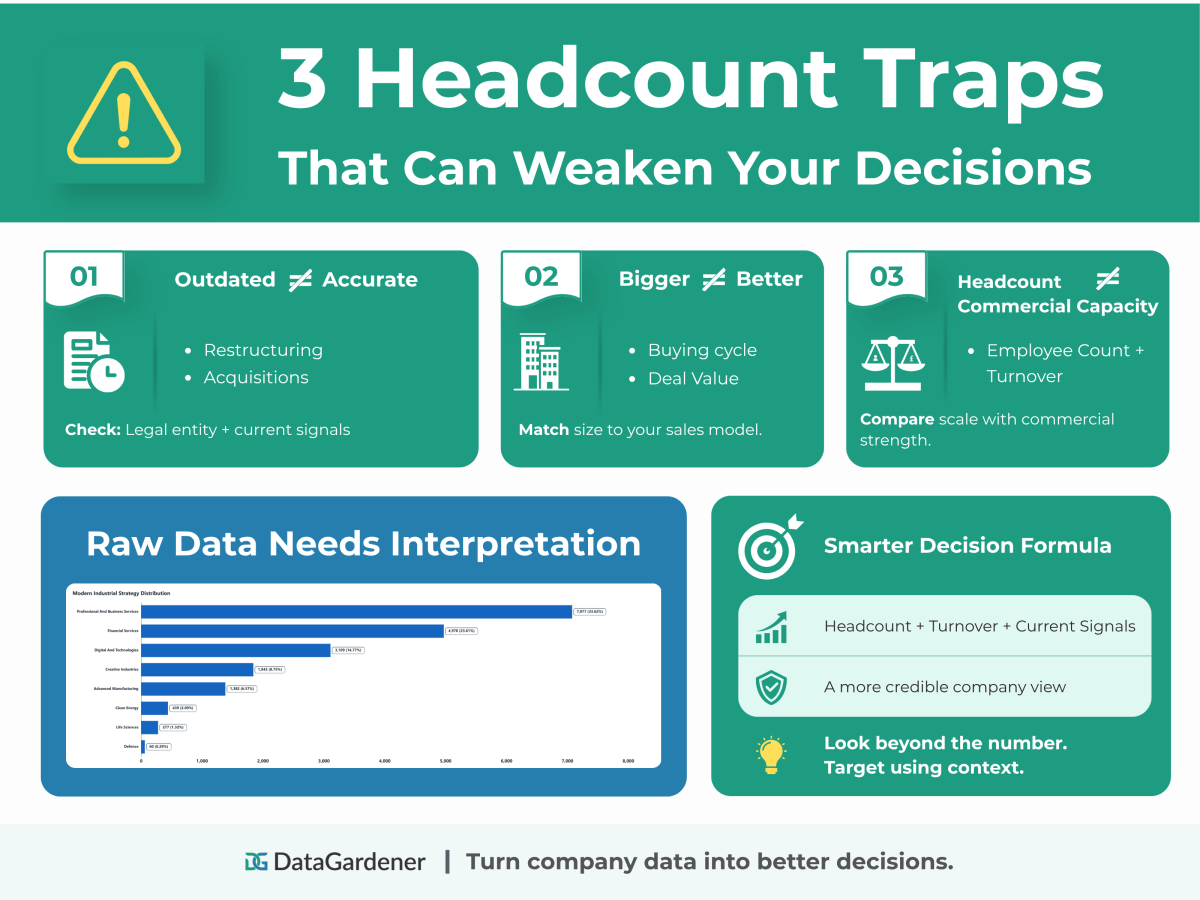
Headcount data requires interpretation. A company’s latest filed accounts may be months old, and employee figures can change quickly after an acquisition, restructuring or contract win. Some businesses use contractors extensively. Others sit within a group where staff are employed by a different legal entity. If you need precision, verify the legal entity you are assessing and use current change signals where available.
Avoid assuming bigger is always better. Large organisations can have long procurement cycles, fragmented ownership of budgets and incumbent suppliers that are difficult to displace. Smaller firms may have lower deal values but faster decisions, better access to owners and strong potential for referral-led growth. The best employee range depends on your cost of sale, product complexity and growth target.
It is also worth separating employee count from turnover. High-turnover wholesalers, property businesses and digital firms may employ relatively few people. Labour-heavy care, hospitality and construction businesses may have significant headcount with variable margins. Matching both measures gives a far more credible view of commercial capacity.
Turn a headcount filter into a repeatable market play
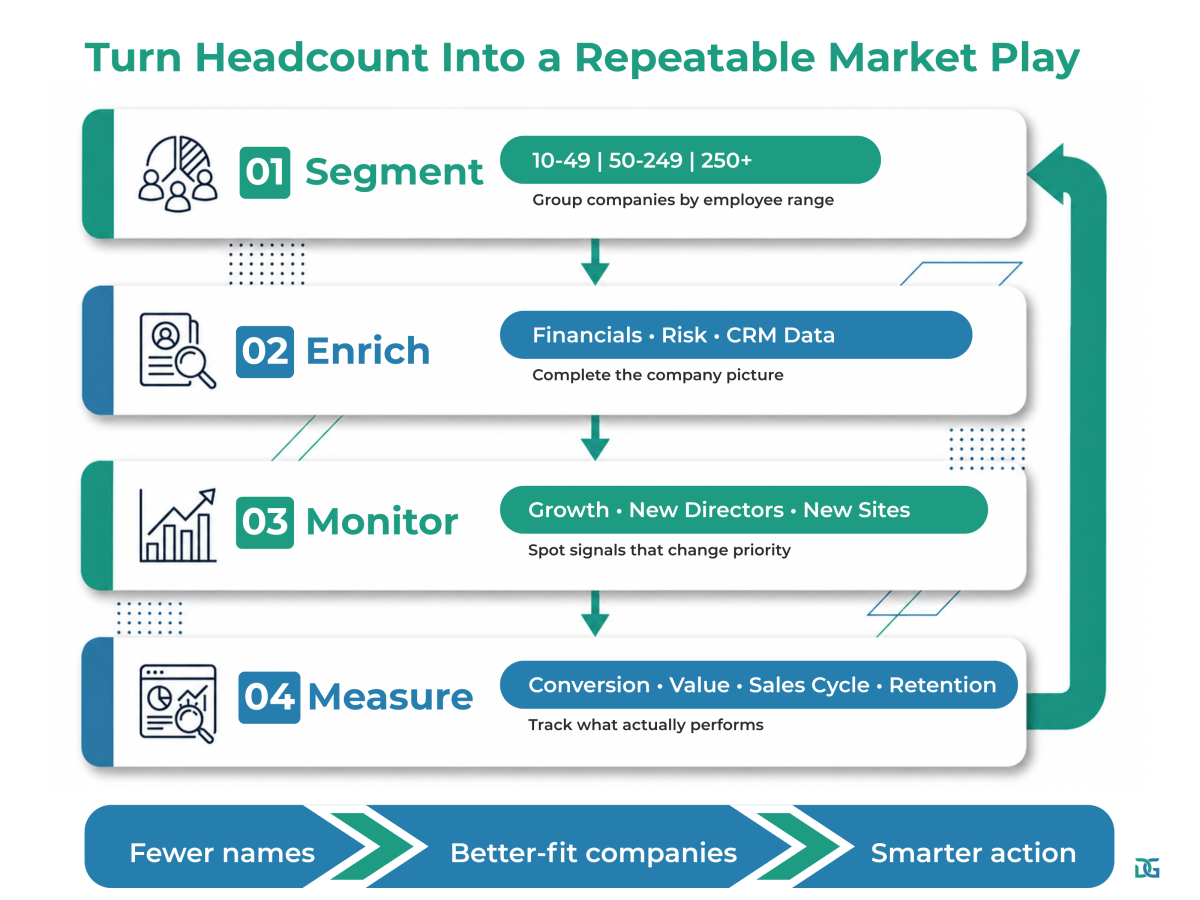
Once you have identified the employee ranges that perform, make the process operational. Build distinct market segments, assign ownership, enrich incomplete CRM records and monitor accounts for meaningful changes. A prospect moving from 20 to 50 employees, appointing new directors or opening additional sites may warrant a different approach from one that has remained static for years.
Review results by segment every quarter. Measure meetings booked, conversion rate, average contract value, sales-cycle length and retention rather than judging a list by lead volume. If 10 to 49 employee businesses generate the fastest payback while 50 to 249 employee firms create the largest long-term value, your campaigns and account plans should reflect both realities.
The strongest company searches do not produce more names. They produce a smaller, better-reasoned set of organisations your team can act on with confidence. Start with the workforce size that fits your proposition, challenge it with financial and risk evidence, and let the results refine the next search.