


A Steady Climb Into the Financial Year’s Third Month
July marks the third month of the UK financial year, the point at which businesses have settled into the rhythm of the new fiscal cycle. This month’s DataGardener Business Insights Report shows momentum building on multiple fronts at once, with incorporation activity, lending and enforcement all picking up pace together.
Explore key trends, emerging risks and growth opportunities in this month’s DataGardener Business Insights Report.
Why is July an important month for UK businesses?
By the third month of the financial year, the early-year uncertainty of April and the settling-in period of May and June have generally given way to a clearer read on trading conditions. Businesses that were cautious at the start of the cycle now have enough evidence to commit, whether that means registering new ventures, taking on fresh financing, or, in some cases, deciding it is time to close.
July 2026 captures that shift well. New business formation accelerated sharply compared with the month before, yet so did dissolutions, charges and County Court Judgements (CCJs). Rather than pointing in one direction, the data suggests a business environment that is becoming more active across the board, with confidence and financial pressure rising side by side.
Business Overview: July 2026 at a Glance
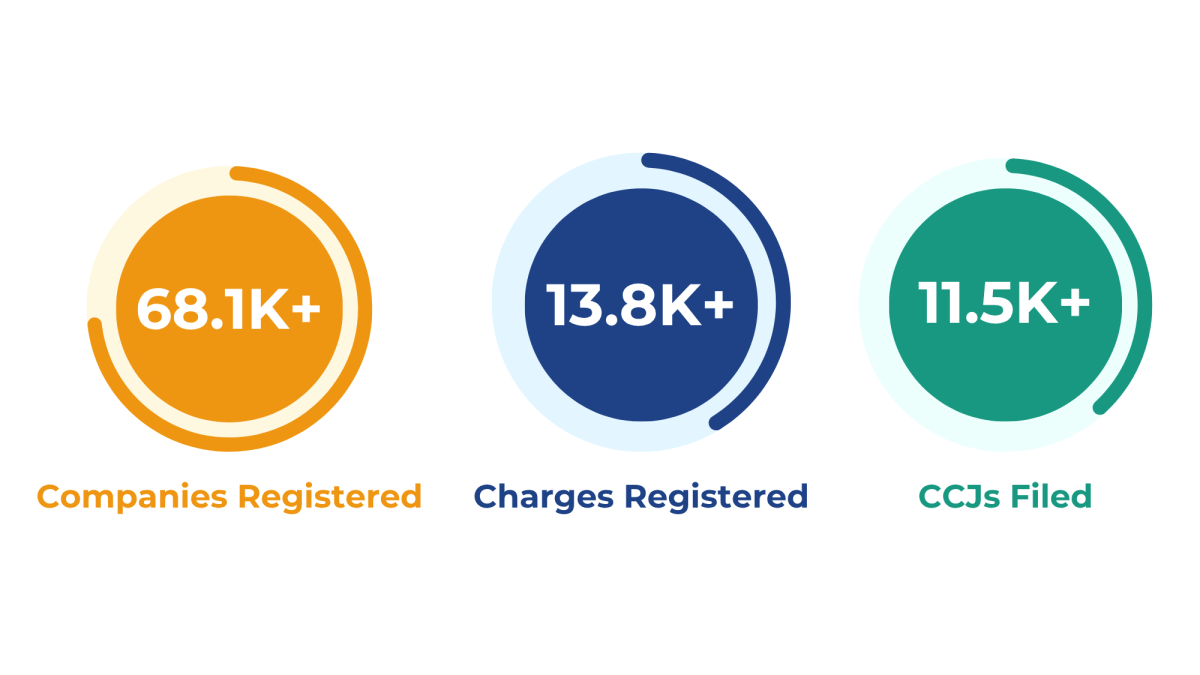
As of July 2026, over 68.1K new businesses were incorporated, 13.8K+ charges registered and 11.5K+ CCJs filed.
These figures point to a business climate that is picking up pace as the financial year progresses, with entrepreneurs continuing to build even as lending and enforcement activity edges higher across the market.
How many companies closed down in July 2026?
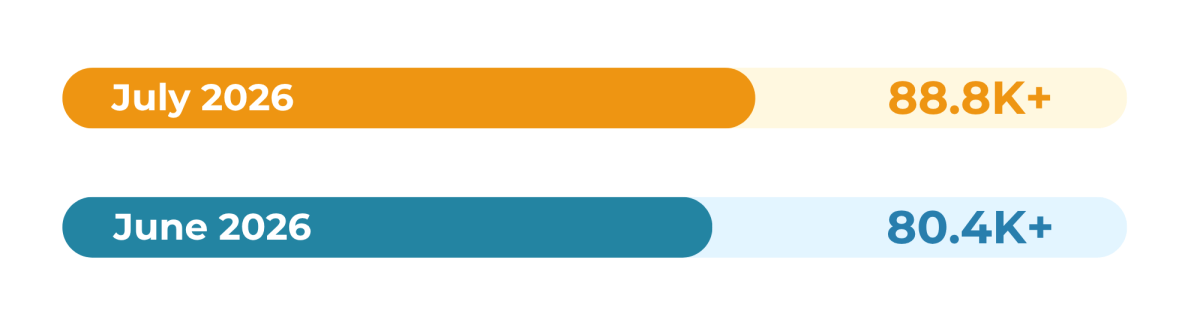
In July 2026, more than 88.8K companies were dissolved, a marked increase compared to 80.4K+ in June 2026.
This shift may reflect businesses reassessing viability as the financial year progresses, alongside ongoing structural adjustments across sectors. A rise of this scale alongside strong new formation numbers suggests the UK corporate landscape is refreshing itself quickly, with weaker structures exiting as new ones enter.
How did new company formations compare to June?
In July 2026, over 68.1K companies were incorporated, an increase compared to 53.1K+ in June 2026.
The uptick suggests strengthening business confidence as the UK economy moves further into the new financial year, with formations rising across all regions.
Which regions saw the most new business activity?
The regional distribution of incorporations remains largely consistent with June, even as volumes rise everywhere.
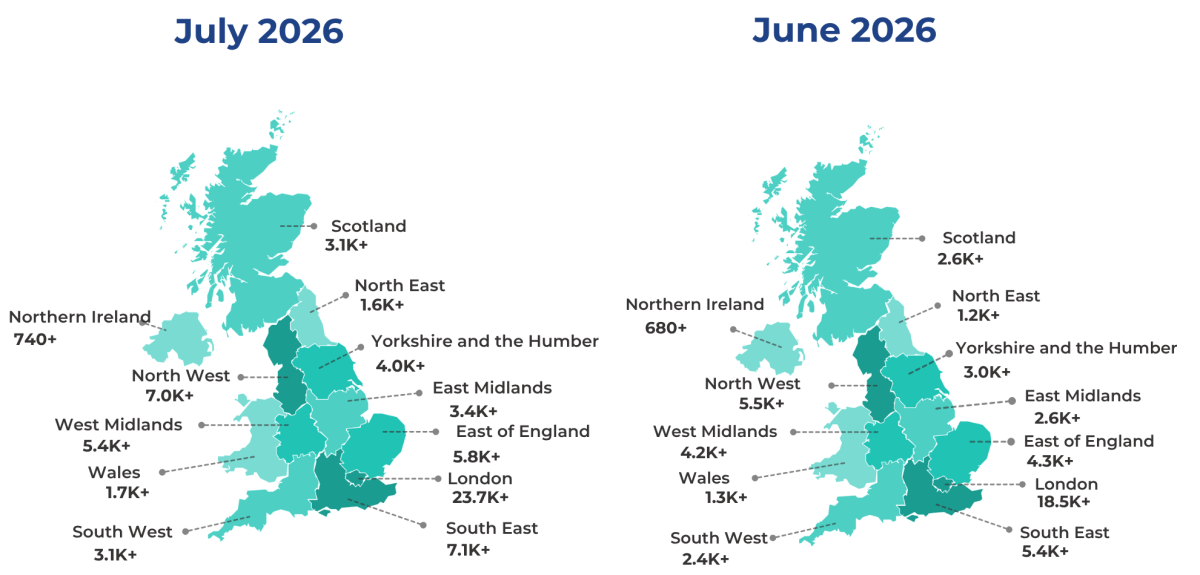
London continues to dominate with 23.7K+ companies, reaffirming its position as the UK’s commercial powerhouse, up from 18.5K+ in June. The South East follows with 7.1K+ (up from 5.4K+), with the North West close behind at 7.0K+ (up from 5.5K+), highlighting steady regional momentum beyond the capital. On the lower end, Northern Ireland (740+) and the North East (1.6K+) reflect the smallest regional contributions, though both also grew from June’s totals of 680+ and 1.2K+ respectively. The West Midlands (5.4K+) and East of England (5.8K+) round out a broad-based national uplift.
Which industries were most active in July 2026?
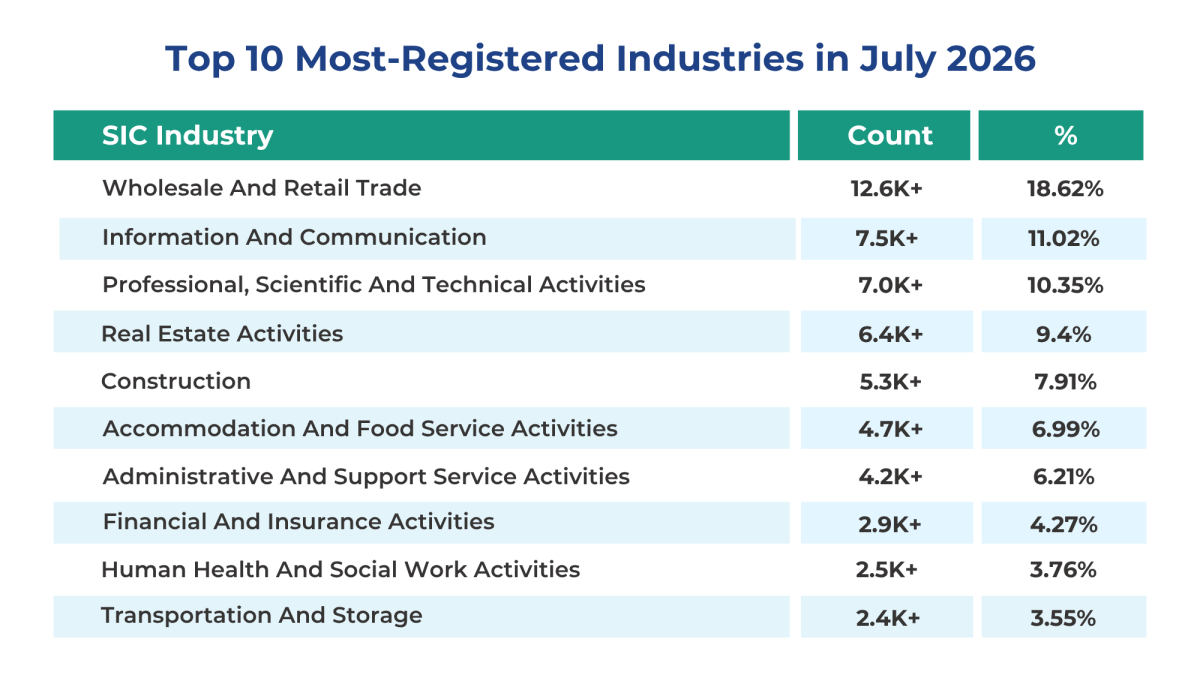
The SIC (Standard Industrial Classification) analysis for July 2026 shows a distribution broadly consistent with recent months. Wholesale and Retail Trade leads with 18.62% (12.6K+ companies), reflecting sustained consumer demand and strong entrepreneurial activity.
Information and Communication (11.02%) and Professional, Scientific and Technical Activities (10.35%) follow closely, driven by continued technology investment and consultancy growth.
Meanwhile, Real Estate (9.40%) and Construction (7.91%) remain solid contributors, underscoring the resilience of property- and infrastructure-led businesses.
Overall, July’s trends highlight steady confidence across core industries, particularly those adapting quickly to digital and market shifts.
What does the risk profile of new companies tell us?
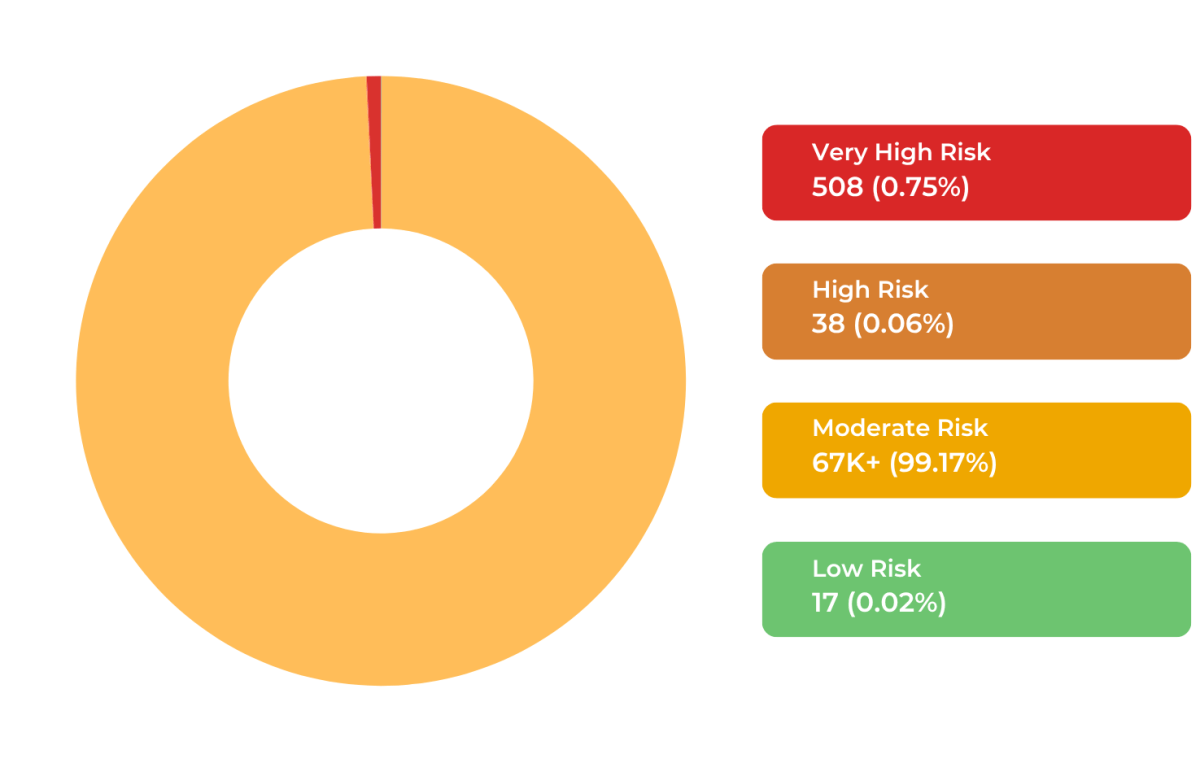
Risk assessment for newly incorporated companies in July 2026 reveals a heavily concentrated distribution, reflecting the nature of new-company risk profiling rather than any single emerging concern.
The overwhelming majority, 99.17% (67K+), fall into the Moderate Risk category, as most new businesses simply lack the trading history needed for a more refined score. A small share, 0.75% (508 companies), were flagged as Very High Risk due to early red flags, while very few, 0.02% (17 companies), achieved a Low Risk rating this early. High Risk firms make up a further 0.06% (38 companies).
Overall, these figures reflect a market where most incorporations start out in a moderate, wait-and-see band until enough operating history builds up to move them toward either end of the risk spectrum.
Were there changes in company charges registered?
In July 2026, 13.8K+ charges were registered, increasing from 11.8K+ in June 2026.
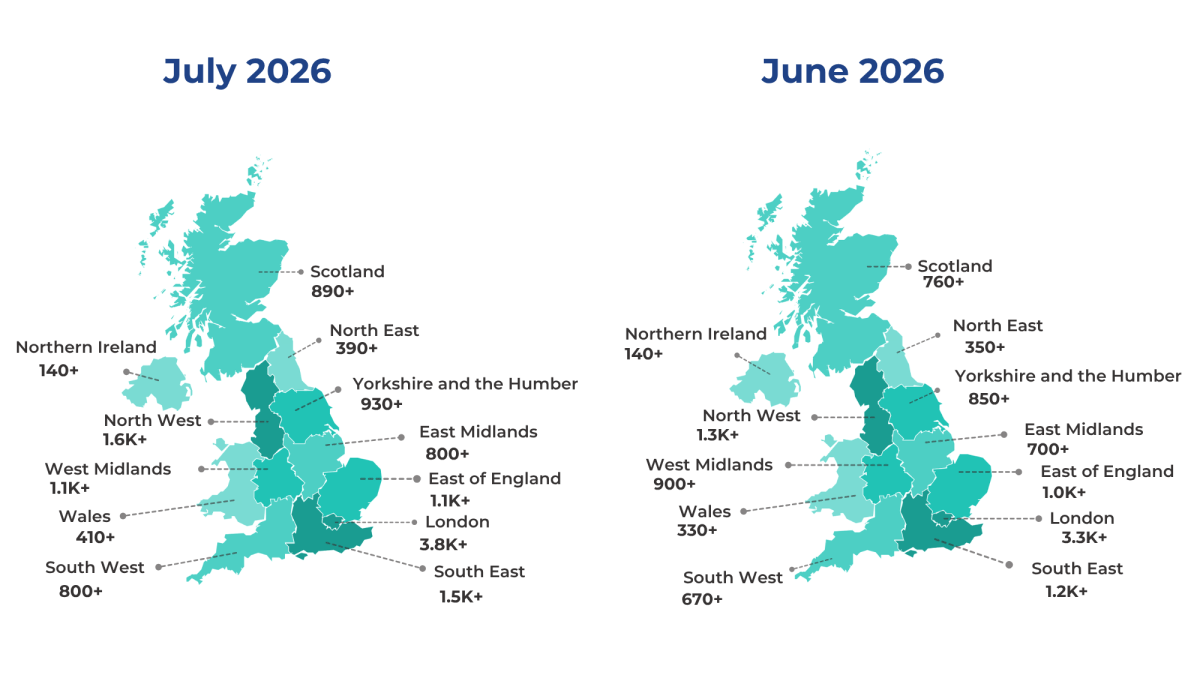
This rise aligns with a pick-up in lending and investment activity, as firms secure fresh financial commitments while the financial year progresses. London led with 3.8K+ charges, up from 3.3K+ in June, followed by the North West (1.6K+, up from 1.3K+) and the South East (1.5K+, up from 1.2K+). The rising volumes across all three regions suggest businesses across the country are drawing on credit with growing confidence rather than caution.
What about County Court Judgements (CCJs)?
CCJ filings increased slightly, with 11.5K+ filed in July 2026, up from 10.5K+ in June 2026.
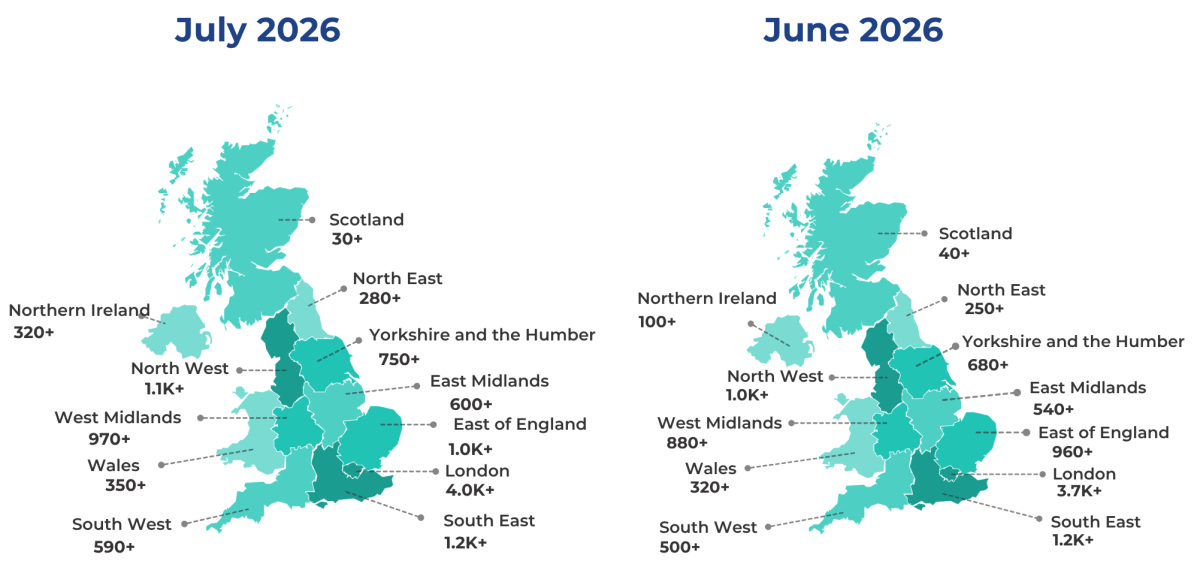
This uptick may reflect a build-up of enforcement activity as the financial year progresses, with more businesses facing formal proceedings after being unable to renegotiate payment terms. London recorded the highest volume with 4.0K+, up from 3.7K+, followed by the South East (1.2K+, unchanged on June) and the North West (1.1K+, up from 1.0K+). The steady rise points to payment pressures building gradually rather than sharply across the UK corporate ecosystem.
Conclusion: What does July 2026 tell us about the UK business landscape?
July 2026 paints a picture of a business environment gathering pace on every measure at once. New incorporations rose faster than dissolutions in percentage terms, yet both climbed together, as did charges and CCJs, suggesting a market that is becoming more active rather than simply healthier or weaker. London remains the clear centre of gravity across formations, charges and enforcement alike, while regional formation growth shows the uplift is not confined to the capital.
As the financial year gathers momentum into its third month, one thing is clear:
Businesses that combine data-driven insight with strategic timing will be best positioned to capitalise on the opportunities ahead, while staying alert to the financial pressures building alongside them.
All insights are sourced from DataGardener’s July 2026 UK Business Insights dataset. For deeper analysis, API access or customised dashboards, visit DataGardener.com.
Download the Full July 2026 UK Business Insights Report
Get the complete picture. The July 2026 UK Business Insights Report brings together company formations, dissolutions, charges, CCJs, risk profiles and industry breakdowns into one comprehensive resource.
Whether you are a business developer, credit analyst, investor or strategic planner, this report gives you the data intelligence to make smarter, faster decisions as the financial year moves into its next phase.
For deeper analysis, API access or customised dashboards, visit DataGardener.