

A Month of Moderation and Market Momentum
August marks the midpoint of the UK’s financial year, a natural checkpoint for businesses to pause and take stock of performance so far. This month’s DataGardener data captures that mood clearly: new company formations, lending activity and CCJ filings all eased back from July, while dissolutions moved in the opposite direction.
Explore key trends, emerging risks, and growth opportunities in this month’s DataGardener Business Insights Report.
Why is August an important month for UK businesses?
Sitting roughly five months into the UK financial year, August is often when the early-year momentum of April and May gives way to a more measured pace. Summer holidays reduce trading days, decision-making slows across many sectors, and businesses use the quieter period to review budgets and reassess plans for the second half of the year.
This year-round rhythm shows up clearly in the August 2026 figures. New incorporations, charges and CCJ filings all declined compared with July, while dissolutions rose, a pattern consistent with businesses closing out weaker positions during a naturally slower trading month rather than an emerging crisis.
Taken together, the topline figures suggest a business environment in a holding pattern: entrepreneurs continuing to build, but with noticeably more caution than in the busier months either side of summer.
Business Overview: August 2026 at a Glance
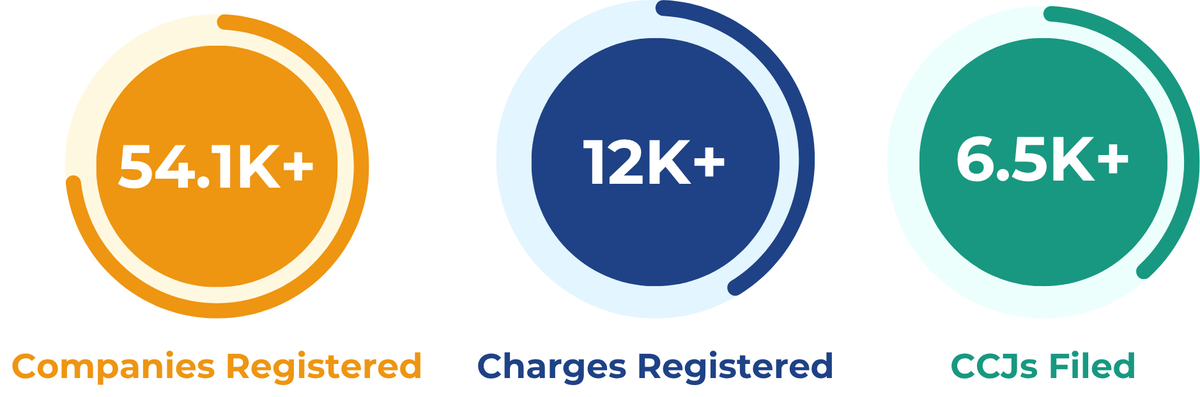
As of August 2026, over 54.1K+ new businesses were incorporated, 12.0K+ charges registered, and 6.5K+ County Court Judgments (CCJs) filed.
How many companies closed down in August 2026?
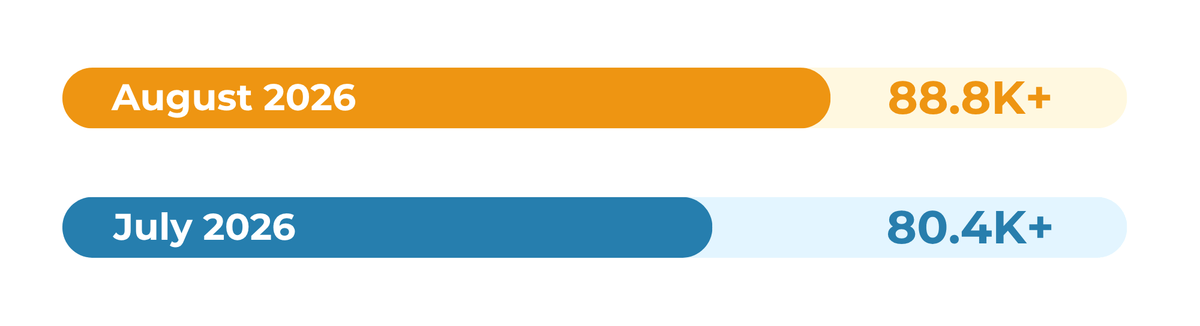
In August 2026, more than 88.8K+ companies were dissolved, a notable increase compared to 80.4K+ in July 2026.
How did new company formations compare to July?
In August 2026, over 54.1K+ companies were incorporated, a notable decrease from 68.2K+ in July 2026.
The pull-back suggests entrepreneurs adopting a more cautious approach to launching new ventures over the summer months, with formation activity likely to pick back up as the autumn trading period begins.
Which regions saw the most new business activity?
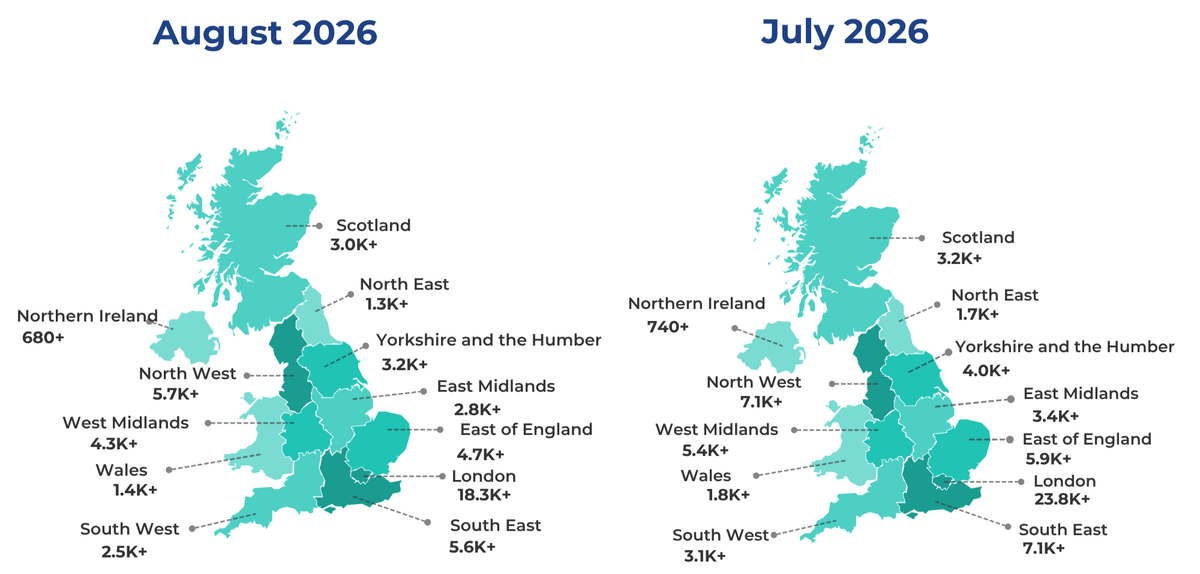
The regional distribution of incorporations remains largely consistent with July, even as overall volumes eased.
London continues to dominate with 18.3K+ companies, reaffirming its position as the UK’s commercial powerhouse. The North West follows with 5.7K+, closely trailed by the South East with 5.6K+, highlighting continued strength outside the capital. On the lower end, Northern Ireland (680+) and the North East (1.3K+) reflect smaller but stable participation in new business formation. The West Midlands (4.3K+) and East of England (4.7K+) also remain solid contributors to the national picture.
Which industries were most active in August 2026?
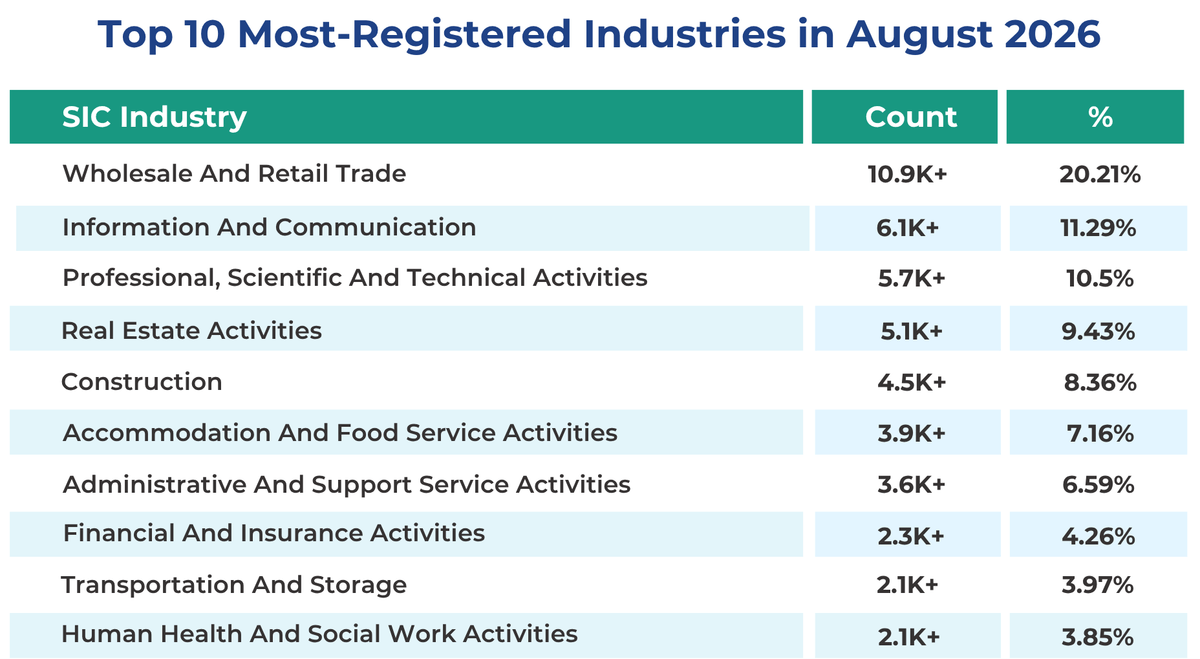
The SIC analysis for August 2026 shows a balanced distribution of new company formations across key sectors. Wholesale and Retail Trade leads with 20.21% (10.9K+ companies), accounting for more than one-fifth of all registrations.
Information and Communication (11.29%) and Professional, Scientific and Technical Activities (10.5%) follow, driven by continued demand for technology services and specialist consultancy.
Meanwhile, Real Estate Activities (9.43%) and Construction (8.36%) remain solid contributors, underscoring steady activity across property and infrastructure-related industries.
Overall, August’s figures show formations concentrated in retail and wholesale, with technology, professional services, real estate and construction all playing a meaningful supporting role.
What does the risk profile of new companies tell us?
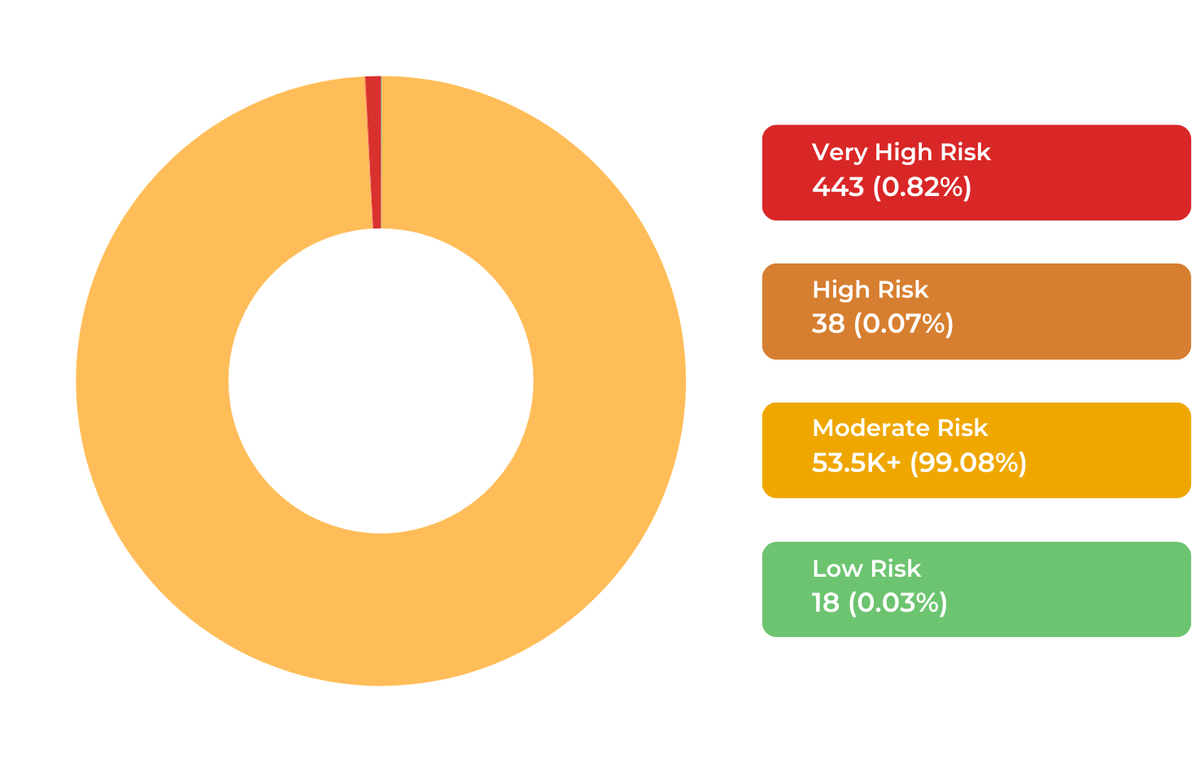
Risk assessment for newly incorporated companies in August 2026 reveals a distribution heavily weighted towards the moderate end of the scale, reflecting a business environment that is diverse but closely monitored.
Moderate Risk companies represent the overwhelming majority, with 53.5K+ firms accounting for 99.08% of all new incorporations. Very High Risk companies stand at 443 (0.82%), while High Risk firms number just 38 (0.07%).
Low Risk accounts for only 18 companies, the smallest category. Overall, these figures reflect a business landscape where most new entrants sit in the moderate-risk bracket as they establish themselves, with only a small minority requiring closer monitoring at either end of the risk spectrum.
Were there changes in company charges registered?
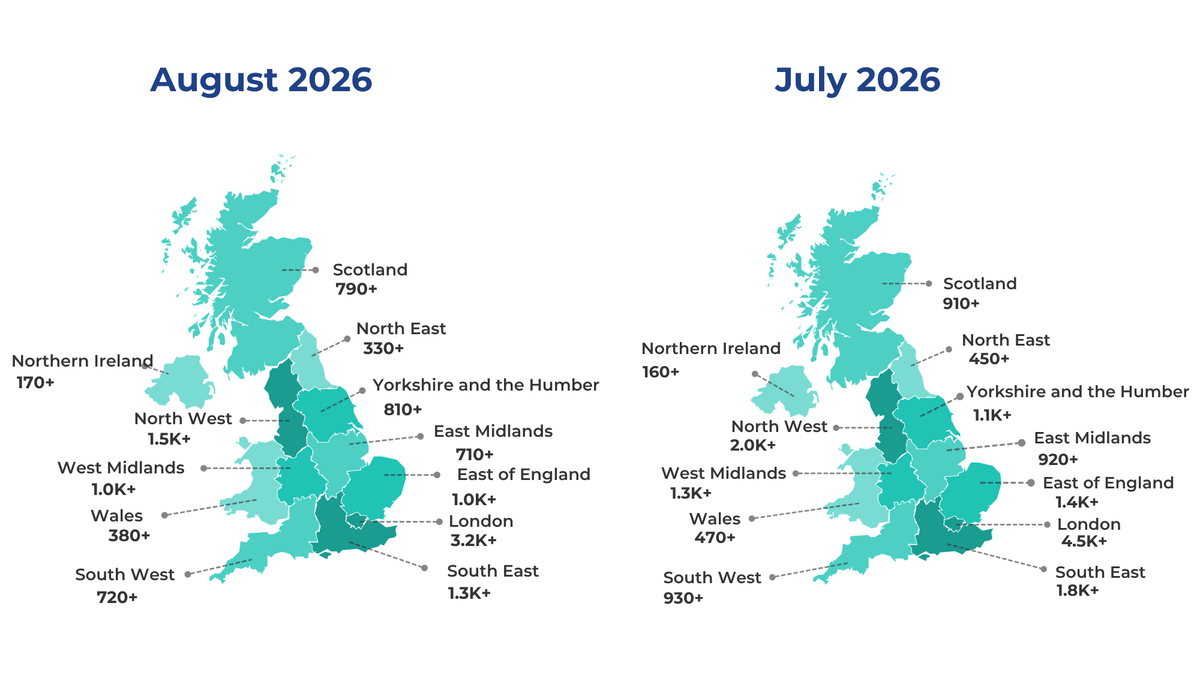
This decline aligns with a broader recalibration of lending and investment activity, as firms slow the pace of securing fresh financial commitments during the summer period. London led with 3.2K+ charges, followed by the North West (1.5K+) and South East (1.3K+). The pull-back points to businesses exercising greater financial discipline as they move through the middle of the financial year.
What about County Court Judgments (CCJs)?
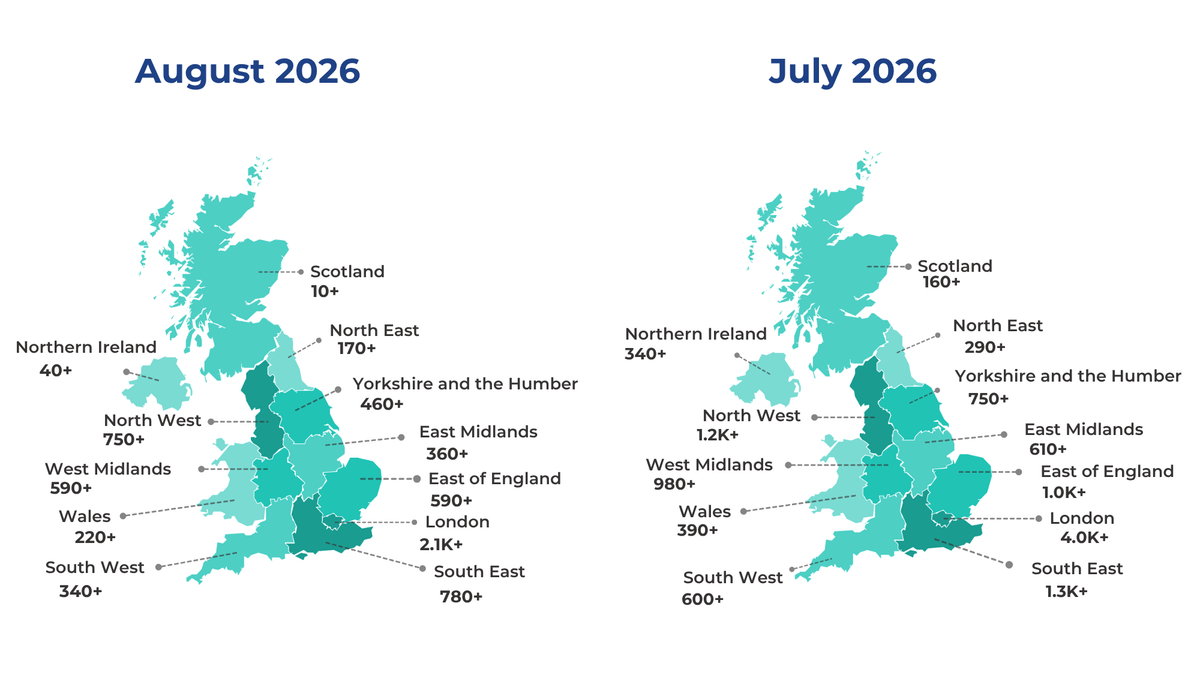
This reduction points to a settling of credit enforcement activity, potentially reflecting fewer formal proceedings being initiated during the quieter summer trading period. London recorded the highest volume with 2.1K+, followed by the South East (780+) and North West (750+). The scale of the drop suggests improved payment behaviour or a temporary easing in enforcement activity across the UK corporate ecosystem.
How are female founders performing?
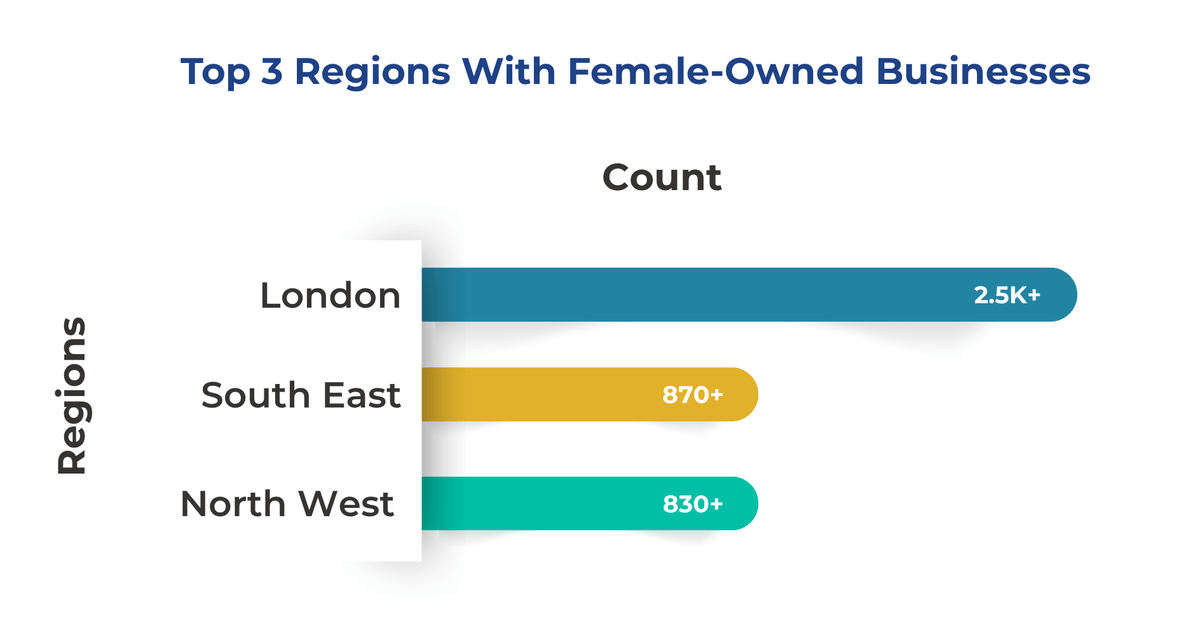
In August 2026, female-owned business registrations were led by London with 2.5K+ companies, followed by the South East (870+) and the North West (830+).
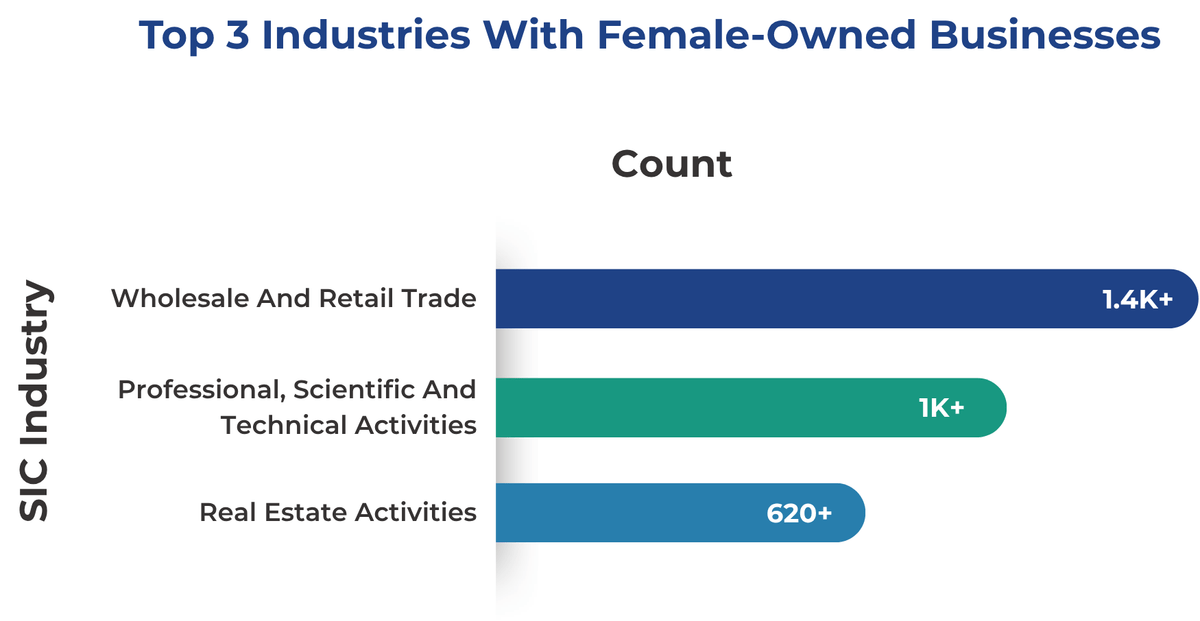
Despite the seasonal recalibration seen across the wider incorporation figures this month, the data highlights sustained entrepreneurial participation among women across multiple sectors. Wholesale and Retail Trade led the way with 1.4K+ female-owned formations, followed by Professional, Scientific and Technical Activities (1K+) and Real Estate Activities (620+).
Female founders remain a resilient segment of the UK business landscape, with retail, professional services and real estate all standing out as areas of particular strength this month.
Conclusion: What does August 2026 tell us about the UK business landscape?
August 2026 paints a picture of a UK business environment pausing for breath. Formations, charges and CCJ filings all eased back from July, while dissolutions ticked upward, together suggesting businesses using the summer lull to consolidate rather than expand. The risk profile of new incorporations remains reassuringly moderate, and London’s dominance across every metric continues unchallenged.
As the financial year moves past its midpoint and businesses look ahead to the autumn trading period, one thing is clear:
Businesses that combine data-driven insight with strategic timing will be best positioned to capitalise on the opportunities as activity picks back up in the months ahead.
All insights are sourced from DataGardener’s August 2026 UK Business Insights dataset. For deeper analysis, API access or customised dashboards, visit DataGardener.com.
Download the Full August 2026 UK Business Insights Report
Get the complete picture. The August 2026 UK Business Insights Report brings together company formations, dissolutions, charges, CCJs, risk profiles, industry breakdowns, and female-founder data into one comprehensive resource.
Whether you are a business developer, credit analyst, investor, or strategic planner, this report gives you the data intelligence to make smarter, faster decisions as the financial year moves into its second half.
For deeper analysis, API access or customised dashboards, visit DataGardener.