


Quick answer: UK lending intelligence uses verified company financials, ownership data and real-time risk signals to score borrowers faster and keep watching them after the loan is drawn. Financial data intelligence software such as DataGardener Lending Intelligence brings filed accounts, charges, CCJs, group structures and credit risk indicators into one workflow, so credit teams spend less time gathering data and more time making decisions.
By the numbers (DataGardener data, October 2026): DataGardener tracks more than 5.8 million non-dissolved UK companies, including over 107,000 in liquidation and over 6,000 in administration. It also holds almost 16 million persons with significant control (PSC) records and over 1 million group structure records. That is the raw material for scoring a borrower in context rather than in isolation.
Why traditional credit risk scoring is under pressure
UK lenders face three pressures at once. Borrowers expect faster decisions. Regulators expect better evidence and ongoing monitoring. And risk can change between annual filings, so a score built on last year’s accounts can be out of date the day it is signed off.
Common symptoms inside credit teams include:
- Analysts copying figures from filings into spreadsheets by hand
- Risk scores that differ between analysts because inputs differ
- Portfolio reviews that happen quarterly or annually, not continuously
- Group exposure that is spotted late because ownership data sits in a separate tool
Modern financial data intelligence software addresses these by standardising the inputs and refreshing them as new information arrives.
What is financial data intelligence software for lenders?
Financial data intelligence software collects, verifies and connects company financial and risk data so lenders can analyse it at speed. For credit teams, that typically means:
- Verified company financials: filed turnover, profit, net assets and growth trends
- Risk and adverse signals: CCJs, registered charges, status changes and late filings
- Ownership and control: directors, PSCs, shareholders and group structure
- Scoring and ratios: credit risk bands and financial ratios that support consistent decisions
The aim is not to replace credit judgement. It is to give analysts a faster, more complete and more consistent starting point.
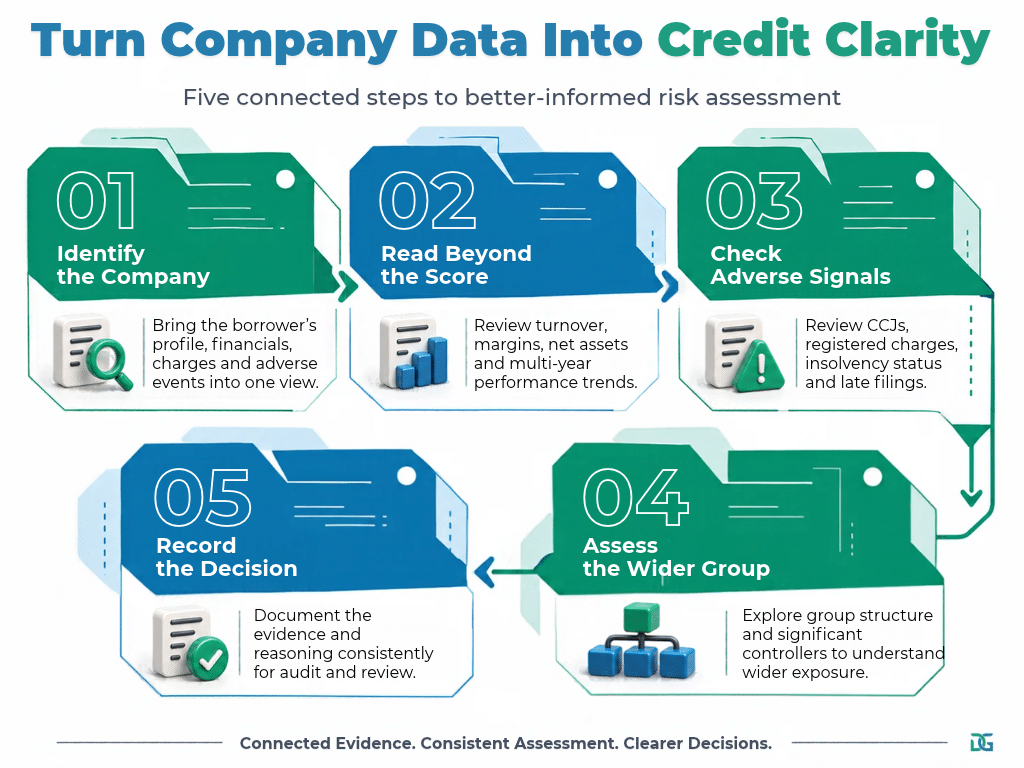
Step 1: Start with the company number
Everything keys off the Companies House number. One lookup should return the borrower’s profile, financials, charges and adverse events together.
Step 2: Read the financials, not just the score
Credit analysis is stronger when analysts see the trend behind a score: turnover direction, margin movement, net asset position and growth over several years. A single risk band hides whether a business is improving or deteriorating.
Step 3: Check for adverse signals
CCJs, existing charges, administration or liquidation status and late filings are early warnings that should shape both the decision and the pricing.
Step 4: Look at the group, not just the entity
A subsidiary with thin accounts may sit inside a strong group, or a strong-looking borrower may belong to a stressed one. Group structure and PSC data show where the exposure really sits and who is behind it.
Step 5: Record a consistent, auditable decision
When every analyst starts from the same verified data, scoring becomes more consistent and easier to evidence to internal audit, regulators and investment committees.
From one-off scoring to credit portfolio monitoring
Scoring a borrower at origination is only half of credit risk management. The other half is watching the book.
Ongoing monitoring means tracking each borrower for changes that matter:
- New CCJs or other adverse events
- New or changed registered charges
- Company status changes, such as moving into administration or liquidation
- Newly filed accounts showing weaker turnover or net assets
- Changes in directors, controllers or group structure
Instead of waiting for the next scheduled review, credit teams can be alerted to deterioration earlier, when there are still options such as renegotiating terms, adding security or reducing exposure.
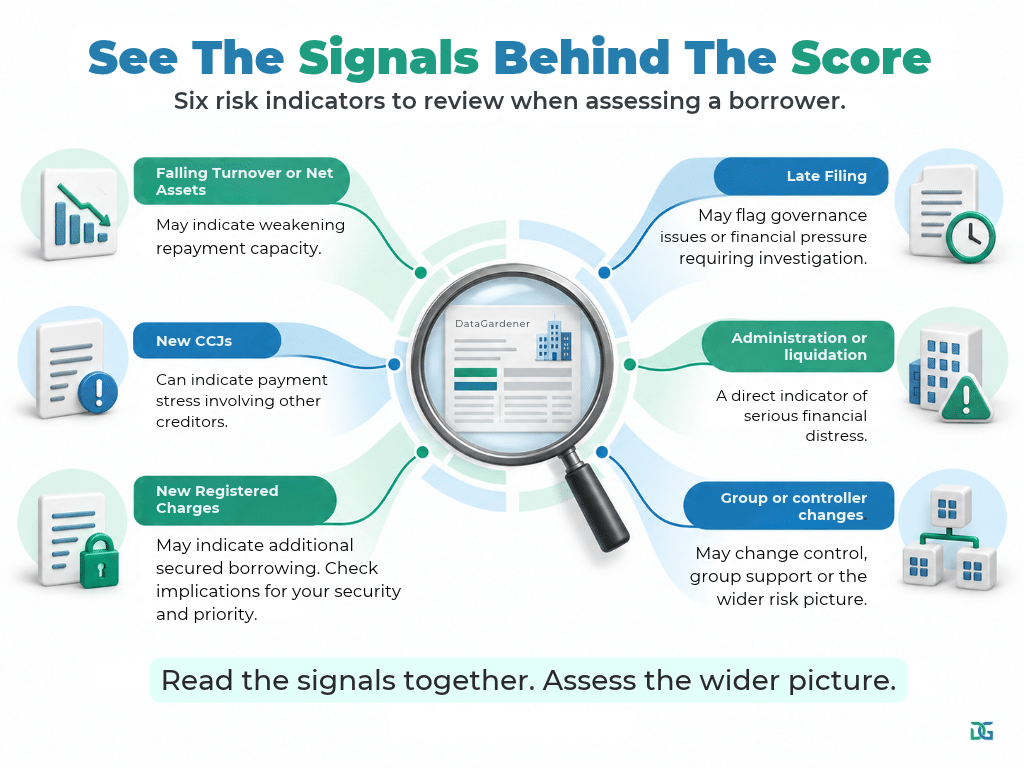
| Signal | Why it matters |
| Falling turnover or net assets | Early sign of weakening repayment capacity |
| New CCJs | Indicates payment stress with other creditors |
| New registered charges | May rank ahead of your security or signal increased borrowing |
| Late filing | Often precedes wider governance or cash flow problems |
| Status change (administration, liquidation) | Direct indicator of distress |
| Group or controller changes | Alters who stands behind the obligation |
Who benefits most
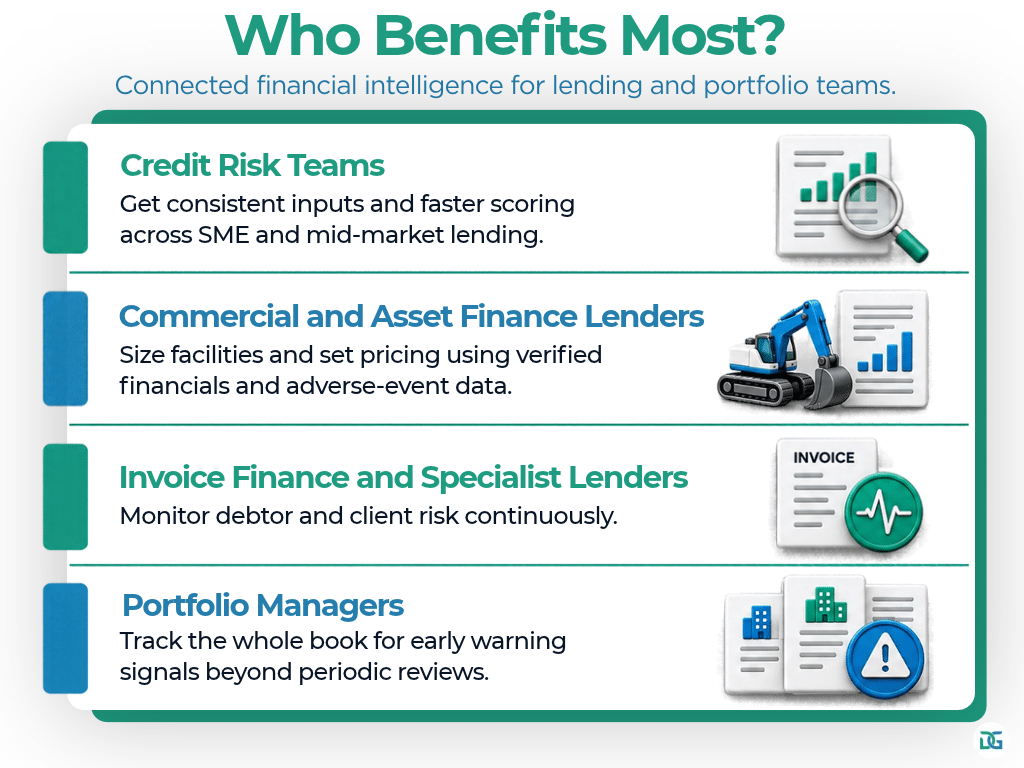
Credit risk teams get consistent inputs and faster scoring across SME and mid-market lending.
Commercial and asset finance lenders can size facilities and set pricing using verified financials and adverse-event data.
Invoice finance and specialist lenders can monitor debtor and client risk continuously.
Portfolio managers can track the whole book for early-warning signals rather than relying on periodic reviews.
A short worked example (illustrative)
A lender receives a request for a working capital facility from a manufacturing SME.
- Profile: The company is live, trading for six years, with filed accounts for the last three.
- Financials: Turnover grew for two years, then dipped. Net assets are positive but falling.
- Adverse signals: A CCJ was registered four months ago, and a new charge was added by another lender.
- Group view: The company is wholly owned by a holding company that also controls two other borrowers in the lender’s book.
- Decision: The facility is approved at a lower limit, with tighter reporting and monitoring triggers set for further CCJs or status changes.
Each step uses data a credit team already needs. The gain comes from seeing it together, quickly. (This example is fictional and for illustration only.)
What to look for when choosing lending intelligence software
- Verified, source-based data from filings and public registers, with clear provenance
- Coverage across the UK company universe, including SMEs and groups
- Adverse and real-time signals, not just annual accounts
- Group and ownership context alongside financials
- Export and integration options so results fit existing credit workflows
- Auditability, so decisions can be evidenced
How DataGardener Lending Intelligence supports credit teams
DataGardener Lending Intelligence is built for UK lenders who need faster, evidence-based risk scoring and continuous portfolio monitoring. It combines verified company financials, credit risk indicators, charges, CCJs, ownership and group structure data in one platform, searchable by company number.
Credit teams use it to screen and score borrowers quickly, understand group exposure, and monitor existing portfolios for new signals, so decisions rest on current, connected data.
Key takeaways
- Faster risk scoring starts with verified, connected company data, not manual data gathering.
- Credit analysis improves when analysts see trends, adverse signals and group context together.
- Credit risk management does not end at origination: continuous monitoring catches deterioration earlier.
- Financial data intelligence software helps lenders make faster, more consistent and more auditable decisions.
See Lending Intelligence in action
Want to score borrowers faster and monitor your portfolio with verified UK company data?
Book a DataGardener Lending Intelligence demo and see it working on your own use case.
What is credit risk scoring?
Credit risk scoring is the process of assessing how likely a borrower is to repay, using financial data, payment behaviour and other risk signals to produce a score or risk band that supports a lending decision.
How is financial data intelligence software different from a credit score?
A credit score is one output. Financial data intelligence software provides the underlying verified data, trends and signals, so analysts can see why a company is scoring as it is and challenge or support the result.
Is the data suitable for SME lending?
Yes. UK company data covers a very large number of small and mid-sized companies, including those with limited financial history, which is where verified filings and adverse signals are especially useful.