

The best financial data intelligence software for a UK mid-market bank is the platform that matches your credit workflow, not the one with the biggest database. Judge every option on six things: company credit check depth, financial risk scoring transparency, data freshness, coverage of UK private companies, integration with your decisioning tools, and total cost of ownership.
For UK credit analysts, the choice has become harder. Late filings, rising insolvencies and thin-file private companies mean a score alone no longer tells you enough. Analysts now need to see the filed accounts, the directors, the charges, the County Court Judgments (CCJs) and the group structure in one place, and to trust that the data is current.
This guide compares the main types of UK credit data platform for credit analysis in mid-market banking. It sets out clear decision criteria, a side-by-side comparison, and a practical way to test platforms before you commit. It is written for credit analysts, risk managers and lending teams at UK banks, challenger lenders and specialist finance providers.
Disclosure: this guide is published by DataGardener, which is one of the platforms discussed. We have kept the criteria vendor-neutral so that you can apply them to any provider, including ours.
What is financial data intelligence software?
Financial data intelligence software turns raw company data into decisions a lender can defend. It combines official sources, such as Companies House filings, with payment behaviour, legal events and analytics, then presents them as scores, alerts and structured records.
A basic credit report tells you what a company looks like today. A financial data intelligence platform also shows how it got there, and where it is heading. In practice, a good platform should support four jobs:
• Company credit checks: verifying status, filings, directors, charges, CCJs and ownership before you lend.
• Financial risk scoring: ranking applicants and portfolio names by likelihood of failure or late payment.
• Credit analysis: reading ratios, trends and peer comparisons to size and structure a facility.
• Monitoring: flagging deterioration after the loan is drawn, so you can act early.
For mid-market banking, the fourth job matters as much as the first. A facility is only as safe as the last time you checked it.
Six criteria for comparing UK credit data platforms
Use these six criteria as a scorecard. Weight them to suit your credit policy before you speak to any vendor.
1. Depth of company credit checks. Look beyond a headline score. Can the platform show full filing history, officers and their other appointments, persons with significant control (PSC), registered charges, CCJs and group structure? Can you export it into a credit memo without re-keying?
2. Transparency of financial risk scoring. A score you cannot explain is hard to defend to a credit committee or a regulator. Ask what drives the score, how often it is recalibrated, and whether you can see the underlying inputs. Check how it performs on small and unlisted companies, where data is thinnest.
3. Data freshness. Ask how quickly a new filing, charge, CCJ or status change appears on the platform. Ask for the timestamp on each data point. Stale data is the most common reason a good score fails to flag a failing company.
4. UK private-company coverage. Mid-market lending lives in the unlisted space. Test the platform on companies you already know, including recent incorporations, dormant entities and companies with late accounts.
5. Workflow fit. The best data is wasted if analysts must leave their tools to use it. Check for an application programming interface (API), batch screening, portfolio alerts and integration with your loan origination or decisioning systems.
6. Total cost and commercial flexibility. Compare licence models, per-search charges, user seats and API limits. A cheaper headline price can become expensive once monitoring and bulk checks are added.
Tip: give each criterion a weight out of 100 before the first demo. It stops the most polished demonstration from deciding the outcome.
UK credit data platforms compared
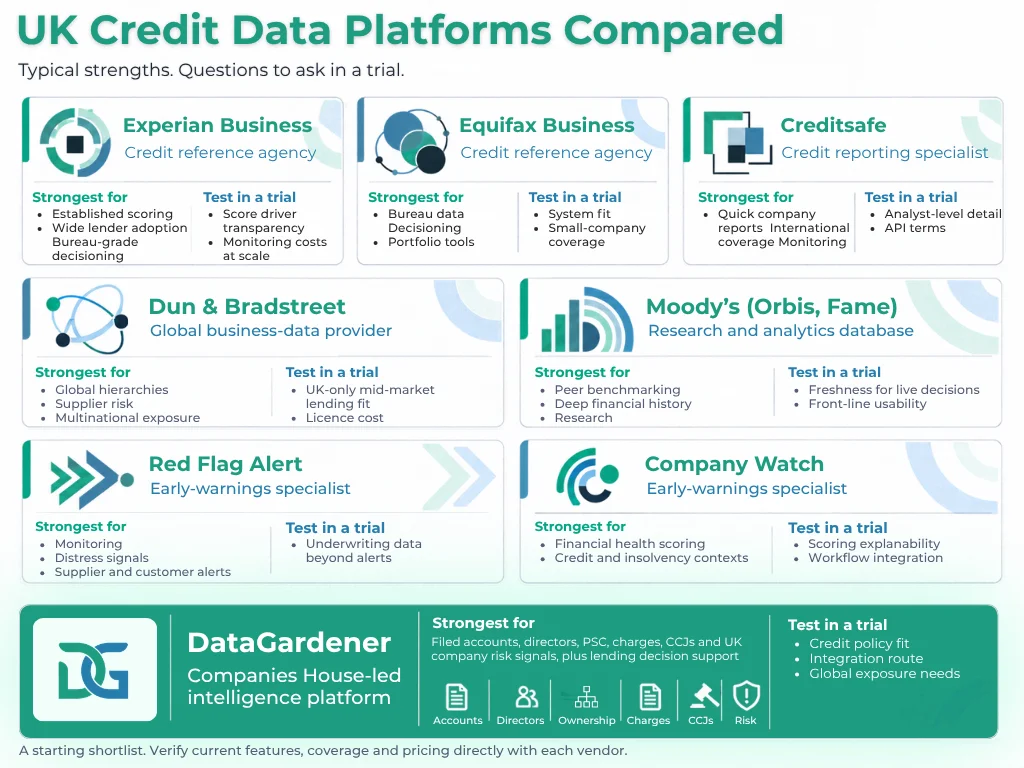
UK platforms fall into four broad groups: credit reference agencies, global business-data providers, early-warning specialists and Companies House-led intelligence platforms. The table below summarises where each tends to fit best. Treat it as a starting shortlist and verify current features, coverage and pricing directly with each vendor.
How to read the comparison
Credit reference agencies suit teams that need established, widely recognised scores and are comfortable with bureau-style outputs. They are often the safest procurement choice, though analysts should check how far they can see inside a score.
Global business-data providers suit banks with international corporate exposure. For a UK mid-market book, they can be more than you need, so test whether the extra reach justifies the cost.
Early-warning specialists suit portfolio teams. They are strongest after the loan is drawn, so many banks pair them with a deeper origination data source.
Companies House-led intelligence platforms suit credit analysts who want to work from the filed record. They tend to offer more granular UK detail and flexible search, which helps when you are screening a segment or building a credit file for an unlisted company.
Note: no single platform leads on every criterion. Most mid-market banks end up with a primary source for origination and credit analysis, and sometimes a second for monitoring.
Which platform fits which mid-market banking team?
Match the platform to the job your team does most often.
• Origination-heavy teams that need defensible scores and fast decisions should shortlist credit reference agencies and Companies House-led platforms with strong decision support.
• Credit analysts writing detailed memos benefit from platforms that expose filed accounts, ratios, directors, charges and CCJs without extra steps.
• Portfolio and recovery teams should weigh early-warning tools and platforms with reliable batch monitoring.
• Banks with cross-border clients should include a global business-data provider alongside a UK-focused source.
A five-step process for testing platforms
1. Build a test set. Choose 30 to 50 companies, including known defaults, healthy borrowers, recent incorporations and companies with late accounts.
2. Run every platform on the same set. Record scores, flags and the date each data point was last updated.
3. Compare against outcomes. Check which platform flagged the known problem cases earliest and with the fewest false alarms.
4. Time is a real workflow. Ask an analyst to build a credit file from scratch. Measure the time, the number of tools used and the amount of re-keying.
5. Test the commercials. Model your expected search, monitoring and API volumes over 12 to 24 months before you compare prices.
Conclusion
The right financial data intelligence software gives your credit analysts current, explainable data inside the workflow they already use. Start with the six criteria, shortlist two or three platforms from the comparison, and test them on companies whose outcomes you already know. A structured trial will tell you more than any brochure.
If you would like to see how DataGardener supports company credit checks, financial risk scoring and lending decisions for UK companies, book a demonstration and bring your own test set.
What is financial data intelligence software?
Financial data intelligence software gathers company data from official and commercial sources and turns it into credit checks, risk scores, alerts and analysis. Lenders use it to assess borrowers before lending and to monitor them afterwards.
How accurate is financial risk scoring for small private companies?
Accuracy varies by provider and by how much data exists for the company. Thin-file and recently incorporated companies are the hardest to score. Always ask for score drivers and test performance on your own portfolio rather than relying on general claims.
How often should credit data be refreshed?
At origination, the data should be as current as possible. After lending, monitoring should alert you to new filings, charges, CCJs and status changes soon after they appear. Ask each vendor for the update frequency and timestamp of every data type you rely on.