

A sector label alone will not tell you whether a company is worth pursuing. In the UK, a construction business may be a sole trader, a regional supplier, or a national group. When you search UK companies by sector, the value comes from combining industry classification with capacity, intent, risk, and relevance. That difference matters when you build a sales pipeline or assess a borrower. Finding alternative suppliers or sizing a market also benefits from clarity. A generic list creates research work. A well-defined search UK companies by sector narrows options and creates an actionable list your team can act on.
Start with the commercial question, not the sector
“Find manufacturing companies” is not a brief. It is a starting point. Before opening a search tool, define the decision the data needs to support.
A sales leader may need established food manufacturers in the Midlands with 50 to 250 employees and evidence of growth. A procurement team may need UK engineering suppliers that meet a specific capability requirement, operate within a sensible travel radius and do not present unacceptable financial exposure. A lender may be looking for profitable businesses in a particular trade that fit a chosen lending appetite.
The sector is the common denominator, but the surrounding criteria make the result commercially useful. This approach also prevents a familiar problem: marketing and business-development teams pursuing companies that look right on paper but lack the scale, budget, operating footprint or buying profile to convert.
Search UK companies by sector using SIC codes – carefully
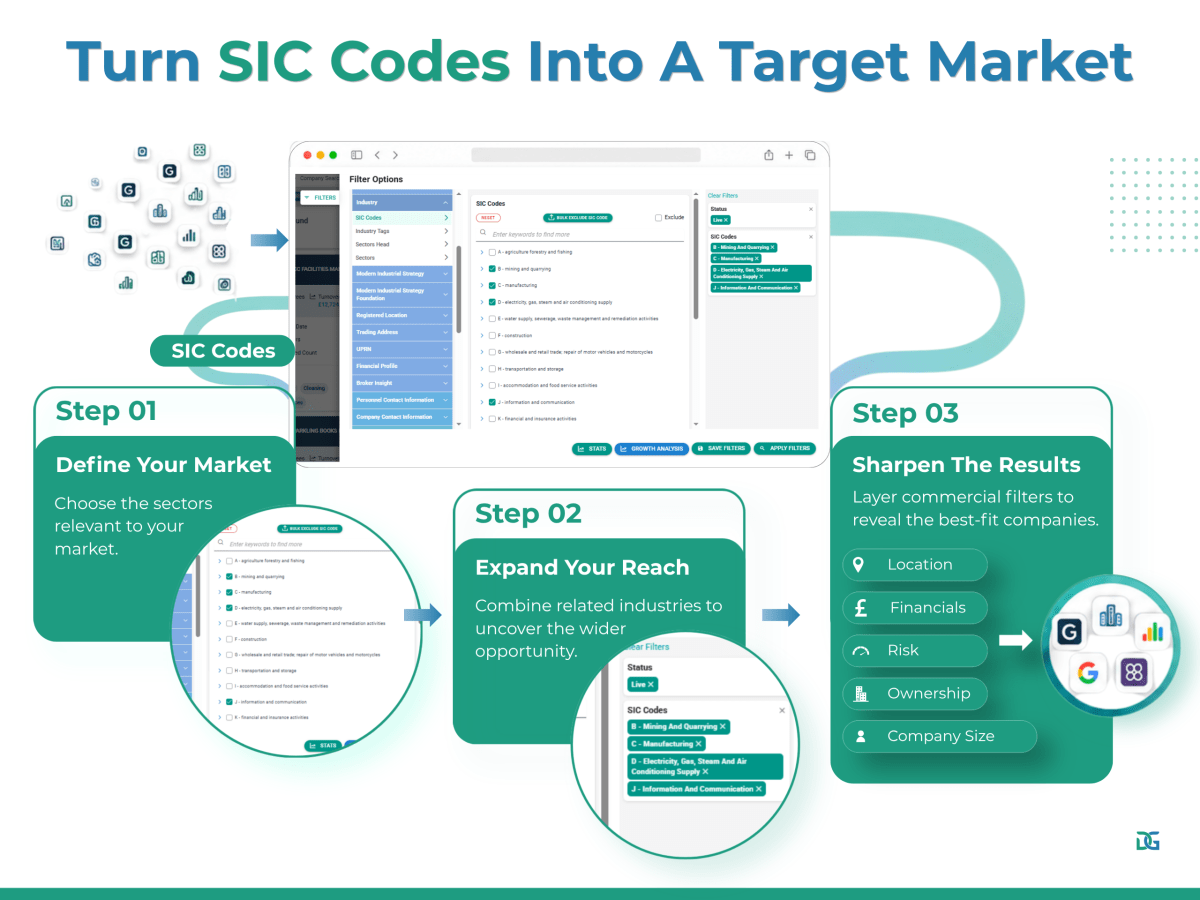
Standard Industrial Classification, or SIC, codes are the foundation of most UK sector searches. They provide a consistent way to identify a company’s declared principal activity, from software development and wholesale trade to care homes, logistics and specialist construction.
They are highly useful, but they are not a perfect description of a business. Companies may select a broad code at incorporation and never update it. A diversified group may have several trading activities while only one is reflected in its primary classification. Newer businesses can also use a code that describes their intended model rather than their current revenue base.
For that reason, the best searches usually begin with a group of relevant SIC codes rather than a single, overly narrow selection. If you are targeting the green economy, for example, a search may need to account for electrical installation, engineering consultancy, renewable generation and related technical services. The right combination depends on what you sell, lend against or procure.
Use sector filtering to define the market universe, then apply commercial signals to narrow it to companies that meet your specific criteria.
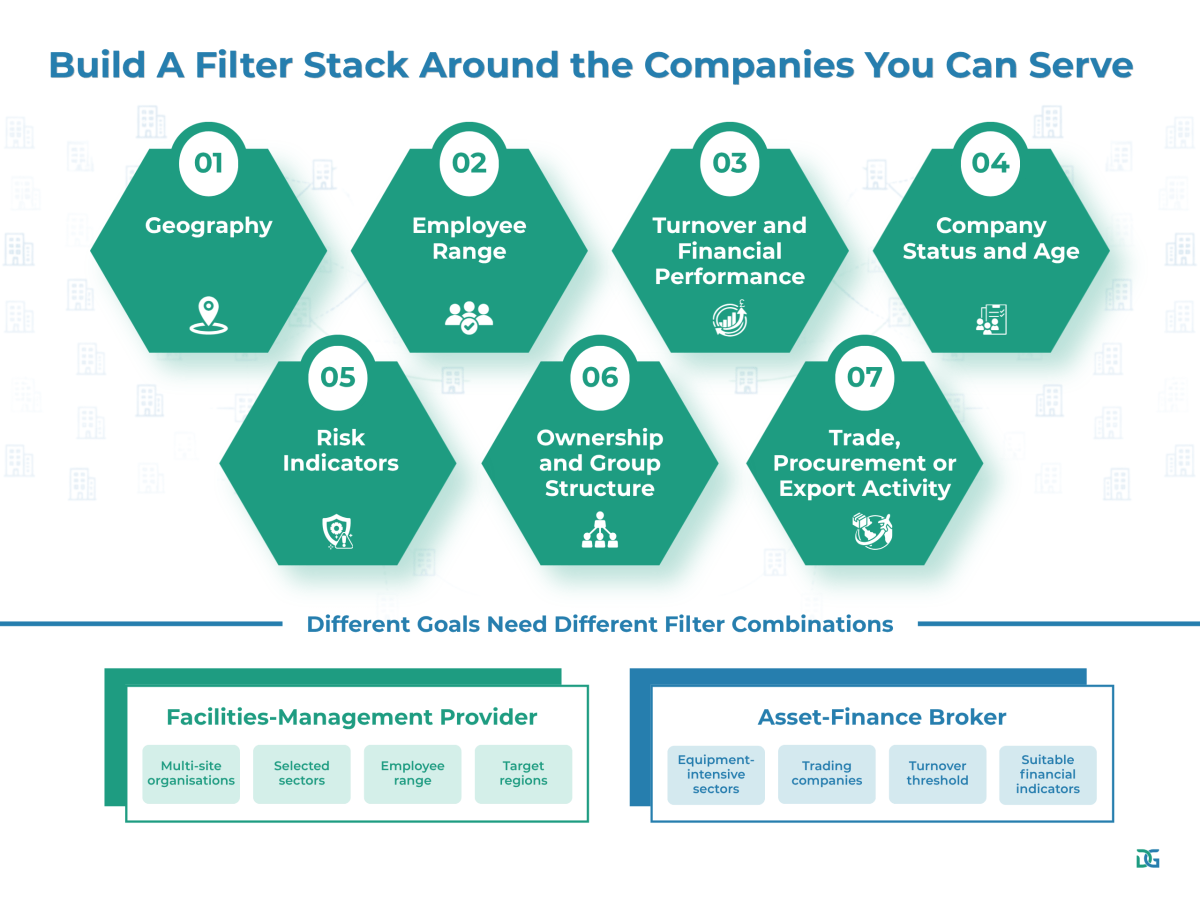
Build a filter stack around the companies you can serve
A high-quality sector search is rarely one filter deep. It should reflect the characteristics of a viable account, supplier or counterpart. The most useful criteria tend to include:
- Geography, such as registered location, operating area or proximity to a delivery network.
- Employee range, which helps distinguish micro businesses from organisations with a likely need and budget.
- Turnover and financial performance, where available, to identify capacity and avoid mismatched account sizes.
- Company status and age, ensuring businesses are active and established enough for the objective.
- Risk indicators, including filing history, financial stress signals and directorship patterns.
- Ownership and group structure, particularly where supplier due diligence, credit exposure or account mapping matters.
- Trade, procurement or export activity, when these signals align with buying intent or market opportunity.
A facilities-management provider, for instance, could identify multi-site organisations in selected sectors, then narrow the list by employee range and region. An asset-finance broker could focus on trading companies in equipment-intensive sectors, with turnover thresholds and financial indicators appropriate to its credit policy. The same sector may sit at the centre of both searches, but the target account profile is completely different.
Use financial and risk data to protect pipeline quality
Sector targeting is often treated as a revenue exercise. It should also be a risk-control exercise.
For sales teams, financial data can help qualify opportunities before time is spent on outreach. A company with suitable turnover, an established filing record and signs of expansion may be a stronger prospect than a similarly classified business with limited trading history. This does not mean every smaller or newer company should be excluded. It means the outreach motion should match the likely value and buying journey.
For credit, lending and procurement teams, the stakes are more direct. Sector can reveal exposure concentration, but company-level intelligence determines whether the individual counterpart meets policy. Review financial performance, payment and filing behaviour where relevant, ownership changes, director appointments and other risk signals before treating a sector match as a suitable prospect or supplier.
There is a trade-off. Tight filters produce a more manageable list but can remove emerging businesses and less visible opportunities. Broader filters uncover more market coverage but demand stronger scoring and prioritisation. The right balance depends on whether your immediate priority is volume, conversion rate, portfolio quality or supplier resilience.
Find the buying signals hidden within a sector
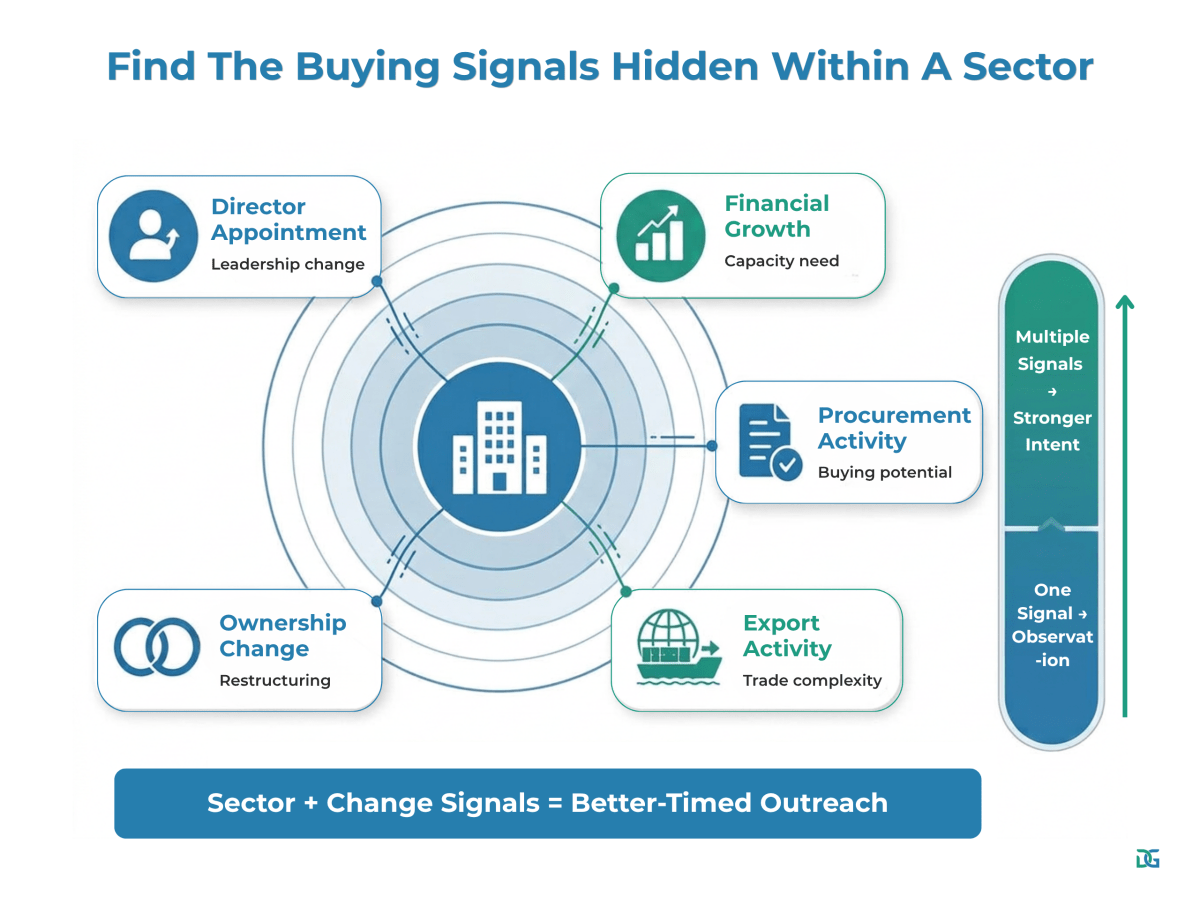
The strongest target lists do more than describe a company. They point to a reason to engage.
Directorship changes can indicate a leadership transition, acquisition activity or a new strategic direction. Financial growth may suggest operational pressure, new capacity requirements or a larger addressable contract value. Procurement activity can reveal organisations that buy through formal routes, while export signals may identify businesses dealing with overseas complexity, trade finance or international logistics needs.
None of these signals is a guaranteed purchase trigger. A director appointment does not automatically mean a company is buying, and turnover growth does not prove a budget has been allocated. Used together, however, they help teams prioritise accounts based on evidence rather than instinct.
This is particularly valuable in sectors with thousands of registered companies. Instead of asking representatives to research every name manually, create a prioritised audience based on sector, size, location and relevant change signals. Your team can then spend more time preparing credible outreach and less time cleaning lists.
Turn a sector list into an account plan
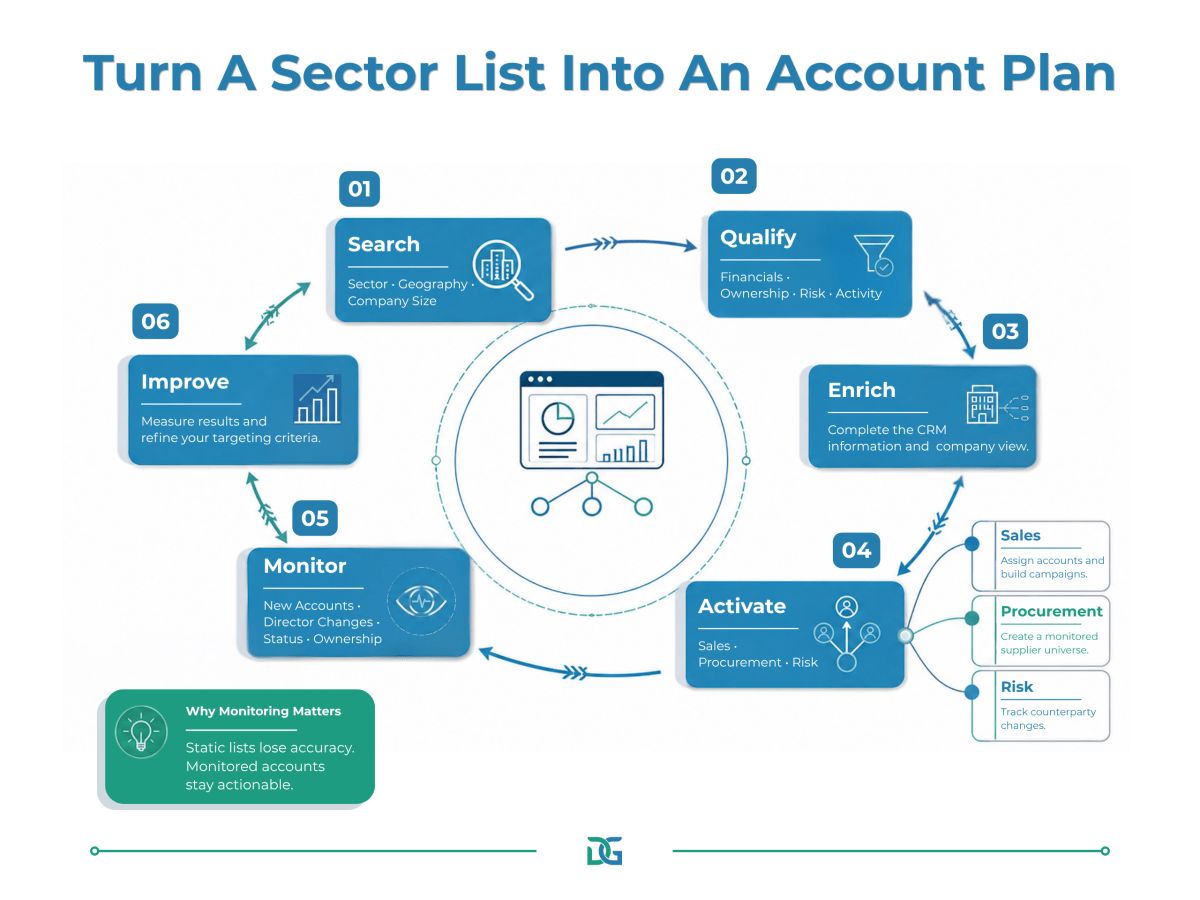
A search result becomes more valuable when it is connected to the systems and workflows your team already uses. Sales and marketing teams may enrich incomplete CRM records, assign accounts by territory and build campaign audiences around a defined ideal customer profile. Procurement teams can maintain a monitored supplier universe rather than beginning each sourcing project from scratch. Risk teams can watch for changes across a portfolio of sector-specific counter parties.
Data freshness is central here. Static downloads age quickly as businesses move, file accounts, appoint directors, change status or enter new ownership structures. A process that supports ongoing monitoring is more defensible than a one-off spreadsheet, especially for regulated, credit-sensitive or public-sector decisions.
Data governance matters too. Company intelligence should support legitimate B2B decision-making, with clear sourcing, appropriate controls and an understanding of the difference between company information and personal data. For teams operating formal compliance processes, being able to explain how a company entered a target, supplier or risk-review population is as valuable as the record itself.
Platforms such as DataGardener allow teams to combine highly granular sector searches with financial, workforce, geography, ownership, risk and activity-based criteria, then carry that intelligence into prospecting, due diligence and automated workflows.
Test the search against real outcomes
Do not judge a sector search by the number of records it returns. Judge it by what happens next.
- For sales, measure contactability, meeting rate, opportunity creation, average deal value, and conversion by segment.
- For procurement, assess how many identified companies meet technical, commercial and compliance requirements.
- For lending, track application quality, approval performance and exposure by sector cohort.
These results show whether your filters are identifying a genuine commercial advantage or simply producing a tidy-looking list.
Refine the model as evidence builds. You may find that a turnover band is excluding high-potential firms, that one SIC code delivers a poor fit, or that a particular regional cluster converts unusually well. Good company intelligence is not a fixed definition of an audience. It is a repeatable process for improving the quality of each decision.
The next time your team needs a sector list, set the question at the level of the outcome: which active UK companies in this market have the scale, profile and signals that make action worthwhile? That is where a company search stops being a directory exercise and starts creating a measurable commercial edge.