

| In brief: The SME procurement spend target has been government policy for years. Tracking progress against it with any real confidence is a different problem, one rooted in data quality, supplier classification, and infrastructure gaps that most councils have not fully addressed. This guide covers what good measurement looks like and what it takes to make the numbers defensible. |
Most procurement teams know the SME spend target exists. Far fewer have a reliable system for measuring whether they are hitting it, or the data infrastructure to prove it when someone asks.
The government’s commitment to directing 30% of public sector procurement spend through SMEs has been embedded in policy for years. It appears across Cabinet Office Procurement Policy Notes, in local authority strategies, and through frameworks issued by the Crown Commercial Service. The publication of PPN 001 in February 2025 sharpened that ambition further, requiring central government departments to set formal three-year direct-spend targets and to publish annual progress against them.
What gets discussed less is how genuinely difficult the measurement is.
Not because procurement teams are not trying. Because the data infrastructure required to track, validate, and report on SME procurement spend with any real confidence is considerably more complex than a single percentage implies. Supplier classifications are inconsistent. Tier-2 spend is largely invisible. Contract registers vary wildly in quality. And the definition of what counts as an SME, for measurement purposes, is not always applied the same way twice.
This is not a compliance problem. It is a data problem. And the operational consequences are real.
Why the Target Is Simpler to State Than to Measure
Government policy on SME procurement has been consistent in ambition, less consistent in methodology. The 30% SME spend target is set out in the Government’s SME and Social Enterprise Action Plan and has been reinforced by the Procurement Act 2023. Most local authorities have adopted some version of it. Some have exceeded it.
But adopting a target and being able to evidence progress toward it are different things entirely.
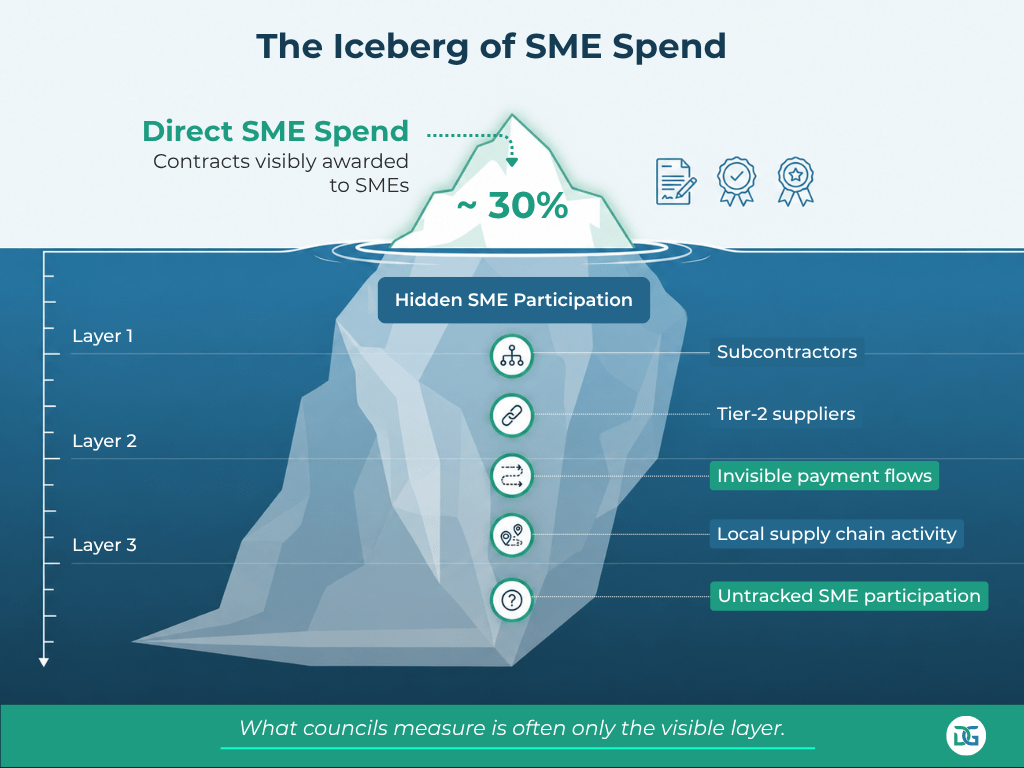
The core problem is structural. Public sector organisations contract directly with suppliers, but a significant proportion of SME involvement in public contracts happens indirectly, through subcontracting arrangements with larger prime contractors. A council could be meeting its SME spend target on paper, based purely on direct awards to smaller businesses, while the economic benefit actually flowing to SMEs is materially lower. The reverse is also true: teams may be significantly underreporting SME engagement because tier-2 flows are not being captured at all.
Neither scenario gives an accurate picture of performance. Both are common.
Getting the Definition Right Before You Start Counting
Before any measurement framework is worth building, procurement teams need to agree on what SME spend actually means for their purposes. The standard UK definition is the starting point. In practice, consistency breaks down quickly.
| UK SME Definition, for procurement measurement purposes | |
| Employees | Fewer than 250 |
| Annual turnover | Under €50 million |
| Balance sheet total | Under €43 million |
| Group structures complicate matters considerably. A subsidiary may appear to qualify individually while being economically part of a larger parent entity. Self-declaration without independent verification is not the same as classification. | |
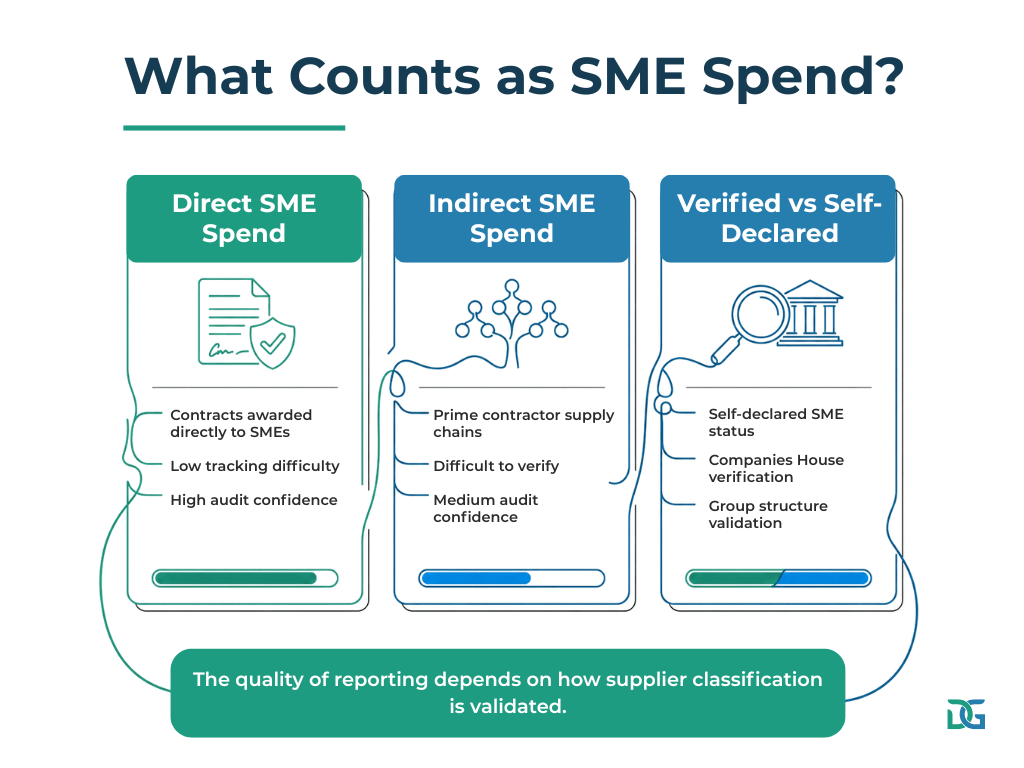
Three categories shape how SME spending is measured in practice.
Direct SME Spend
Contracts awarded by a public sector organisation directly to a supplier meeting the SME definition at the point of award. The most straightforward to capture and the most commonly reported figure in council procurement returns.
Indirect SME Spend
The proportion of prime contractor spend that flows down to SME subcontractors. Capturing this requires either active supply chain reporting obligations written into contracts or deliberate post-award engagement with prime suppliers. It is significantly harder to measure. It is rarely included in routine council reporting. And it often represents a substantial share of the economic activity the policy is trying to create.
Verified vs Self-Declared Status
Whether classification rests on supplier declarations alone or is independently cross-referenced against Companies House data, including group structure checks, makes a material difference to accuracy. The gap between a self-declared SME and a verified one is often wider than procurement teams expect.
Understanding which of these your current measurement captures, and which it does not, is the necessary first step before any reported figure carries real meaning.
Building a Framework That Actually Holds Up
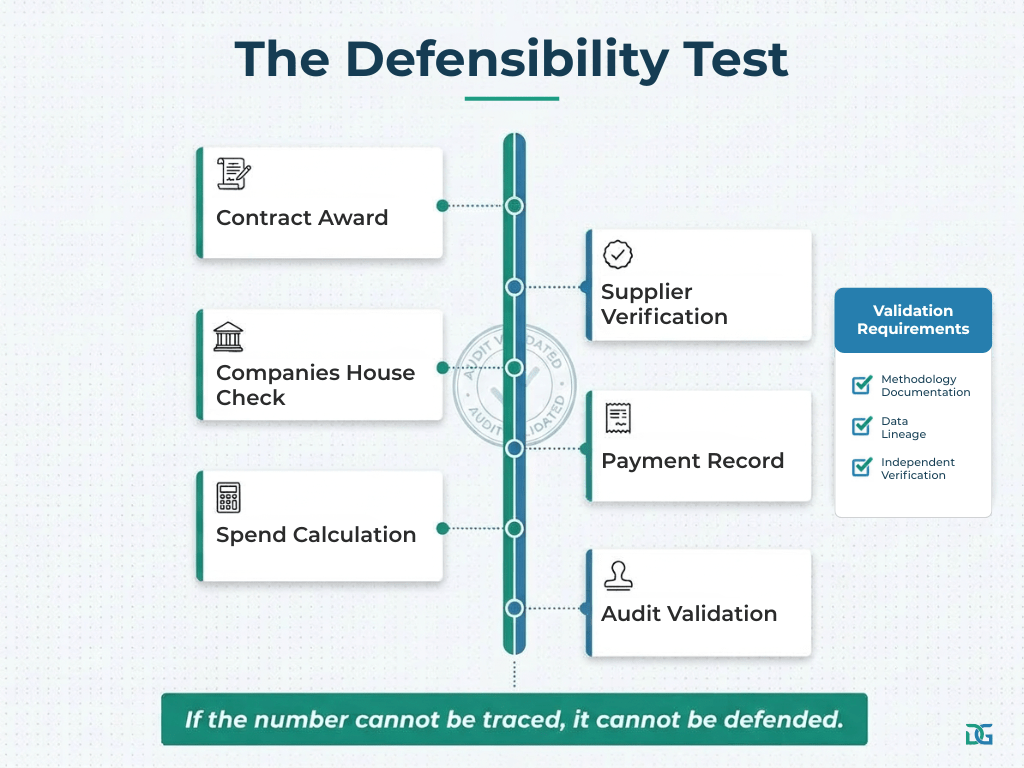
For councils looking to build or strengthen their approach, a few structural elements consistently determine whether the output is credible.
Supplier Classification at Source
SME classification should be captured during supplier onboarding, not applied retrospectively. Systems that require suppliers to declare size classification at registration, with periodic re-verification prompts, produce substantially cleaner data than those that attempt to classify after the fact. Cross-referencing self-declared status against Companies House filings, including group structure checks, materially improves accuracy. DataGardener and similar Procurement intelligence platforms can do this at scale, cross-referencing declarations against Companies House in real time. For smaller registers, it can be built into manual workflows if the process is clearly owned.
Contract Register Discipline
The contract register is the foundational data asset for any spend measurement. Its quality determines the quality of everything downstream.
For meaningful SME spend analysis, registers need to consistently capture: a supplier identifier (ideally a Companies House number or consistent internal ID), contract value, contract duration, procurement category, and SME status at award. Without consistent identifiers, aggregating spend across frameworks, departments, and financial years becomes unreliable. Many local authority registers currently fall short in one or more of these fields, not through neglect, but because historical data-entry practices were not designed with spend analysis in mind.
| Related: A robust contract register is foundational to responsible procurement practice and increasingly central to Procurement Act 2023 compliance obligations across local government. |
Spend Data Reconciliation
Contract register data and actual payment data rarely reconcile cleanly. A contract awarded to an SME does not mean the full contract value was spent; contracts are varied, extended, partially drawn down, or terminated early. Producing a credible SME spend figure requires linking award data to actual invoice and payment records.
Finance systems and procurement systems are often separate, operating with different supplier identifiers, contract reference formats, and reconciliation cycles. Bridging them requires either a dedicated data function, purpose-built tooling, or a structured manual process with clearly assigned ownership. There is no shortcut here. Teams that have solved this have mostly done so incrementally.
Tracking What Flows Through Prime Contractors
Capturing indirect SME spend requires a fundamentally different approach to measuring direct spend.
The most robust method is contractual: requiring prime contractors above a defined threshold to report quarterly on their subcontractor spend, including SME status of those subcontractors. Central government contracts have used this approach for several years. It is increasingly appearing in local authority procurement, particularly for major infrastructure and transformation programmes.
The challenge is consistency. Without a standardised reporting format, prime contractor submissions vary enormously; some provide detailed supply chain breakdowns, others offer high-level estimates with limited traceability. Aggregating these into a meaningful council-wide figure requires significant normalisation, and most councils have not yet built that capacity.
For teams without the resources for active supply chain reporting, a more limited but still useful alternative is to focus on subcontracting commitments at the tender stage, requiring bidders to declare intended SME subcontracting proportions at award, and then following up on actual outcomes at contract closure. DataGardener draws on over 40 verified UK sources to provide structured supplier intelligence that gives procurement teams a reliable foundation for both writing these requirements into tender documentation and benchmarking outcomes at contract closure.
Making the Numbers Defensible
There is a real difference between having an SME spend figure and having one that would withstand scrutiny. As transparency obligations under the Procurement Act 2023 become further embedded in procurement practice, and as local audit processes, scrutiny committees, and parliamentary interest in procurement performance continue to grow, the defensibility of reported numbers matters considerably more than it used to.
Defensibility requires three things.
Methodology documentation. Record which suppliers are included, how SME status was classified, whether the figure reflects direct spend only or includes indirect spend, and how the denominator was defined. This protects against challenge and creates continuity when people move on.
Data lineage. The reported figure should be traceable back to source data, contract register entries, payment records, and supplier classification records. Figures that exist only as aggregated dashboard outputs, without traceable lineage, are structurally vulnerable to audit.
Independent verification. Cross-referencing internal figures against Companies House for supplier verification, or against procurement intelligence platforms for benchmarking, provides a layer of confidence that purely internal processes cannot. Auditors increasingly expect to see it.
What Good Reporting Looks Like in Practice
The organisations that handle this well tend to share a few characteristics.
They report SME procurement spend as a proportion of total relevant spend, not total organisational spend. Utilities, salaries, and statutory payments are not addressable through competitive procurement. Including them in the denominator artificially deflates the percentage and obscures actual performance against the target.
They separate direct and indirect figures rather than blending them. Conflating the two obscures performance by type of engagement and makes year-on-year comparisons unreliable.
They track trends over time. A single percentage is hard to interpret without direction of travel. Historical trend data is what external reviewers and auditors typically examine most closely and what demonstrates genuine intent rather than selective reporting.
And they connect SME spend data to procurement pipeline planning, using it to identify where future opportunities could be structured or disaggregated to increase SME accessibility, rather than treating it as a backwards-looking compliance output with no operational application.
The Infrastructure Question Sitting Beneath the Target
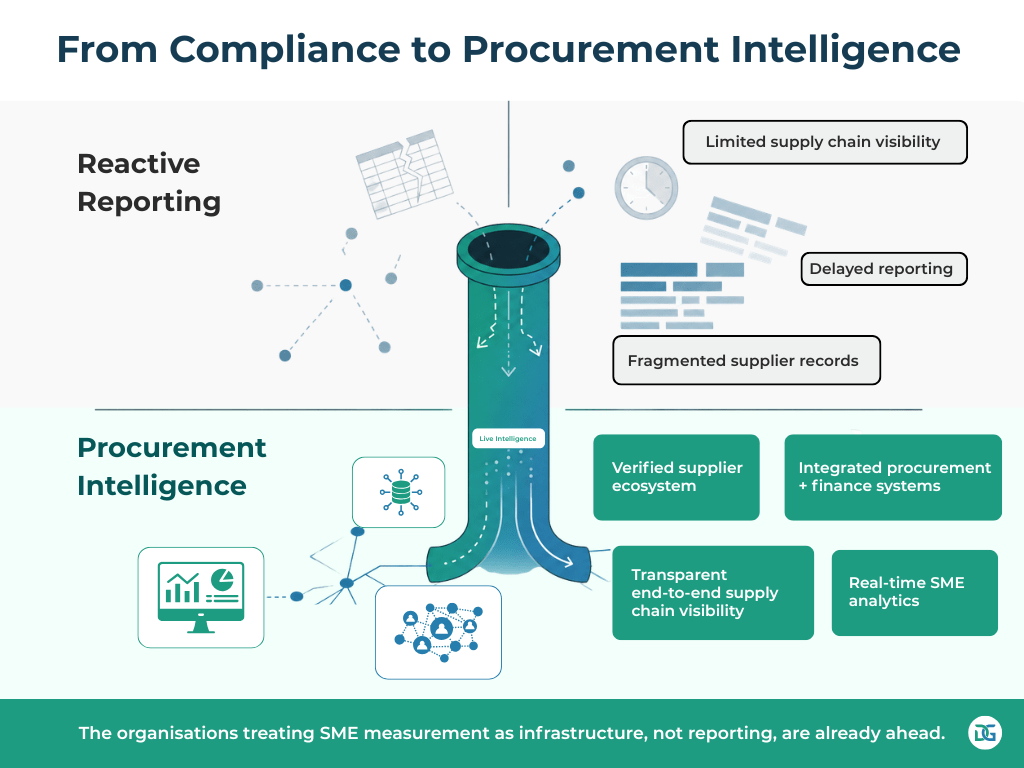
The SME procurement spend target and the transparency requirements of the Procurement Act 2023 assume a level of procurement data maturity that is not uniform across local government. Contract registers are incomplete. Supplier data is inconsistent. Finance and procurement systems do not communicate cleanly. Supplier classification is unreliable at scale without dedicated tooling or process.
Meeting the target is one challenge. Demonstrating that you have met it, with evidence that would withstand external scrutiny, is a separate one. The gap between the two is, in most cases, a data infrastructure gap.
Closing it rarely requires a single large investment. It typically requires a sequenced approach: start with supplier classification hygiene, improve contract register discipline, build payment reconciliation processes, introduce supply chain reporting obligations into new contracts, and build toward integrated spend analytics over time. In our experience working across public sector procurement teams, those that began this work two or three years ago are materially better placed today than those that treated the SME spend target as a reporting exercise rather than an operational commitment.
Where to Start
For teams at the beginning of this process, a baseline audit is the most pragmatic first step, not an attempt to produce a figure, but an honest assessment of the data quality you would be measuring with.
That means reviewing your contract register for completeness, auditing supplier classification records to understand how SME status was captured and whether it is independently verifiable, assessing how well your contract data reconciles with payment data, and identifying which category areas or frameworks you have reliable information for and which you do not.
That diagnostic shapes everything that follows, the priorities, the tooling decisions, the resource requirements, and the realistic timeline for producing figures that are genuinely credible.
The SME procurement spend target is not going away. And as the Procurement Act 2023 continues to embed greater transparency requirements into procurement practice, the pressure to evidence SME engagement, not just assert it, will only increase. The measurement framework built now is the foundation for everything that follows.
DataGardener helps procurement teams build the data infrastructure for credible SME spend reporting, from supplier classification and Companies House verification to spend analytics that draw on over 40 verified UK sources. To see how it works in practice, visit datagardener.com or speak to a member of our team.
Other Articles:
- Intent-Based Sales Prospecting Techniques for UK B2B Teams
- The 20 Largest Companies in the UK: What You Need For 2026
- What is Trade Finance and How Does it Work?
Frequently Asked Questions
What is the government’s SME procurement spend target?
The UK government’s SME procurement spend target requires at least 30% of central and local government procurement spend to flow through small and medium-sized enterprises. Formalised through Cabinet Office Procurement Policy Notes and reinforced in the Government’s SME and Social Enterprise Action Plan, PPN 001, published in February 2025, introduced mandatory three-year direct spend targets for central government departments.
How do councils measure SME procurement spend?
Councils measure the SME procurement spend target by combining contract register data with actual payment records and cross-referencing supplier classifications against Companies House data. Accurate measurement requires consistent supplier identifiers, SME status captured at onboarding, and reconciliation between finance and procurement systems. The most robust approach separates direct SME spend from indirect spend flowing through prime contractor supply chains.
What counts as SME spend in public sector procurement?
SME spend in public sector procurement refers to the contract value awarded to suppliers that meet the UK SME definition: fewer than 250 employees, under €50 million in turnover, and under €43 million in balance sheet total. For measurement purposes, it is categorised as direct spend, indirect spend through prime contractor subcontracting chains, and verified versus self-declared status, each carrying different data quality implications.
What is the difference between direct and indirect SME spend?
Direct SME spend refers to contracts awarded directly to an SME supplier. Indirect SME spend flows from a prime contractor down to SME subcontractors in the supply chain. Direct spend is straightforward to capture from contract award data. Indirect spend requires active supply chain reporting obligations written into contracts with prime contractors, is significantly harder to measure, and is rarely included in standard council reporting.
How do you validate SME spend figures for audit purposes?
Validating SME spend figures requires methodology documentation (which suppliers are included, how SME status was classified, how the denominator was defined), data lineage (tracing figures to source contract register entries and payment records), and independent verification (cross-referencing against Companies House or procurement intelligence platforms). As the Procurement Act 2023 embeds greater transparency requirements, the defensibility of reported figures is increasingly important.