

In 2026, effective B2B lead generation is built on a foundation of quality data. No longer a mechanical exercise in collecting contact details, the process has become one of identifying, attracting, and engaging organisations already moving towards a decision.
At its core, a lead represents intent. Not just interest, but a signal that a business is progressing along a path where your product or service becomes relevant. The sophistication lies in recognising that signal early and responding with precision.
For UK organisations operating in competitive markets, B2B lead generation has shifted from volume-driven activity to intelligence-led engagement. The quality of the data underpinning that process determines everything that follows.
Why Has B2B Lead Generation Data Become Central to UK Business Growth?
The commercial landscape in 2026 is defined by saturation and speed. With more than five million active companies registered across the UK and constant market entry, attention is fragmented and decision cycles are increasingly compressed.
In such an environment, growth is not driven by reaching more people. It is driven by reaching the right people at the right moment. Consequently, the data informing those targeting decisions has become the primary driver of commercial outcomes.
Effective B2B lead generation data enables structured pipeline creation, strengthens conversion probability, and provides continuous insight into customer behaviour. More importantly, it allows UK organisations to replace guesswork with informed, evidence-based targeting.
How Should B2B Leads Be Properly Understood?
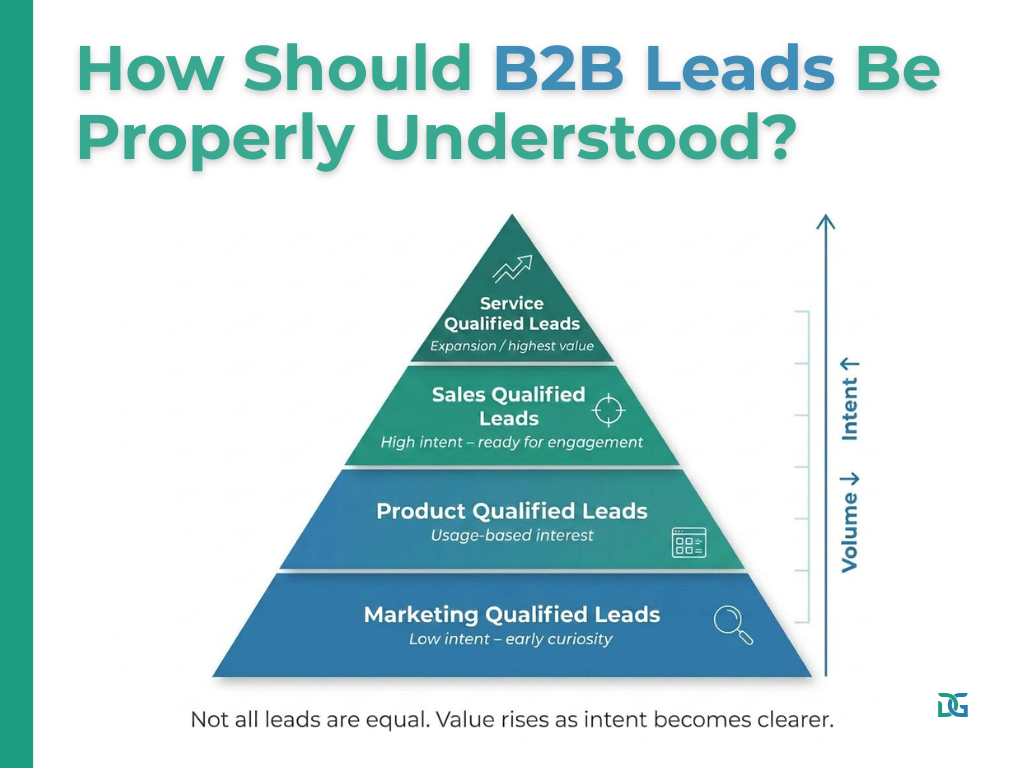
Not all leads carry equal value, and treating them as such is one of the most common inefficiencies in modern UK sales pipelines.
A Marketing Qualified Lead reflects early engagement. These organisations have interacted with content or demonstrated curiosity, yet remain some distance from a decision.
A Product Qualified Lead emerges through usage. In environments offering trials or freemium access, behaviour within the product itself becomes a meaningful indicator of intent.
A Sales Qualified Lead represents clear progression. These have been evaluated against defined criteria and exhibit characteristics aligned with purchase readiness, making them suitable for direct commercial engagement.
Service Qualified Leads indicate expansion potential. Existing customers signal openness to additional services, presenting opportunities for deeper commercial relationships.
Understanding these distinctions allows organisations to align effort with the likelihood of conversion rather than distributing resources evenly across an undifferentiated prospect list.
What Does the B2B Lead Generation Process Look Like in Practice?
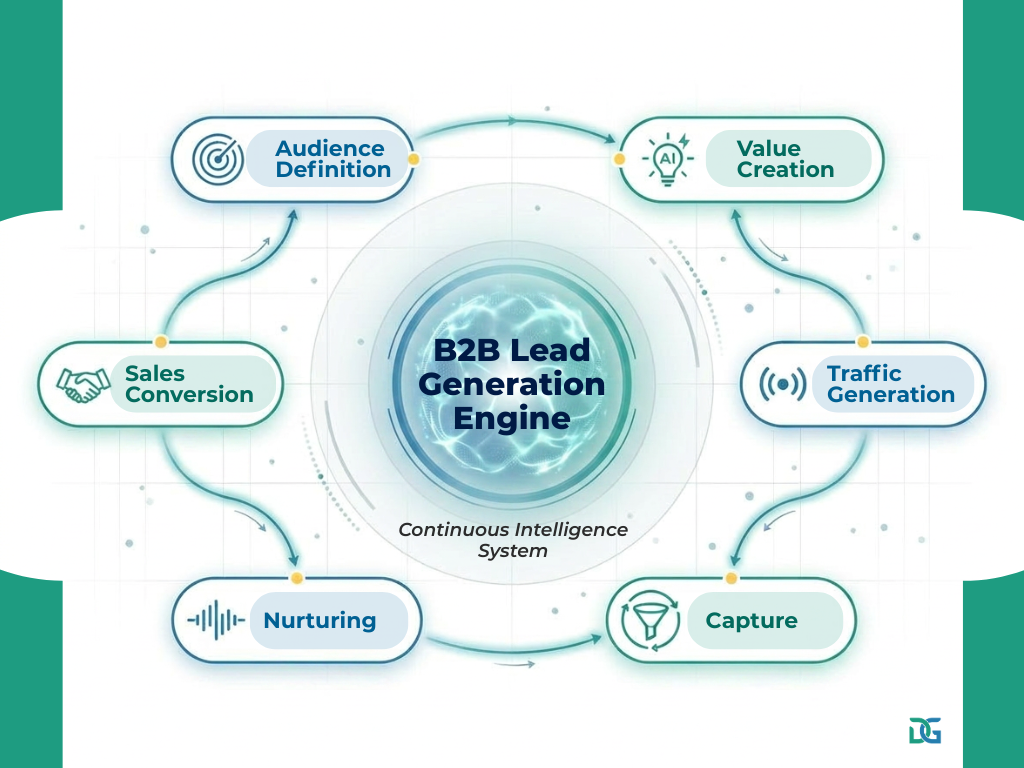
A well-structured B2B lead generation data process follows a logical progression, though in reality, it is rarely linear.
It begins with defining the target audience. Without clarity on who is being pursued, even the most sophisticated UK data-driven campaigns quickly lose direction.
This is followed by the creation of meaningful value. Whether through content, tools, or insights, the objective is to provide something that resonates sufficiently to initiate engagement.
Traffic generation then brings visibility. Digital channels, search, and targeted outreach all play a role in ensuring that relevant audiences encounter these offerings.
Capture transforms attention into an identifiable interest. Nurturing sustains that engagement through personalised communication and relevant content. Finally, conversion occurs when readiness aligns with opportunity.
The effectiveness of this process is not measured by its completeness, but by how seamlessly each stage transitions into the next.
Which B2B Lead Generation Approaches Work Best for UK Organisations?
The distinction between inbound and outbound methods remains relevant, though the boundaries between them have become increasingly fluid for UK B2B teams.
Inbound strategies attract interest through value. Content, search visibility, and social engagement attract prospects organically, often leading to greater trust and stronger long-term relationships.
Outbound strategies initiate contact. Targeted outreach, whether through email or direct engagement, creates opportunities that may not arise naturally. For UK sales teams, growth-focused businesses, and organisations operating in competitive sectors, outbound remains the primary driver of new pipeline activity.
Hybrid approaches are now the norm. The most effective B2B lead-generation data strategies combine channels, ensuring a consistent presence across digital and physical touchpoints.
How Can UK Organisations Generate Higher Quality B2B Leads?
Quality in B2B lead generation is rarely accidental. It is the result of deliberate alignment between audience, message, timing, and data.
Content remains central, though its role has evolved. It is no longer sufficient to inform. It must demonstrate relevance and authority within the specific UK market context in which a prospect operates.
Search optimisation ensures discoverability, but increasingly, it is intent-based targeting that determines effectiveness. Platforms such as DataGardener, which draw on over 40 verified UK sources, enable sales teams to identify prospects at the precise moment of commercial movement, before competitors have spotted the same signal.
Social platforms act as amplifiers, whilst paid channels provide controlled visibility where precision is required. Email continues to play a critical role, particularly in nurturing relationships over time.
The underlying principle is consistency. High-quality B2B leads are generated not through isolated campaigns but through sustained, coherent activity across channels backed by accurate, current data.
How Should B2B Leads Be Qualified and Prioritised Using UK Data?
Qualification is where B2B lead generation data transitions into commercial value for UK sales teams.
Interest provides the initial signal, but it must be evaluated alongside fit. A prospect may be highly engaged yet misaligned with the product offering. The budget determines feasibility, whilst authority determines whether the individual has decision-making power.
Need remains the most decisive factor. Without a clear requirement, even the most engaged lead is unlikely to convert.
Lead scoring systems bring structure to this process. For UK B2B teams, scoring based on company financial health, charge activity, director movements, and sector expansion signals provides a considerably more precise qualification framework than generic demographic filters alone. DataGardener surfaces these signals in real time, drawing on over 40 verified UK sources, so sales teams can act on commercial moments as they happen rather than after the fact.
This ensures that effort is concentrated where it is most likely to produce commercial outcomes.
Why Is Lead Nurturing Often the Decisive Stage in B2B Lead Generation?
Many UK organisations generate leads successfully yet fail to convert them. The gap almost always lies in nurturing.
Effective nurturing is not persistent selling. It is the gradual development of trust through relevance. Personalised communication, timely follow-ups, and content aligned with the buyer’s stage all help maintain engagement.
Retargeting reinforces visibility, whilst demonstrations or trials provide tangible experience. The objective is to remain present without becoming intrusive, guiding the prospect towards a decision without forcing it.
For B2B lead generation data strategies in the UK, nurturing that references specific company signals, such as recent expansion activity or financial changes, consistently outperforms generic sequences.
How Should B2B Lead Generation Data Performance Be Measured?
Measurement provides the feedback necessary for refinement. Without it, optimisation becomes speculative.
Conversion rates indicate effectiveness at each stage of the funnel. Cost per lead reflects efficiency, whilst time to conversion highlights process friction that may be addressable through better data quality or faster signal identification.
Lead quality scores offer insight into the relevance of generated prospects. Customer lifetime value connects B2B lead generation data activity to long-term commercial impact.
With consistent measurement, UK sales and marketing strategies can evolve in response to evidence rather than assumption.
What Challenges Continue to Define B2B Lead Generation in the UK?
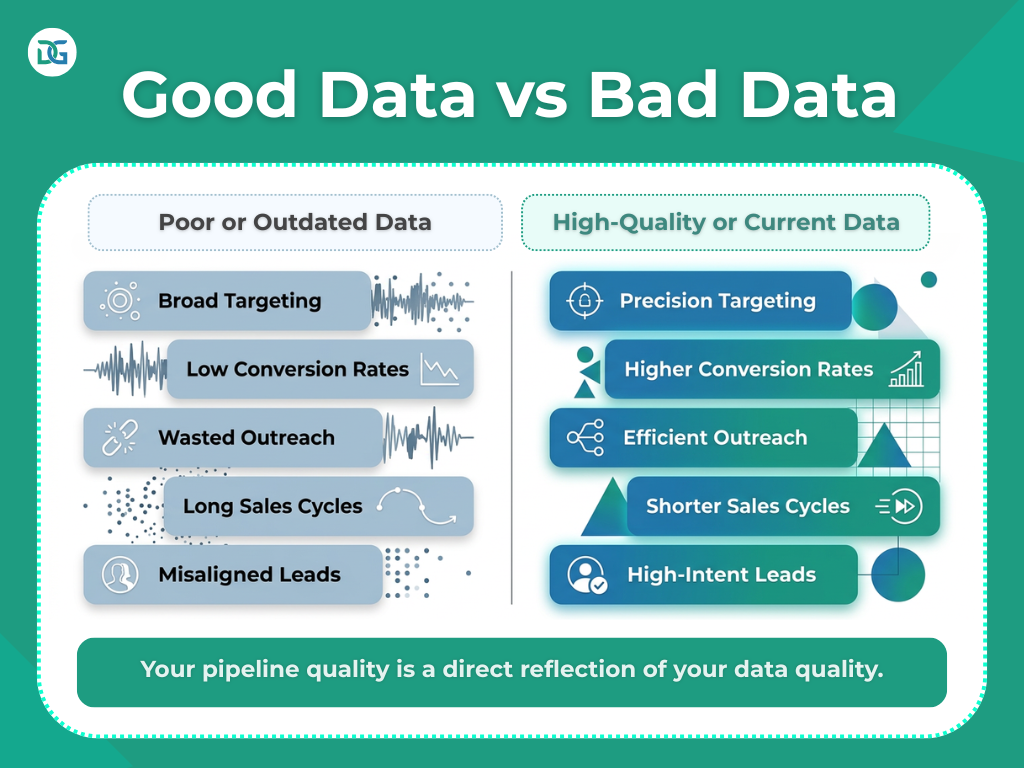
Generating high-quality B2B leads remains the most persistent challenge for UK organisations. Attracting attention is relatively straightforward. Attracting the right attention is considerably more difficult.
Market saturation intensifies competition, making differentiation essential. Organisations must articulate value clearly and consistently across every channel and touchpoint.
Alignment between sales and marketing is another critical factor. Without coordination, leads are either mishandled or lost entirely. Technological change introduces both opportunity and complexity. Tools evolve rapidly and the ability to adapt determines competitiveness.
Data privacy regulations, particularly UK GDPR, require careful handling of B2B lead generation data, reinforcing the importance of compliance, transparency, and working only with verified and responsibly sourced information.
Where Is B2B Lead Generation Data Heading in the UK?
The direction is increasingly defined by intelligence and integration.
Artificial intelligence is enabling deeper personalisation and more accurate targeting across UK B2B markets. Automation streamlines processes, allowing teams to focus on strategy rather than on manual execution.
Most significantly, B2B lead generation is becoming predictive. Rather than reacting to expressed interest, UK organisations are beginning to identify data signals that indicate future intent before it becomes visible to the rest of the market.
This shift transforms lead generation from a reactive function into a proactive growth driver. The organisations investing in higher-quality, more connected UK B2B lead generation data today are the ones that will move fastest on the right opportunities tomorrow. DataGardener is built to support exactly that shift — drawing on over 40 verified UK sources to help UK organisations act first on the signals that matter.
Find the Right Leads, at the Right Time
DataGardener gives UK organisations access to over 40 verified data sources — covering company financial health, charge activity, director movements, and sector expansion signals — updated twice daily to ensure every outreach decision is grounded in current intelligence. To explore how DataGardener can strengthen your B2B lead generation data strategy, visit datagardener.com.
Frequently Asked Questions:
What is B2B lead generation data, and why does it matter in the UK?
B2B lead generation data refers to structured information on UK companies, their decision-makers, financial behaviour, and commercial signals that enable organisations to identify and engage the right prospects at the right time. In 2026, the quality and currency of this data directly determine the quality of the leads it produces.
Why is buying B2B leads often ineffective for UK sales teams?
Purchased leads frequently lack genuine intent and are often outdated or inaccurate. Without prior engagement and without verification against live UK company data, conversion rates tend to be low and trust is difficult to establish. Intelligence-led lead generation built on current, verified data consistently outperforms purchased lists.
How does B2B lead generation data improve sales pipeline quality?
High-quality B2B lead-generation data enables UK sales teams to filter prospects by financial health, sector activity, company growth signals, and director movements. This precision targeting ensures that effort is concentrated on companies most likely to convert rather than distributed evenly across broad, unqualified lists.
What role does data freshness play in UK B2B lead generation?
Data freshness is critical. UK company circumstances change rapidly. Charges are registered, directors change, companies expand or contract. DataGardener, for instance, updates its data twice daily, ensuring outreach is timed to commercial moments rather than historical snapshots that may no longer reflect a company’s current position.
How should UK organisations ensure their B2B lead generation data is GDPR compliant?
UK organisations should work only with data providers that source information from verified, publicly available, and compliant sources. All outreach should be conducted under legitimate interest or consent frameworks, with clear records maintained. DataGardener, for example, draws on over 40 verified UK sources — all publicly available and responsibly sourced — providing a compliant foundation for B2B outreach. Transparency about data sourcing and straightforward unsubscribe mechanisms are both legal requirements and best practice.
Other Articles: