

A low-risk prospect can still be the wrong account. A high-growth supplier can still create exposure. The ability to find businesses by risk level is valuable because it lets commercial and risk teams make decisions using evidence, not assumptions based on company size, brand recognition or a polished website.
For UK organisations, risk-level filtering is not simply a credit-control exercise. Sales teams can protect pipeline quality before investing time in outreach. Lenders and brokers can build more appropriate borrower segments. Procurement teams can reduce the chance of supplier disruption. Compliance professionals can prioritise the organisations that need deeper review.
The advantage comes from treating risk as a practical targeting criterion, alongside sector, turnover, location, employee range and ownership structure.
Why find businesses by risk level before you engage?
Every new commercial relationship carries a decision cost. Someone has to qualify the account, assess payment terms, complete onboarding, approve credit, monitor changes and, where things go wrong, manage the consequence. A long prospect list with no risk context shifts that cost downstream, where it becomes more expensive.
Risk-level intelligence allows teams to separate the market into workable groups. A sales leader may want financially stable mid-market firms that can support a larger contract value. A finance provider may seek companies with lending signals that fit its credit appetite. A procurement manager may need alternative suppliers with a lower risk profile in a specific region or trade category.
This is not about refusing to work with every company carrying an elevated risk signal. It is about matching the relationship, commercial terms and monitoring effort to the evidence available. A newer company with limited filed accounts may be suitable for a small initial order or staged payment arrangement. It may not be suitable for a high-value, unsecured credit limit from day one.
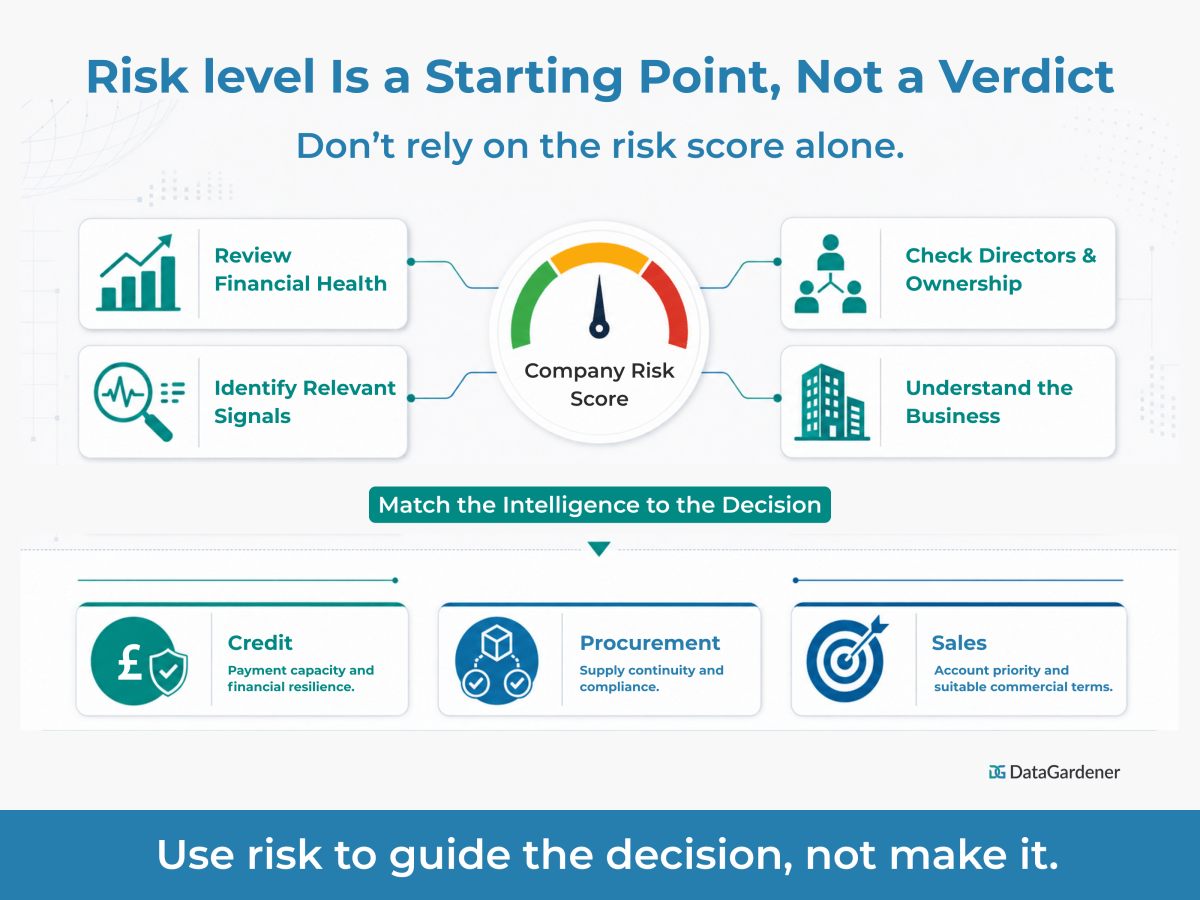
Risk level is a starting point, not a verdict
A risk score or category condenses complex information into something teams can act on quickly. That makes it useful, but it should not be mistaken for a complete view of a business.
A company can appear higher risk for legitimate reasons. It may be newly incorporated, have undergone a restructure, operate in a volatile sector or have filed limited financial information. Conversely, a seemingly low-risk company can still present operational or reputational concerns if its ownership, director history, supply chain or trading pattern warrants attention.
The strongest approach combines a risk-level filter with supporting company intelligence. Review financial performance and trends, directors and directorship changes, ownership information, age of business, industry, location and relevant trade or lending indicators. The exact mix depends on your decision.
For a credit decision, payment capacity and financial resilience may take priority. For supplier due diligence, continuity of supply, ownership transparency and compliance considerations may matter more. For sales prospecting, risk can help determine account priority and proposed commercial terms without becoming a barrier to a valuable opportunity.
Use risk bands to create clear operating rules
Risk bands are most useful when they lead to defined actions. Without agreed rules, a filter merely produces another list for someone to interpret manually.
For example, low-risk businesses might enter a fast-track outreach or onboarding route. Medium-risk businesses could receive standard review with tighter initial terms. Higher-risk businesses may require a credit check, a smaller first order, director-level approval or exclusion from certain campaigns.
These rules should be proportionate. Setting thresholds too aggressively can shrink your addressable market and cause teams to miss viable companies, particularly in sectors where newer or asset-light businesses are common. Setting them too loosely can create avoidable bad debt, supplier failures and wasted sales effort.
The right threshold is the one that reflects your organisation’s risk appetite, unit economics and ability to monitor change.
Build a targeted market, not a generic company list
The real commercial value appears when risk-level filtering is layered with the criteria that define your ideal account or supplier.
A business development team selling enterprise software, for instance, may search for UK companies in professional services and technology, with 50 to 500 employees, a specified turnover range, recent director activity and a low-to-medium risk profile. That is materially more useful than a list of every company in those sectors.
An asset-finance provider might focus on established transport, construction or manufacturing firms in selected postcodes, then segment results by risk category, turnover and lending indicators. This gives the team a more defensible starting universe for outreach and underwriting.
A procurement team replacing a critical supplier could identify businesses by product or service category, geography, employee scale and risk profile. It can then investigate ownership, financial history and company changes before inviting suppliers into the qualification process.
The principle is straightforward: risk should narrow and prioritise a relevant market, not replace market definition.
How to find businesses by risk level with confidence
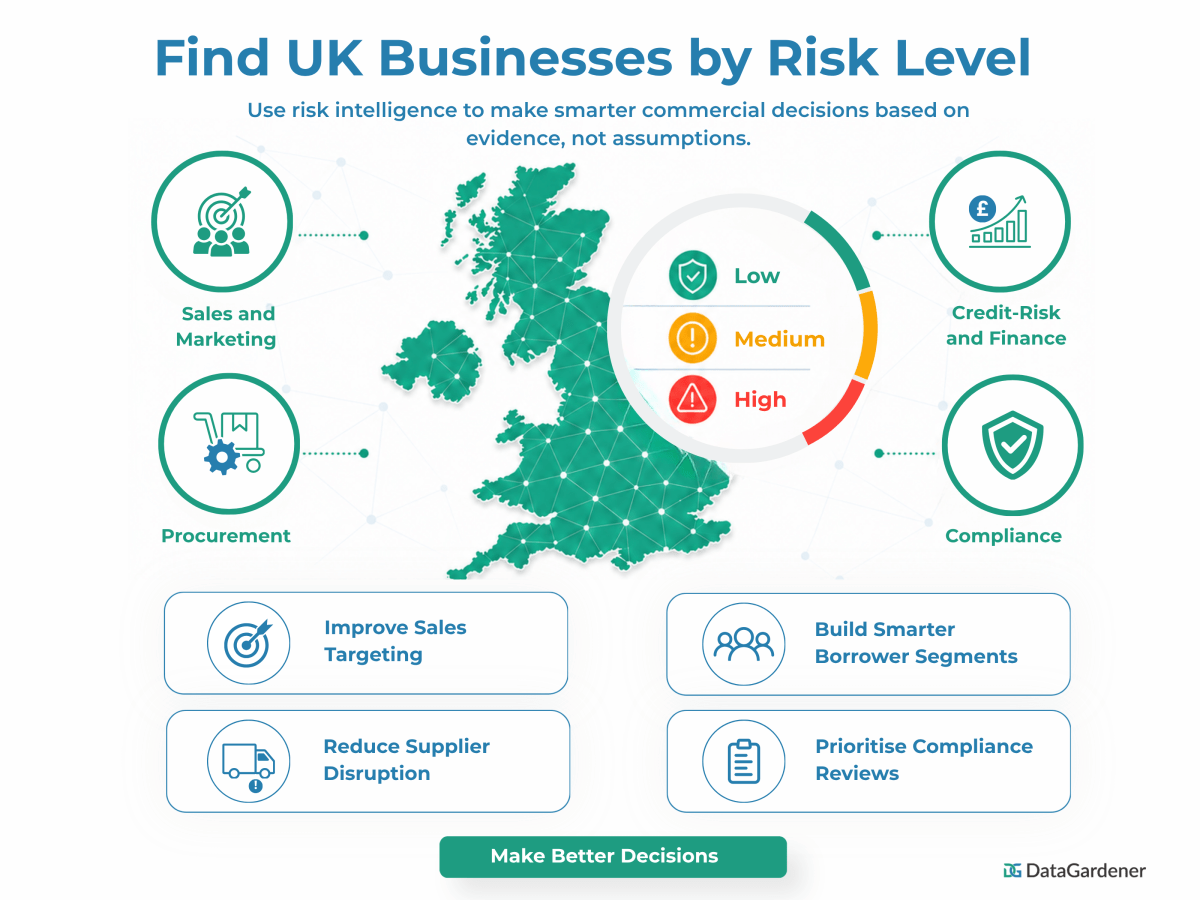
Start by agreeing what the search must achieve. “Low risk” means different things to a sales team offering annual subscriptions, a lender advancing capital and a public-sector buyer managing a critical contract. Define the decision first, then choose the signals that support it.
Next, establish your acceptable risk range and any non-negotiable exclusions. This may include particular risk bands, insolvency-related indicators, adverse company changes, sectors outside your policy or companies below a minimum trading history. Keep the policy clear enough for teams to use consistently, but avoid creating rules so rigid that commercial judgement disappears.
Then apply your core market filters. Geography, SIC sector, employee range, turnover, age, growth profile and ownership characteristics turn a broad UK company universe into a relevant target population. Risk level should sit within this search logic, not be reviewed as an afterthought.
Once results are available, prioritise rather than simply export. Rank businesses according to the commercial outcome you want: likelihood to buy, ability to support a credit limit, fit for a supplier panel or potential for portfolio expansion. A low-risk company with no need for your offer is still not a priority account.
Finally, create a review process for exceptions. Some of the best opportunities will not fit a simple score threshold. A company may have strong directors, visible contract momentum or an improving financial trajectory despite a cautious risk classification. Give authorised teams a way to record why they proceeded, what terms were agreed and when the account should be revisited.
Match the workflow to the team using the data
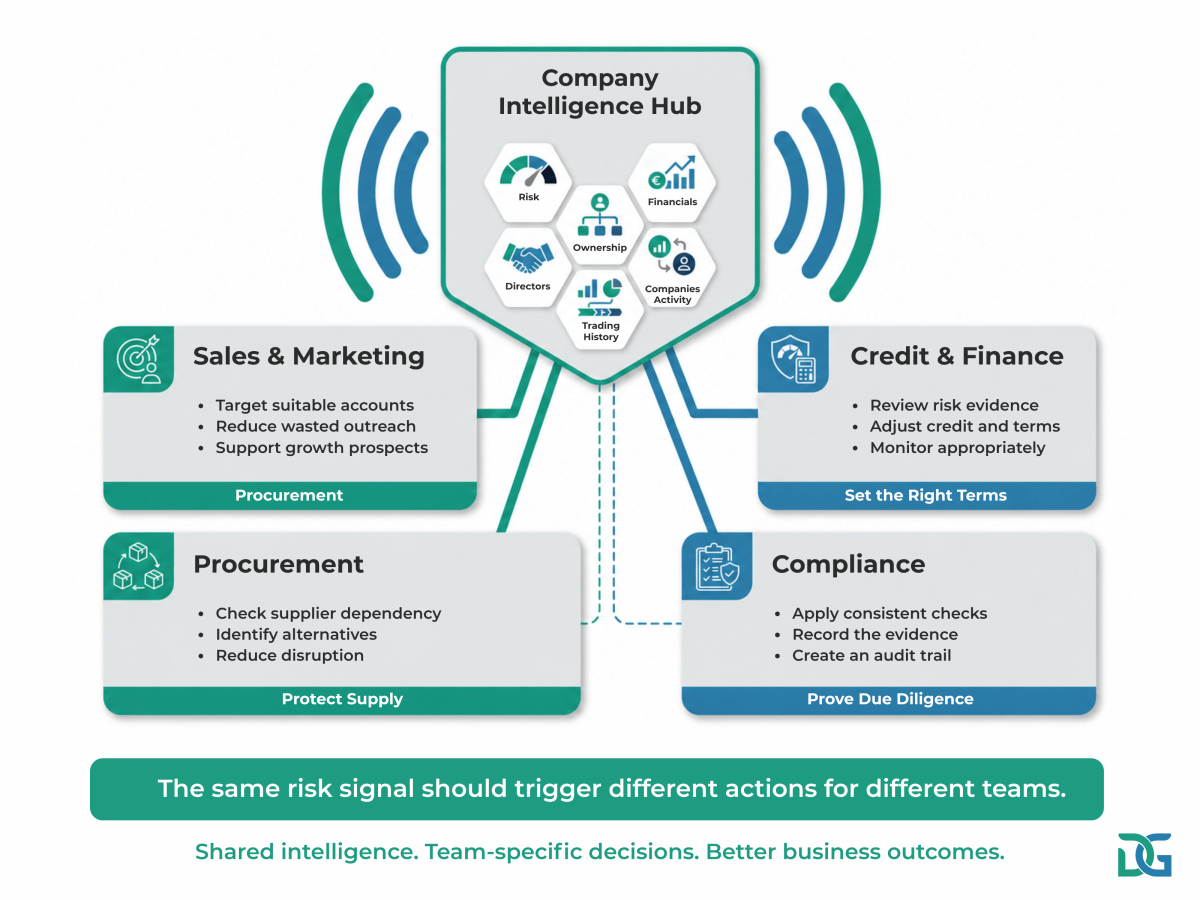
Sales and marketing teams should use risk intelligence to improve qualification and campaign design. Excluding companies that cannot reasonably support the proposed spend can improve conversion rates and reduce time spent progressing unsuitable accounts. But a blanket exclusion may be counterproductive where your product is designed for start-ups or rapidly growing firms.
Credit-risk and finance teams need the underlying context behind the risk level. A category can trigger the right workflow, but evidence should inform credit limits, payment terms, guarantees and monitoring frequency. This supports consistent decisions that can be explained internally.
Procurement and supplier-management teams should view risk alongside dependency. A low-risk supplier can still be a single point of failure if it is the only qualified provider in a specialist category. A higher-risk supplier may be manageable where there are alternatives, modest spend or protective contract terms.
Compliance teams benefit when company intelligence creates an audit trail. The aim is not to produce paperwork for its own sake. It is to show that supplier or customer decisions were based on a repeatable, proportionate process using relevant information.
Keep the view current after the first decision
Company risk is not fixed. Directors change, financial performance shifts, ownership structures evolve and external trading conditions can alter quickly. A one-off assessment is useful at onboarding, but it becomes less reliable as the relationship grows.
Monitoring matters most where exposure is meaningful. High-value customers with extended payment terms, key suppliers and borrowers should not be treated in the same way as low-value, low-dependency accounts. Use change alerts and scheduled reviews to focus attention where a change could affect revenue, continuity or compliance.
This is where an intelligence platform such as DataGardener can support operational teams: combining granular UK company search with risk information, financial data, director changes, ownership intelligence and workflow-ready data enrichment. The outcome is not more data for its own sake. It is a cleaner route from market selection to informed action.
A risk-level filter cannot predict every failure or guarantee every opportunity. What it can do is give your team a disciplined way to spend time, credit and procurement budget where the evidence is strongest. That is a better basis for growth than treating every company in the market as equally suitable.