

Are women demonstrating leadership in business in the UK?
Absolutely, and at a remarkable scale. Between 2019 and 2025, over half a million female-founded companies emerged across the UK (532,994 to be precise). In Women Leadership in UK 2025, 135,259 women launched their own ventures, representing a significant share of new company formations.
Women leadership in the UK is not a marginal trend. Female entrepreneurs are actively shaping business growth across every region and sector. The numbers reflect ambition, commitment, and sustained participation.
However, participation is just the start. What happens after launch – progression and scale – is where women leadership truly shows its impact.
Think Data. Think DataGardener
DataGardener users double their leads and cut research time in half — with smarter data, faster insights, and better decisions.
Where are female entrepreneurs building their businesses?
Female-founded companies cluster in service-led sectors, particularly those with low barriers to entry and greater flexibility. The strongest concentrations appear in professional and business services, creative industries, and digital technology-enabled services.
These sectors align with the UK’s service-oriented economy. You can start a consultancy, creative agency, or digital service with a modest investment compared to those in manufacturing or infrastructure-heavy industries.
Yet accessibility comes with challenges. Service sectors face intense competition, thin profit margins, and cash-flow pressures. Easy entry does not always translate into sustainable growth or visible women leadership in the UK.
How many women-led businesses actually scale up?
While entry is strong, progression tells a different story. Between 2019 and 2025, over 1.3 million UK companies operated at micro scale. Only 69,740 reached small enterprise size, 14,081 achieved medium scale, and 5,687 reached enterprise level.
Female-founded businesses show an even steeper drop-off. Of over half a million businesses, only 61 reached enterprise scale.
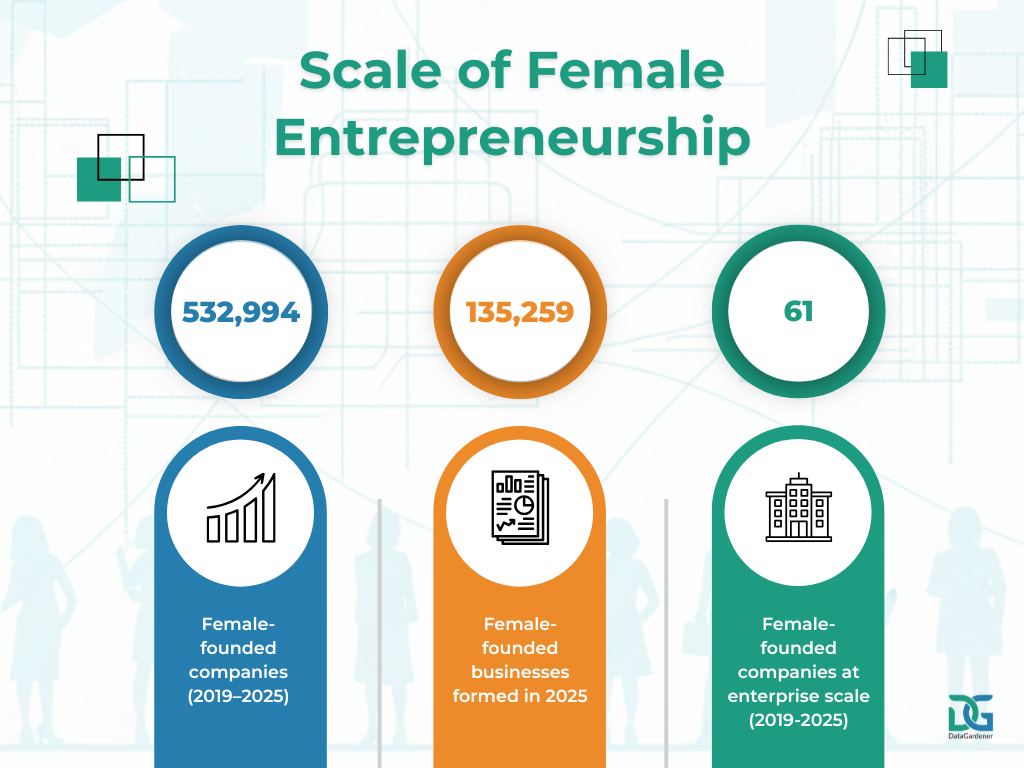
This highlights a severe bottleneck. Many female entrepreneurs start strong, but few move into larger, enterprise-level businesses where women leadership can significantly influence outcomes.
What does growth quality mean for women-led businesses?
Growth has become selective. Not all growth is equal. The market now differentiates volume from quality.
DataGardener’s Women Leadership in UK 2025 analysis identified 63,382 companies with excellent growth quality and low risk. Another 11,732 showed emerging growth with high risk, and 1,924 exhibited excellent growth alongside high risk.
Female-founded businesses remain under-represented in the highest-quality growth cohort. This is not about ability or ambition. Structural conditions, including access to capital and governance support, are key factors enabling women leadership in scaling businesses.
Why access to capital is critical for women leadership
Financial pressures in the UK are increasing. This has particular implications for female entrepreneurs and women leadership in the UK.
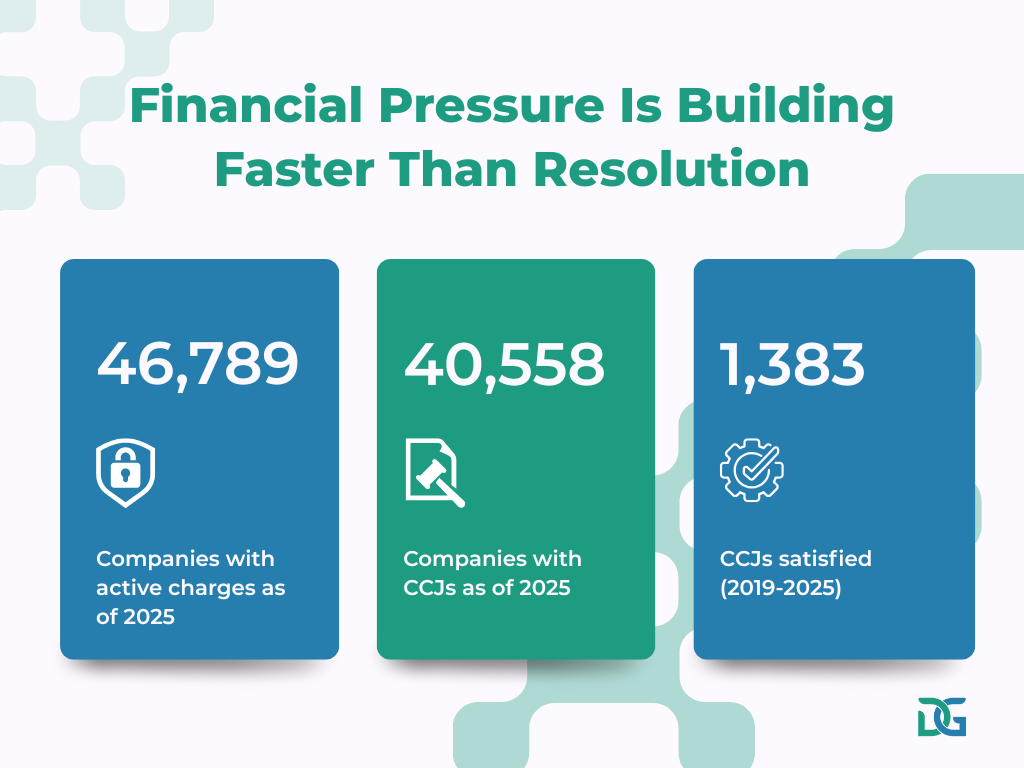
In 2025, 120,529 companies held active registered charges, and 332,549 had at least one County Court Judgement (CCJ) on record. Only 5,649 CCJs were satisfied. Many businesses operate while carrying unresolved financial stress.
Female-founded businesses often rely on personal savings or short-term funding. Limited external finance slows scaling and constrains women leadership. The result is that many businesses remain micro or small, even when demand exists.
Access to the right finance at the right time is essential for translating ambition into tangible growth.
Does leadership and governance experience matter?
Increasingly, yes. Women leadership is a major differentiator between businesses that progress and those that plateau.
In Women Leadership in UK 2025, there were 572,486 male directors and 239,179 female directors across the UK. Female representation continues to grow, but governance experience is unevenly distributed.
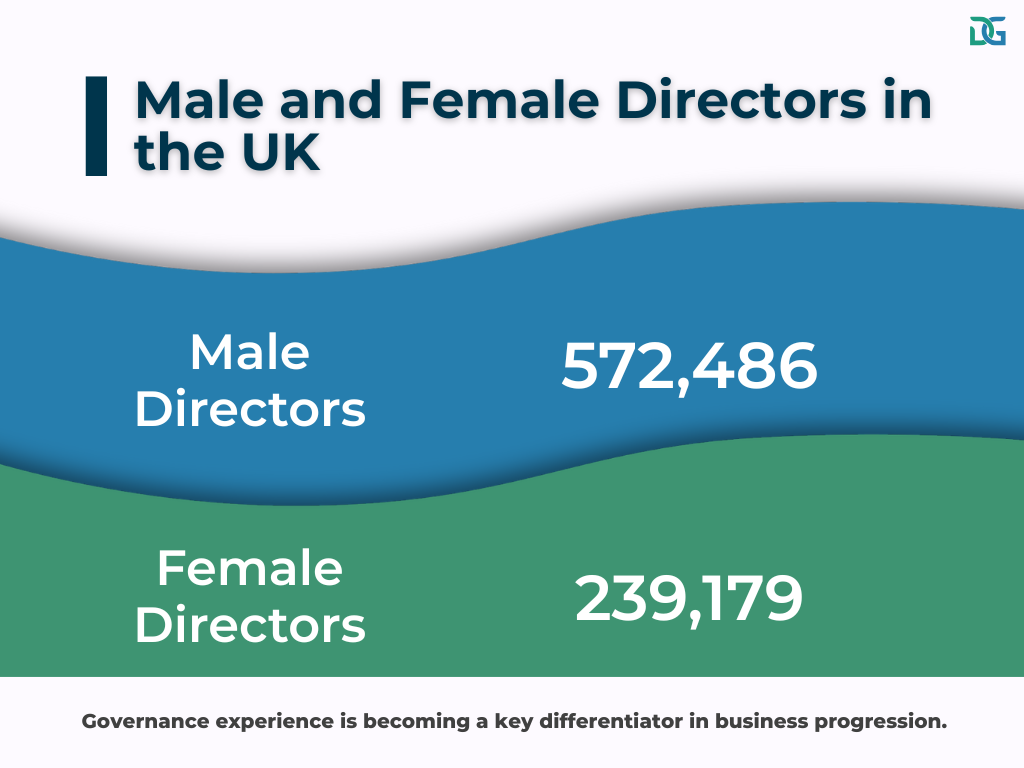
Businesses led by directors with exposure to multiple business cycles, complex operations, and diverse sectors show stronger growth quality. Female entrepreneurs often lack advisory networks or experienced non-executive support. This can slow progression, even when operational performance is strong.
Women leadership thrives where guidance, mentorship, and governance structures exist. Without these, even capable entrepreneurs face growth constraints.
Structural barriers holding women-led businesses back
Female entrepreneurs aren’t under-represented at entry. They face under-support at progression.
Strong participation contrasts with limited medium and enterprise scale movement, lower representation in high-growth cohorts, and sensitivity to financial constraints. These factors directly influence women leadership in the UK visibility and impact.
The barriers are structural, not behavioural. The ecosystem allocates capital, networks, and risk unevenly. Businesses without established track records or conventional funding pathways encounter disproportionate friction.
What 2026 looks like for women-founded businesses
Conditions in 2026 will likely become more demanding. The economy is entering a phase of selective growth, mounting financial pressure, and heightened emphasis on governance quality.
Businesses in the emerging growth-but-high-risk cohort present a critical intervention opportunity. Targeted finance, strategic advisory, and governance support can enable these businesses to scale and strengthen women leadership.
Without intervention, many will remain micro or small-scale despite potential. The gap between potential and actual growth may widen further, reinforcing the need for support structures.
How to support female entrepreneurs and women leadership
Inclusive growth requires more than increasing participation. Focus must shift to scale-appropriate capital, governance and leadership support, early identification of growth-quality signals, and targeted interventions.
These measures strengthen women leadership in the UK and allow female-founded businesses to reach higher growth levels. Evidence-led interventions at key lifecycle points have the greatest impact.
The future of women-founded businesses and leadership
The UK women-founded business landscape isn’t about untapped ambition. It’s about constrained progression.
Female entrepreneurs continue to innovate and contribute at scale. Yet structural conditions for sustainable growth remain unevenly distributed. As selective growth intensifies, disparities may become more pronounced.
The opportunity in 2026 lies in recognising these realities early. Evidence-led support, strategic advisory, and targeted funding can enhance women leadership and unlock the full potential of female-founded businesses.
The question isn’t whether female entrepreneurs have what it takes—they already do. The question is whether the ecosystem will provide the infrastructure needed to fully realise strong women leadership in the UK.
All insights drawn from DataGardener’s UK Market Intelligence datasets and the DataGardener Annual UK Market Report 2025.