


In This Article
- What Does Each Platform Actually Do?
- How Do They Serve the Four UK Audience Segments?
- Data Freshness and What It Actually Costs You
- Where Does Predictive Intelligence Separate the Two?
- Integration: Where Day-to-Day Value Is Won
- Key Differences at a Glance
- What Does the Comparison Reveal?
Not every business intelligence platform is built for the same purpose. For UK organisations working through a DataGardener vs mnAi evaluation, that distinction matters considerably.
The UK market comprises more than 5.4 million active companies according to Companies House. Both DataGardener and mnAi help organisations make sense of that landscape. However the problems each platform was designed to solve are fundamentally different.
mnAi is built to surface data that is otherwise difficult to locate. DataGardener is built to connect data from over 40 verified sources into intelligence you can act on before your competitors do. For organisations in financial services, procurement, sales, and compliance, that gap has direct commercial consequences. Choosing the wrong platform means making high-stakes decisions on an incomplete picture.
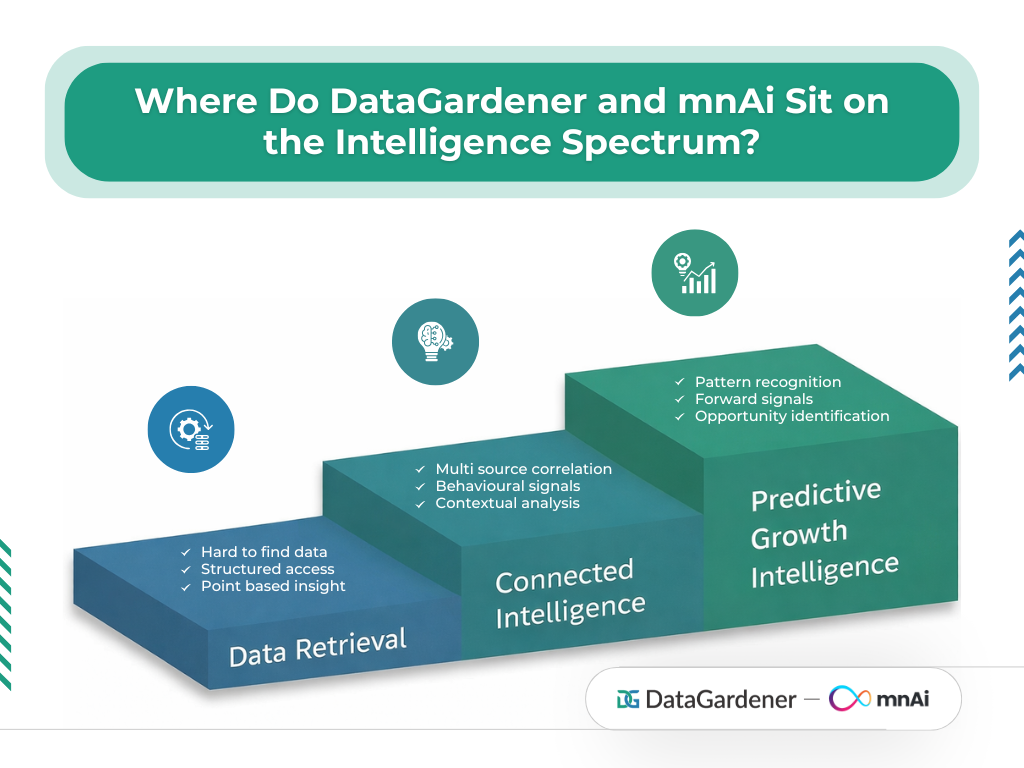
What Does Each Platform Actually Do in the DataGardener vs mnAi Comparison?
The clearest starting point for any DataGardener vs mnAi comparison is understanding the original design intent behind each platform.
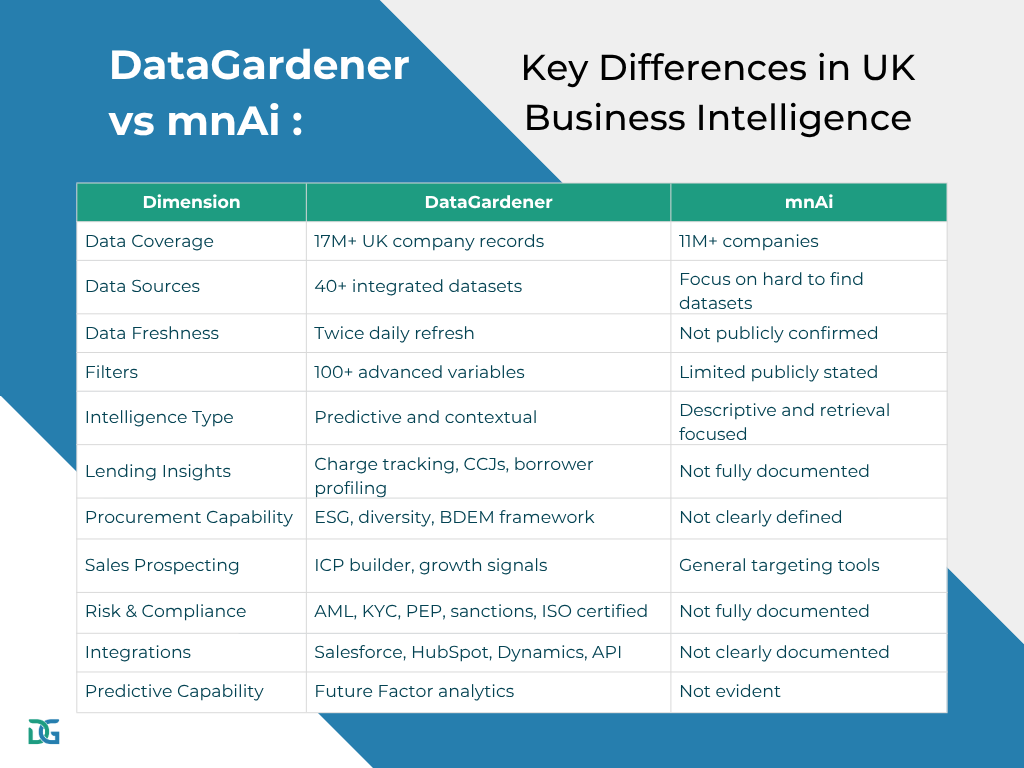
mnAi, headquartered in Crawley, positions itself around uncovering hard-to-find data. It covers over 11 million UK companies and claims more than 12 billion data points. Its Data Factory feature provides a visual representation of its data processing pipeline, which is a useful tool for organisations with clearly defined and targeted research tasks.
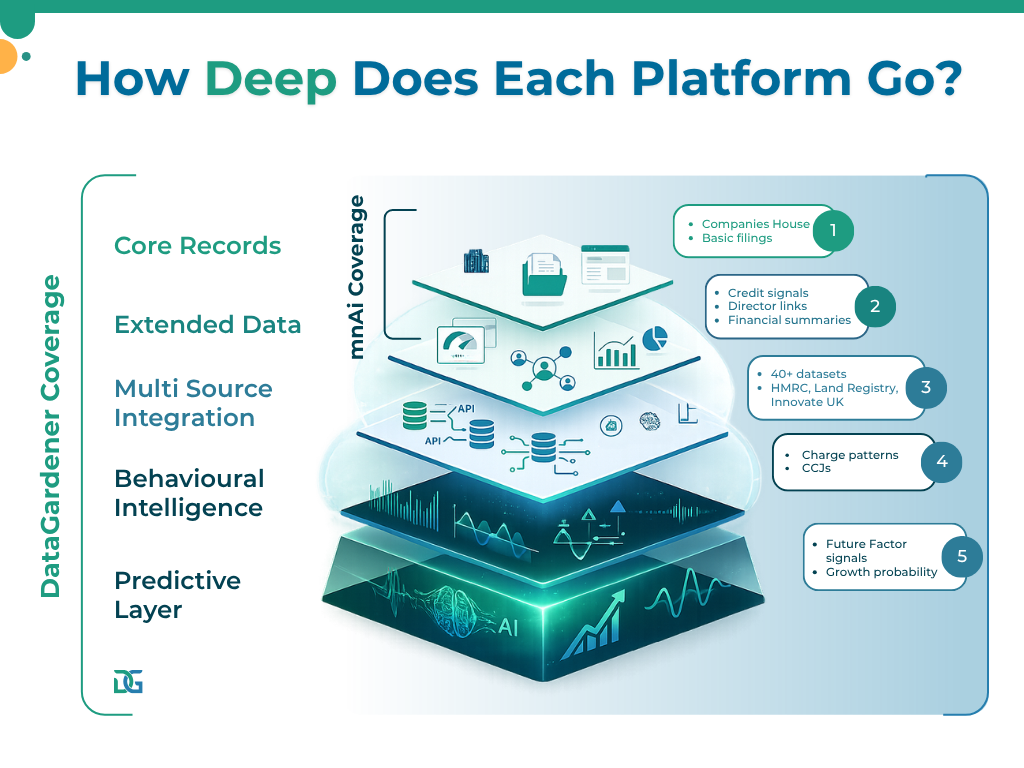
DataGardener, based in Eastleigh, Hampshire, integrates over 40 distinct verified UK data sources into a single platform. These include Companies House, HMRC datasets, Land Registry records, Innovate UK funding data, Electoral Roll, ONS statistics, and international trade flows. The platform covers more than 17 million UK company records, refreshed regularly, with nearly 100 advanced filtering variables available to users.
The architectural difference is not simply a matter of volume. When financial signals, ownership patterns, legal stress indicators, and growth data are analysed in combination, the picture that emerges is qualitatively different from any single dataset in isolation. A lender assessing a CCJ wants to know whether it sits within a broader pattern of financial distress or whether it is an isolated historical event. That contextual judgement requires a multi-source architecture to support it.
How Do DataGardener vs mnAi Serve the Four UK Audience Segments?
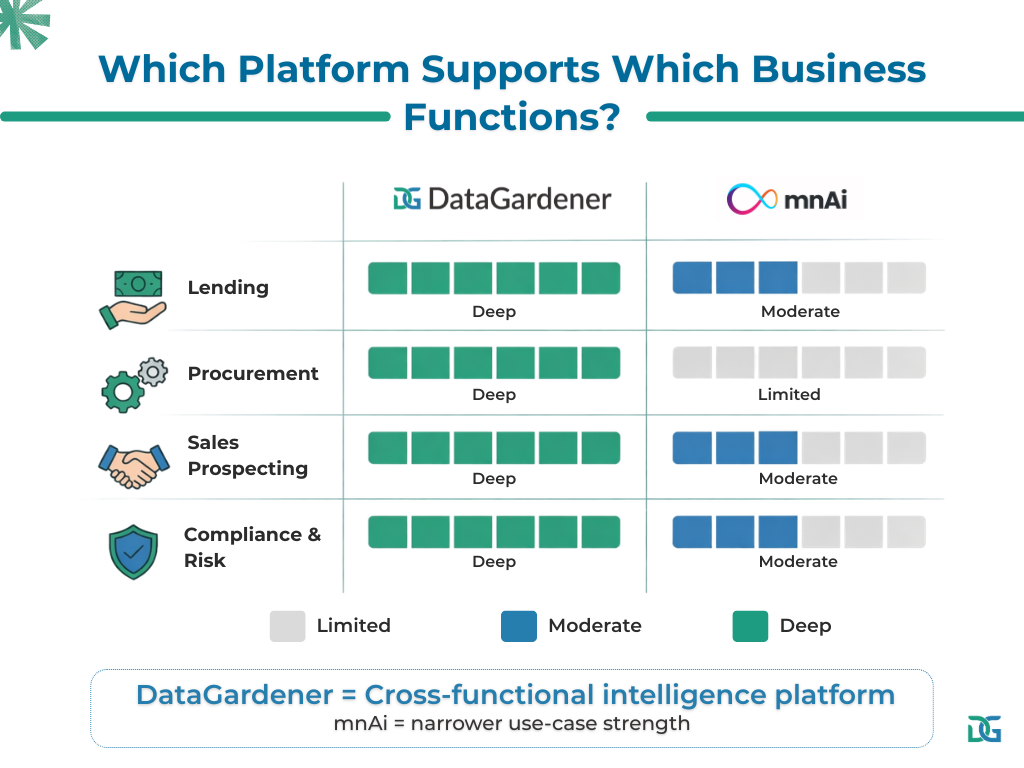
The most practical lens for any DataGardener vs mnAi evaluation is how each platform performs for the teams using it daily. For the four segments most likely to assess this comparison, the differences are pronounced.
Financial Services and Lending
DataGardener’s Lending Intelligence module tracks charges, surfaces CCJ data on firms, enables borrower risk profiling, and delivers portfolio monitoring with live alerts. Named clients include Allica Bank, Bibby Financial Services, Star Asset Finance, and Clear Asset Finance, each using the platform to identify lending opportunities before applications arrive.
UK SME lending volumes have consistently exceeded targets annually according to the British Business Bank Small Business Finance Markets Report 2024, creating sustained demand for origination intelligence. mnAi does not publicly document equivalent lending-specific capabilities, and no named financial services clients are listed for independent assessment.
Procurement
The Procurement Act 2023 came into force on 24 February 2025, governing approximately £300 billion in annual public sector spending and creating formal compliance requirements that extend well beyond financial risk assessment.
DataGardener’s Responsible Procurement module tracks supplier diversity across WEConnect-certified women-owned businesses, MSDUK-certified ethnic minority firms, veteran-owned enterprises, and disability-owned businesses. It cross-references against the Prompt Payment Code, Science Based Targets, Modern Slavery Statements, and Living Wage Foundation accreditation. DataGardener holds Crown Commercial Supplier status and is listed on the BlueLight Commercial ICT Framework.
mnAi does not publicly document comparable procurement functionality. For a detailed breakdown of what the Procurement Act 2023 requires from procurement teams around supplier risk, see DataGardener’s guide to the Procurement Act 2023.
Sales and Marketing
DataGardener provides an ICP Builder, lead qualification scoring, verified contact data, and nearly 100 advanced filters. The proprietary Future Factor framework enables teams to prioritise outreach toward companies showing active expansion signals, preventing effort being distributed uniformly across an undifferentiated prospect list.
mnAi offers general targeting tools, though specific filter counts and deliverability metrics are not publicly available for direct comparison. For a practical guide to how data-driven prospecting improves pipeline quality, see DataGardener’s guide to B2B lead generation data UK.
Risk and Compliance
DataGardener provides tier risk scoring, CCJ and charge monitoring, PEP and sanctions screening, including Ultimate Beneficial Ownership analysis. The platform holds ISO 27001, ISO 9001, and Cyber Essentials certifications and is GDPR-compliant with end-to-end encryption throughout.
mnAi references compliance and risk management as core use cases, and its hard-to-find data proposition is genuinely relevant to due diligence workflows. However, independent security certifications and a documented risk scoring methodology are not listed in publicly available information.
Data Freshness and What It Actually Costs You
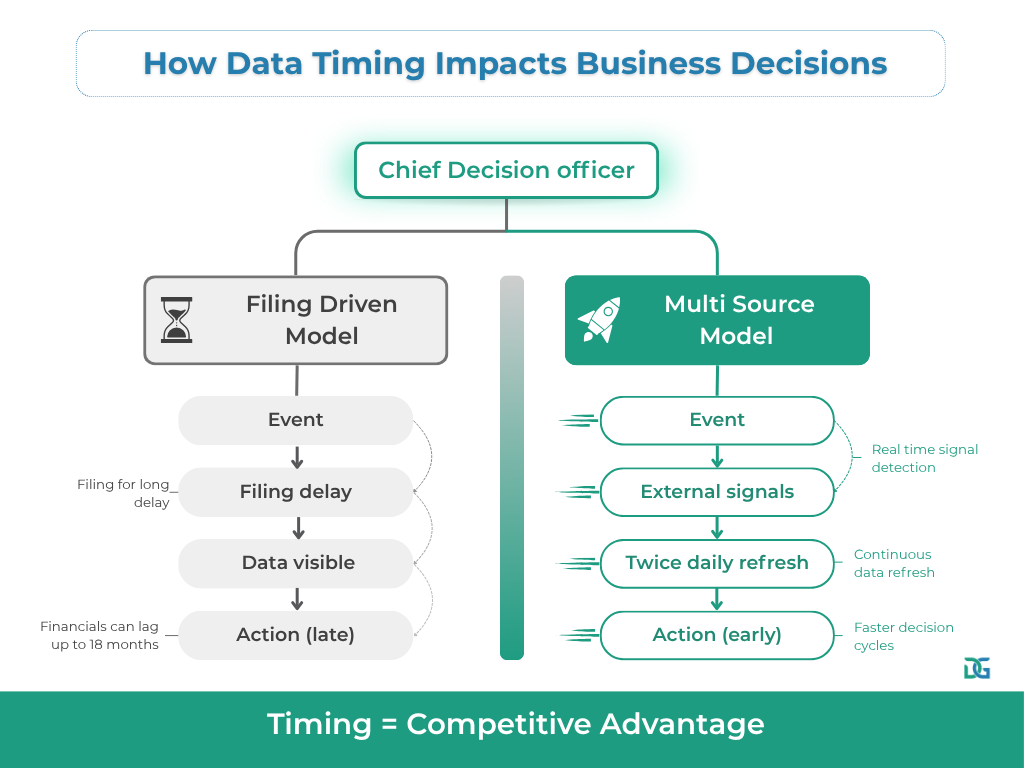
Any platform that draws primarily from Companies House filing cycles inherits a structural constraint. Financial accounts can reflect performance from up to 18 months prior to appearing on any platform. Director changes appear only once formally recorded, introducing delays between real-world events and data visibility.
For verification tasks where confirming established facts is the objective, this cadence is workable. For organisations where the timing of a decision determines its commercial value, it introduces meaningful lag.
DataGardener addresses this through a regular refresh cycle combined with multi-source ingestion from over 40 external datasets. New charge registrations, property transactions, and director appointments are captured from external signals in near real-time, not tied exclusively to filing cycles.
For a B2B sales team, contacting a prospect at the point of expansion rather than months after it determines whether a deal is originated at all. Furthermore, that difference in data latency is not a minor feature distinction. It is a competitive advantage built into the platform’s architecture. To understand how data freshness affects sales prospecting outcomes specifically, see DataGardener’s guide to sales prospecting techniques UK B2B.
Where Does Predictive Intelligence Separate DataGardener vs mnAi?
The most significant difference in the DataGardener vs mnAi comparison is forward-looking capability. It is here that the two platforms occupy genuinely different market positions.
mnAi’s model is largely descriptive. It provides a structured account of what is currently known, enabling users to draw conclusions from existing data. For verification and targeted investigation, this is a legitimate and effective approach.
DataGardener introduces a predictive dimension through its proprietary Future Factor framework. By analysing patterns across its multi-source ecosystem, it identifies companies likely to seek finance, expand operationally, or enter new markets before those behaviours become visible through conventional indicators.
The IS-8 Sector Framework adds contextual depth by mapping companies across eight strategic sectors including FinTech, HealthTech, CleanTech, and GovTech, enabling sector-level trend analysis alongside individual company assessment. Additionally, for a broader understanding of how UK business intelligence platforms compare across the market, see DataGardener’s B2B business data guide.
One platform supports investigation. The other supports anticipation.
Integration: Where Day-to-Day Platform Value Is Won
Integration is a dimension of the DataGardener vs mnAi comparison that often determines day-to-day platform value more than any feature specification.
mnAi functions effectively as a standalone platform for focused research at defined intervals. It suits organisations that do not need company intelligence embedded into live operational workflows.
DataGardener’s native integrations with Salesforce, HubSpot, and Zoho CRM allow intelligence to flow directly into ongoing commercial processes without manual intervention. Consequently, for organisations where company data informs daily decisions, this integration breadth is not a convenience feature. It is a core part of the platform’s value.
DataGardener vs mnAi: Key Differences at a Glance
What Does the DataGardener vs mnAi Comparison Reveal About UK Business Intelligence?
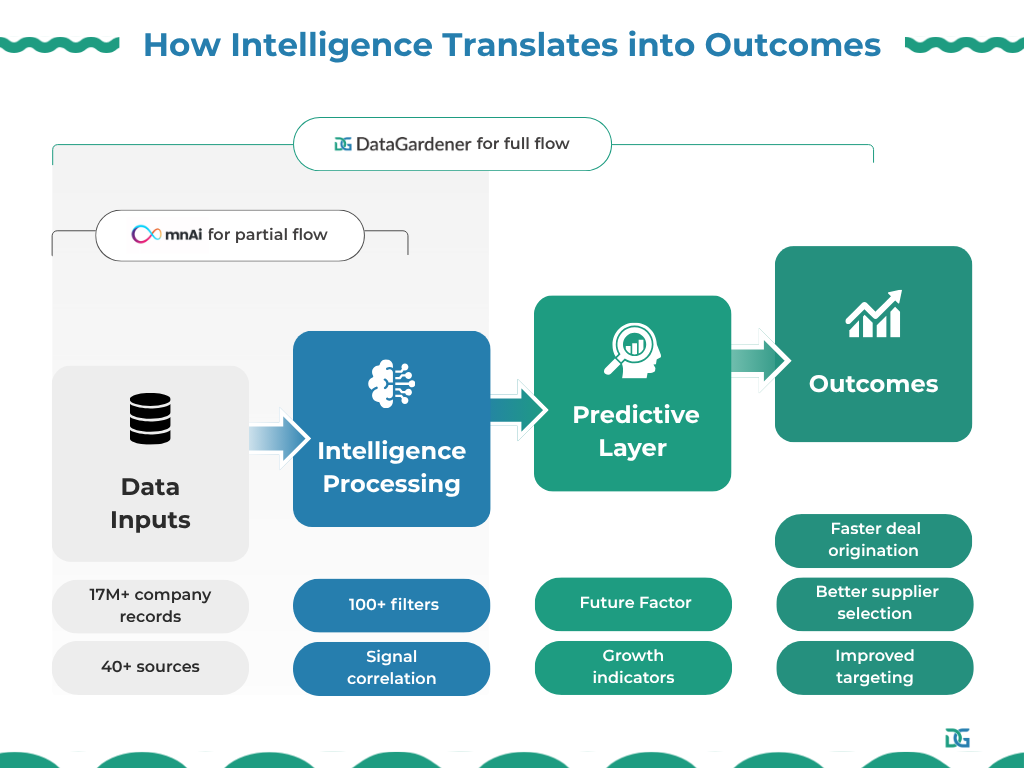
mnAi’s focus on surfacing hard-to-find data addresses a genuine market gap. For investigative and verification-focused use cases, it warrants serious consideration. Its Data Factory visualisation provides a clear and accessible entry point for targeted research workflows.
DataGardener’s architecture is built for a broader scope of problem: connecting intelligence across 40-plus verified sources, surfacing predictive signals before they appear in conventional data, and embedding that intelligence into the operational systems teams already use every day.
The Procurement Act 2023 has raised compliance requirements across the public sector. Competitive windows in lending and B2B sales are narrowing. In this environment, the central question is not which platform holds more data. It is which platform turns data into decisions you can act on faster, with more confidence, and at lower risk.
That is the distinction the DataGardener vs mnAi comparison ultimately comes down to.
Other Articles:
- DataGardener vs Beauhurst: A UK Data Platform Guide
- Why DataGardener Is Better Than ZoomInfo for UK Businesses in 2026
What is the main difference between DataGardener and mnAi?
DataGardener integrates over 40 verified UK data sources covering 17 million-plus company records, updated regularly, and adds predictive capability through its Future Factor framework. mnAi focuses on surfacing hard-to-find data across 11 million-plus UK companies. The core distinction is descriptive retrieval versus connected, predictive intelligence.
Is DataGardener a good alternative to mnAi for UK financial services teams?
Yes. DataGardener serves Allica Bank, Bibby Financial Services, Star Asset Finance, and Clear Asset Finance. Its Lending Intelligence module surfaces charge data, CCJ patterns, and borrowing behaviour signals that directly support deal origination and portfolio risk management.
Which platform is better for UK procurement and supplier due diligence?
DataGardener is the stronger choice. Its Responsible Procurement module covers supplier diversity analytics, ESG compliance, and Procurement Act 2023 alignment through the BDEM Framework. It holds Crown Commercial Supplier status and is available through the BlueLight Commercial ICT Framework.
How does DataGardener’s data freshness compare to mnAi?
DataGardener refreshes data regularly across all 40-plus integrated sources, capturing charge registrations, property transactions, and director appointments as they occur. mnAi’s update frequency is not publicly confirmed. For organisations where data latency affects decision quality, DataGardener’s refresh cadence is a meaningful advantage.
Does DataGardener integrate with CRM systems in a way that mnAi does not?
DataGardener offers native integrations with Salesforce, HubSpot, and Zoho CRM, along with a RESTful API. mnAi’s integration capabilities were not independently verifiable. For teams needing intelligence embedded in existing workflows, DataGardener provides a documented, practical advantage.