

A lending decision can lose its value quickly when it is based on a borrower record that is already out of date. A company may have filed weaker accounts, changed directors, taken on new charges or entered a high-risk trading position since the last review. Lending intelligence gives credit teams the current, connected company evidence needed to act before exposure becomes a problem.
For UK lenders, brokers, asset-finance providers and alternative finance teams, the objective is not merely to approve or decline applications.
Rather, it aims to make faster, more defensible decisions and identify lending intelligence uk credit decisions.
That requires more than a credit score or a basic Companies House lookup.
What lending intelligence changes in the credit process
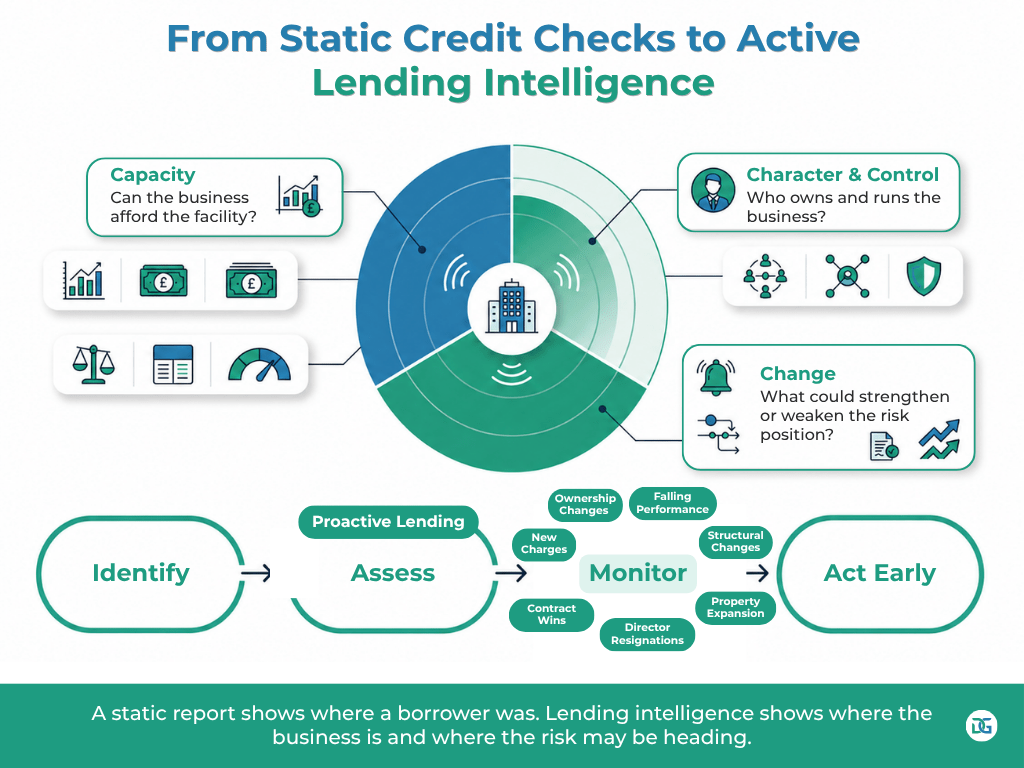
Lending intelligence brings together the commercial signals that explain a business in context. Financial performance matters, but so do directorship history, ownership structure, previous insolvencies, legal charges, sector exposure, trading indicators, property and land activity, procurement wins and changes within the business. The focus key phrase lending intelligence uk credit decisions should be integrated naturally where appropriate.
Used properly, this intelligence changes lending from a reactive review process into an active portfolio strategy. Instead of waiting for a borrower to request finance, a lender can identify companies that meet a defined profile: profitable firms in a growth sector, businesses with a recent contract award, companies expanding their property footprint, or organisations whose current borrowing may be nearing renewal. This approach embodies lending intelligence uk credit decisions by turning data into proactive lending actions.
That distinction has direct commercial value in lending intelligence uk credit decisions. Relationship managers can approach a relevant prospect with a timely proposition. A credit analyst can spend less time validating basic facts. A portfolio manager can investigate deteriorating accounts. Before a missed payment forces the issue, intervene promptly.
The strongest lending decisions combine three views of the borrower. First, there is capacity: can the business afford the proposed facility? Second, there is character and control: who owns and runs the company, and what is their track record? Third, there is change: what has happened recently that could improve or weaken the risk position?
A static report may answer the first question at a point in time. Lending intelligence is designed to answer all three, repeatedly.
Assess affordability with commercial context
Turnover, profit, balance-sheet strength and cash are core components of a credit assessment, but figures without context can lead to false confidence. A growing turnover line may conceal falling margins. Healthy cash may be tied to a seasonal cycle. A strong balance sheet may be offset by significant existing charges or a sector facing pressure.
Credit teams need to compare financial indicators with a company’s size, industry and recent trajectory. A lender considering an asset-finance agreement for a construction business, for example, will want to understand not only its latest accounts but also its existing debt, director history, trading footprint and whether the business is winning work that supports future repayments.
The right level of analysis depends on the facility. A modest, short-term working-capital facility may justify a streamlined assessment with clear policy thresholds. A larger secured facility, complex group structure or longer-term exposure warrants deeper due diligence. Lending intelligence supports both approaches by allowing teams to apply consistent filters and then investigate exceptions where they matter.
See risk before it becomes arrears
Risk rarely arrives as one dramatic event. It often develops through smaller changes: a director resignation, a newly registered charge, declining financial performance, an ownership shift or repeated alterations to a company’s structure. In isolation, none of these necessarily means a borrower will default. Together, they may justify a review.
This is where monitoring is as valuable as origination. Once a facility is live, teams should not rely solely on annual reviews or customer-provided updates. Automated alerts can flag relevant changes across a portfolio, directing analysts towards accounts that require attention while leaving stable borrowers on a proportionate monitoring path.
That improves both risk control and customer experience. Strong borrowers are not burdened with unnecessary information requests, while emerging concerns receive earlier, evidence-led engagement. The aim is not to treat every change as a warning sign. It is to know which changes deserve a closer look.
Build a lending intelligence workflow that people use
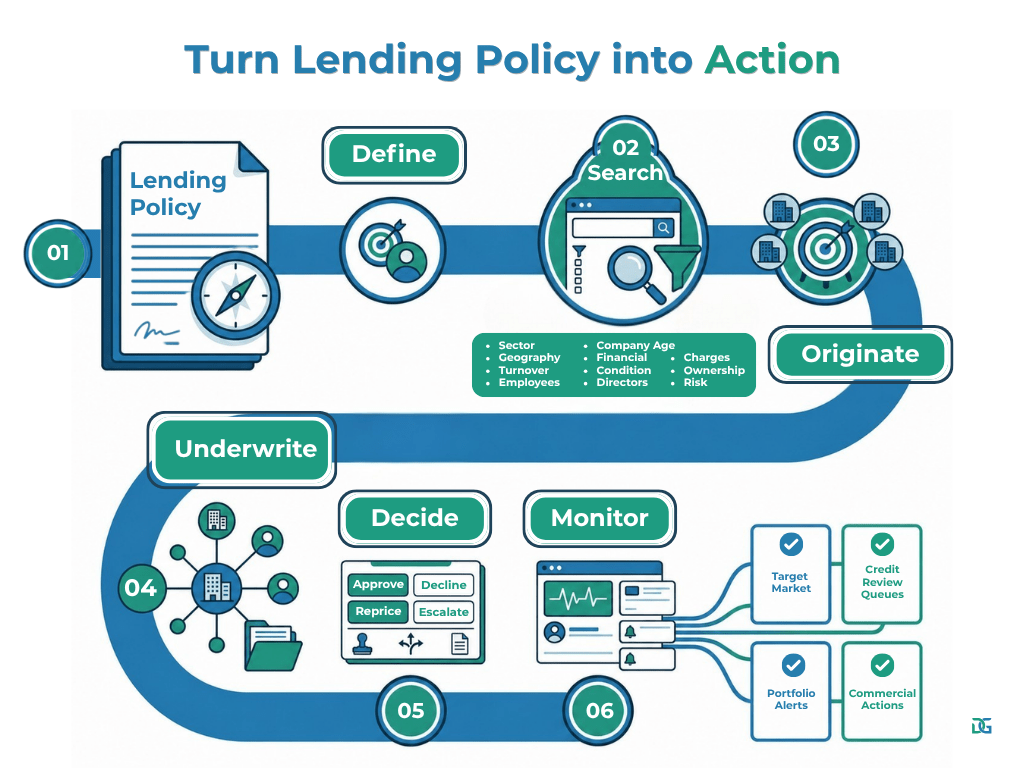
The technology matters, but a useful lending intelligence programme begins with clear commercial questions. What does an attractive borrower look like? Which risk events require intervention? What information must be captured before a case can move to credit approval? If teams cannot answer these questions, more data will only create more noise.
Start by translating lending policy into searchable criteria. This may include SIC sector, geography, turnover range, employee count, company age, financial condition, directorship activity, existing charges, ownership characteristics and risk indicators. The result is a repeatable borrower profile rather than a prospect list assembled from guesswork.
For business development teams, this means finding companies that match the product and lending appetite before competitors do. A broker may target established firms with the financial profile for asset finance. A commercial lender may identify organisations that have recently secured public-sector contracts and could need working capital to deliver them. A specialist lender may exclude sectors, legal forms or risk profiles that sit outside mandate.
For underwriting teams, the same data should feed a structured case review. Rather than opening multiple tabs, manually reconciling records and chasing basic company information, analysts can begin with a fuller picture of the borrower and its connected entities. That reduces duplicated work and creates a clearer audit trail for credit committees.
For portfolio teams, the workflow should include monitoring rules. Material director changes, new charges, adverse risk developments or financial events can be surfaced against the existing book. The rules should be tailored by exposure, sector and product type. A trigger appropriate for a £25,000 unsecured facility will not necessarily be appropriate for a multi-year property-backed loan.
DataGardener can support this approach by combining granular UK company search with financial, ownership, directorship, risk and lending indicators across 17 million companies. The practical advantage is not data for its own sake. It is the ability to turn lending criteria into target markets, review queues and operational actions.
Precision matters more than volume
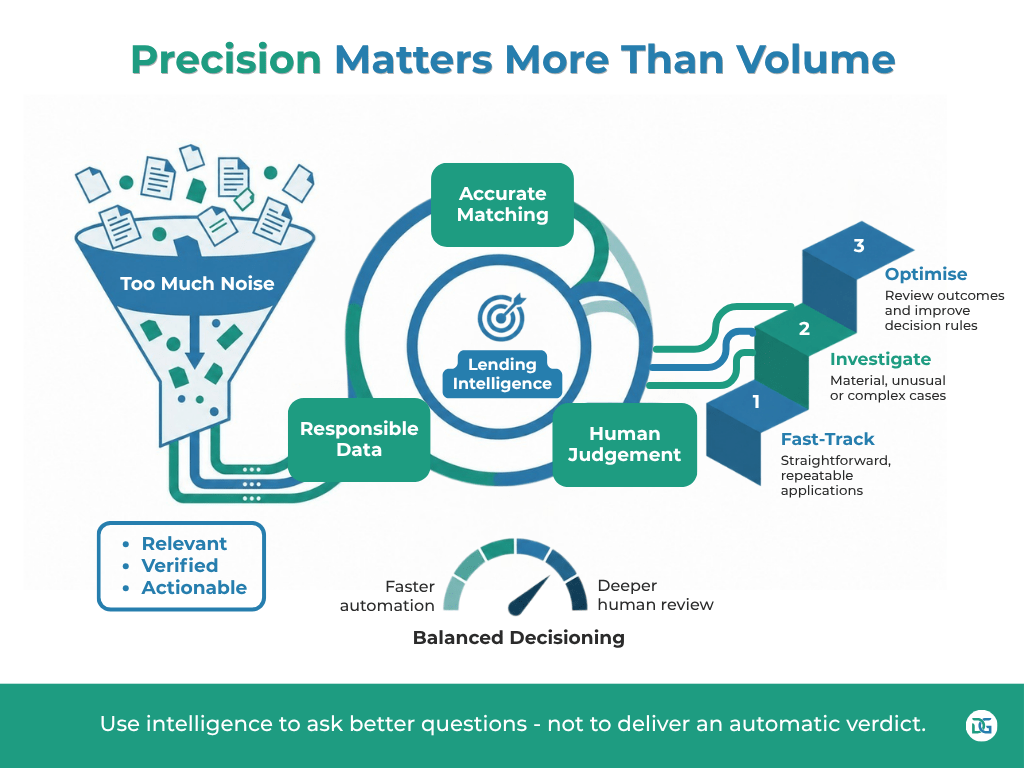
Many lenders still face a familiar problem: plenty of records, limited confidence. Generic company lists create low-quality outreach. Incomplete CRM data slows case handling. Overly broad risk alerts cause teams to ignore the signals that matter. Lending intelligence should improve precision at every point.
That requires connected data and sensible governance. Legal entity matching must be accurate, particularly where trading names, group structures or similarly named businesses are involved. Source provenance should be understood. Teams need a clear distinction between company intelligence used for legitimate B2B decision-making and personal data that requires different controls.
It also requires human judgement. A model can prioritise a case; it cannot fully explain a director’s decision to restructure a business, the implications of a one-off loss or the quality of a borrower relationship. Credit policy, underwriting expertise and documented exceptions remain essential. Intelligence strengthens judgement when it is used to ask better questions, not when it is treated as an automatic verdict.
There is a trade-off between speed and depth. Tight automation can reduce turnaround times for straightforward applications, but it can miss nuance in complex cases. Comprehensive manual review provides richer scrutiny, but it can make a lender too slow to compete. The better approach is tiered decisions: automate what is repeatable, escalate what is material and continuously review whether the rules are producing the right outcomes.
From borrower search to portfolio growth
The commercial case for lending intelligence extends beyond risk avoidance. Lenders that understand their market can direct sales effort towards firms most likely to qualify, need finance and value the proposition. That improves conversion rates while reducing the cost of pursuing unsuitable opportunities.
It can also reveal white space. A lender may see strong performance in one region but under-penetration among viable companies in adjacent sectors. An asset-finance provider may identify businesses with the scale and trading profile that suggest equipment investment. A broker may spot firms whose growth, procurement activity or property changes point to a likely funding requirement.
These opportunities are stronger when origination and credit teams work from the same intelligence base. Sales should understand the boundaries of lending appetite before making approaches. Credit should understand the commercial rationale and borrower context behind a proposal. Shared data helps replace hand-offs built on opinion with conversations built on evidence.
The most effective lending teams do not wait for uncertainty to become urgency. They define the borrowers they want, monitor the risks they hold and make each decision with enough context to stand behind it. That is how company intelligence becomes a practical advantage: fewer blind spots, better-quality conversations and a portfolio built with purpose.