

Quick answer: UK property ownership intelligence connects who owns a property, which companies sit behind that owner, and how financially healthy those companies are. Combining Land Registry-style asset ownership data with Companies House records, PSC data, group structures and financial risk signals gives property, legal and professional services teams a single, evidence-based view for due diligence, instead of piecing it together across five or six separate sources.
Why property due diligence still breaks down at the ownership layer
A title register tells you a property is owned by a company. It does not tell you who controls that company, what else the group owns, whether its accounts show stress, or whether a charge or county court judgment (CCJ) is sitting against it.
For solicitors, surveyors, valuers, lenders and advisers, that gap is where deals slow down. Analysts end up copying company numbers between portals, matching names by hand and hoping nothing was missed. The result is slow, inconsistent and hard to audit.
Modern financial data intelligence closes that gap by treating property, company and financial data as one connected picture rather than separate lookups.
What is financial data intelligence in a property context?
Financial data intelligence is the practice of combining financial, ownership and risk data from multiple trusted sources into one analysable view of a business or asset. In property due diligence, it means connecting:
- Asset ownership data: which properties a company or group holds, where they are, and how they were acquired
- Corporate records: company status, filing history, directors and registered charges
- Control and ownership: persons with significant control (PSC), shareholders and parent entities
- Financial risk signals: filed accounts, turnover and net asset trends, CCJs, credit risk indicators and stress markers
The value is not in any single dataset. It is in the links between them.
The four building blocks of a connected due diligence workflow
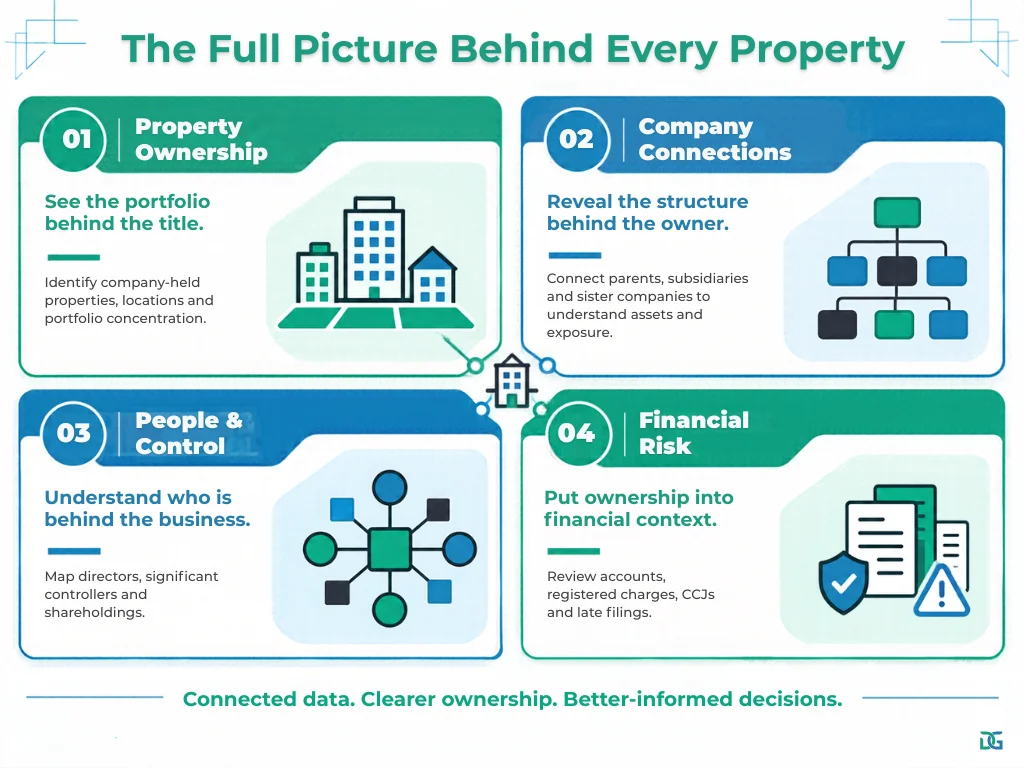
1. Property ownership analysis
Property ownership analysis starts with the asset. Which titles does the entity hold? Are they concentrated in one region or spread nationally? Are properties held directly or through subsidiaries?
Seeing a full portfolio, rather than the single title you were instructed on, changes the risk conversation. A borrower with one disclosed asset and nine undisclosed ones is a very different counterparty.
2. Company linkage analysis
Company linkage analysis connects a property-owning entity to the other companies around it: parents, subsidiaries, sister companies and entities sharing directors or controllers.
This matters because property is often held in special purpose vehicles (SPVs). The SPV’s own accounts may be thin. The real picture sits in the wider group. Linking an owner to its group structure shows where the assets, debt and risk actually sit.
3. Business relationship mapping
Business relationship mapping goes one step further than company linkage. It maps the people and organisations connected across entities: shared directors, common PSCs, cross-shareholdings and recurring investors.
For legal and compliance teams, this is a practical route to answering “who are we really dealing with?” It supports source-of-wealth checks, conflict checks and ultimate beneficial ownership (UBO) verification.
4. Financial risk signals
Once ownership and relationships are clear, financial signals show whether the counterparty can stand behind its assets. Useful signals include:
- Filed turnover, profit and net assets over several years
- Registered charges and lender relationships
- CCJs and other adverse indicators
- Company status changes and late filings
- Overall credit risk banding
Reading these signals alongside the property portfolio shows, for example, whether a heavily asset-backed group is also heavily leveraged.
Step by step: a connected due diligence workflow
Step 1: Start from the property or the company. Whichever you hold first, a title or a company number, becomes your anchor.
Step 2: Resolve the legal owner. Confirm the registered proprietor and match it to the correct company record.
Step 3: Expand to the group. Pull parent, subsidiary and related entities to see the full corporate structure.
Step 4: Identify the people. Review directors, PSCs and shareholders to understand who ultimately controls the assets.
Step 5: Check the financial picture. Review accounts, charges, CCJs and risk indicators across the group, not just the SPV.
Step 6: Record and report. Export the findings into a consistent, auditable format for your file or client.
Done manually, this can take hours per entity. Done in one connected workflow, it becomes a repeatable process.
Who benefits most from ownership intelligence?
Property professionals use asset ownership data to identify portfolio owners, vet counterparties and prioritise outreach to genuine decision makers.
Legal teams use corporate intelligence to verify ownership chains, support anti-money laundering (AML) and know your customer (KYC) checks, and evidence the steps taken in a transaction.
Professional services firms, including accountants, advisers and valuers, use linked data to assess client and counterparty risk and to spot undisclosed exposure earlier.
Lenders and investors use the combined view to size risk accurately before committing capital.
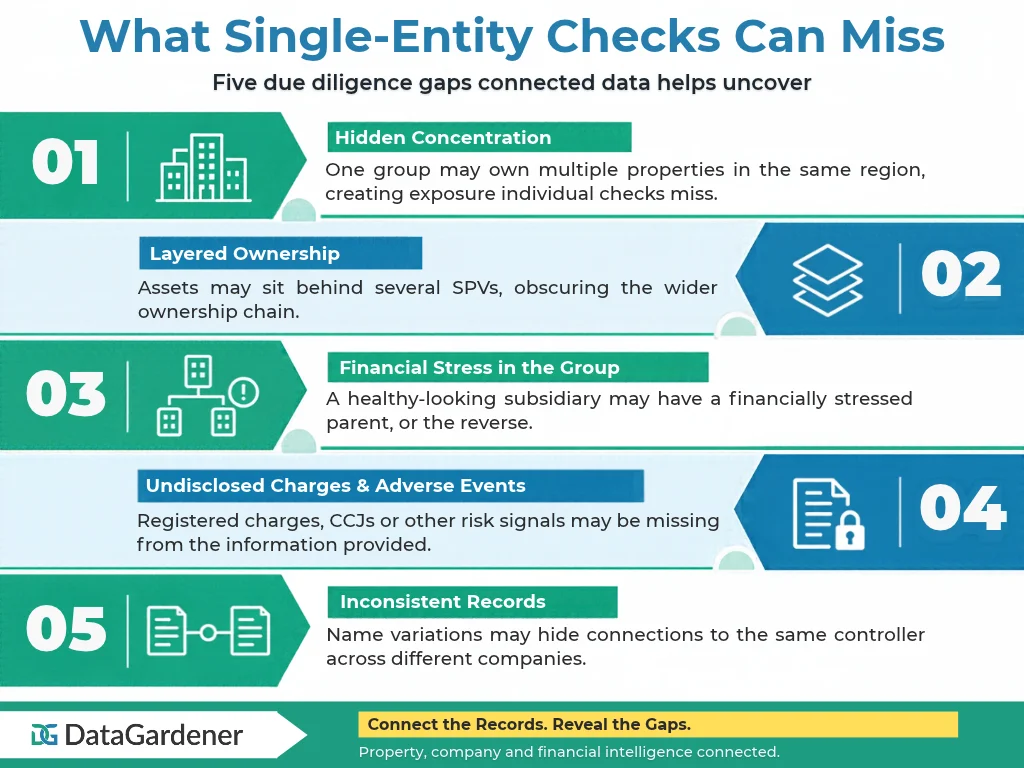
- Hidden concentration risk: one group quietly holding a large share of a regional market
- Layered ownership: assets sitting several SPVs deep, away from the entity you were told about
- Stressed parents behind healthy-looking subsidiaries: or the reverse
- Undisclosed charges and adverse events: that never appeared in the instruction pack
- Inconsistent records: where the same controller appears across entities under slightly different names
How DataGardener supports this workflow
DataGardener brings UK company records, ownership and control data, group structures, shareholdings, property and land ownership data, and financial risk signals together in one platform. That lets teams move from a property to its owner, from the owner to its group, and from the group to its financial health without switching tools or re-keying data.
Because the data sits in one place, the process is faster, easier to repeat and easier to evidence, which matters when your work may later be reviewed by a client, regulator or insurer.
Key takeaways
- Property due diligence is only as strong as the ownership picture behind it.
- Asset ownership data, company linkage analysis and financial risk signals work best together.
- Group structure and business relationship mapping reveal exposure that single-entity checks miss.
- A connected financial data intelligence workflow makes due diligence faster, more consistent and easier to audit.
See the full ownership picture
Ready to link property ownership, company records and financial risk in one due diligence workflow?
Book a DataGardener demo and see how connected corporate intelligence works on your own use case.