

February marks the start of real momentum in the new year, with businesses moving from planning into action, testing early strategies, and responding to the renewed pace of Q1 activity. It is the month when organisations begin executing budgets, launching new ventures, and making the first meaningful commercial moves of the year.
So what did this February reveal about the UK’s business landscape?
Let’s explore the trends, numbers, and insights shaping the opening stretch of 2026, powered by DataGardener’s February 2026 Business Insights Report.
Why is February an important month for UK businesses?
February consistently marks the first real test of the year for UK businesses. After January’s administrative and planning activity, February is when strategies are put into motion, hiring begins in earnest, and new company formations reflect genuine commercial intent.
As organisations move beyond the year-start reset and into active Q1 delivery, filings, incorporations, and financial activity all begin to signal how confidently the market is entering 2026.
59.9K+ Companies Registered | 13.4K+ Charges Registered | 8.4K+ CCJs Filed
These figures reflect a business environment that is active and purposeful. Entrepreneurs and investors are moving forward, albeit with measured decision-making in the face of ongoing macroeconomic considerations. It is the month where the tone for the rest of Q1 is set, whether that means launching a new business, securing funding, or consolidating an existing operation.
How many companies closed down in February 2026?
In February 2026, more than 63.2K companies were dissolved, showing a moderate increase compared to 59.5K in January 2026.

This increase likely reflects post-January reviews, early-year restructuring decisions, and the conclusion of winding-up processes initiated at the start of the year. Many organisations use this period to finalise structural changes before fully committing resources to their 2026 plans.
Think Data. Think DataGardener
DataGardener users double their leads and cut research time in half — with smarter data, faster insights, and better decisions.
How did new company formations compare to January?
In February 2026, over 59.9K companies were incorporated, a decrease compared to 69.7K in January 2026.
Despite this dip, incorporation rates remain substantial, suggesting that UK entrepreneurs and investors continue to demonstrate confidence as the economy progresses through Q1. January’s elevated figures reflect a typical post-New Year registration surge, making February’s numbers a more representative baseline for underlying market activity throughout the quarter.
Which regions saw the most new business activity?
The regional distribution of incorporations remains largely consistent with earlier months.
London continues to dominate with over 19.5K companies, reaffirming its position as the UK’s commercial powerhouse.
The South East follows with 6.2K and the North West with 6.1K, highlighting steady regional growth and investment interest across the country.
On the lower end, Wales (1.2K) and Northern Ireland (0.8K) reflect smaller but stable participation in new business formation.

Overall, the geographical pattern underscores London’s continued influence but also reveals resilient momentum across regional economies, particularly in the South East and North West.
Which industries were most active in February 2026?
Top 10 Highest Registered Industries in February 2026
The Wholesale and Retail Trade sector leads with 17.58% of total incorporations, reflecting robust consumer demand and strong entrepreneurial movement in trade and e-commerce.
Following closely are Real Estate (11.86%) and Professional, Scientific, and Technical Services (11.29%), driven by property investments, consulting, and professional service growth.
Meanwhile, Information and Communication (9.51%) and Construction (8.97%) continue to show resilience, underscoring confidence in technology, infrastructure, and innovation-led sectors.
Together, these trends highlight broad-based confidence across industries adapting to market and digital shifts.
What does the risk profile of new companies tell us?
Risk assessment for newly incorporated companies in February 2026 shows a predominantly stable business landscape.
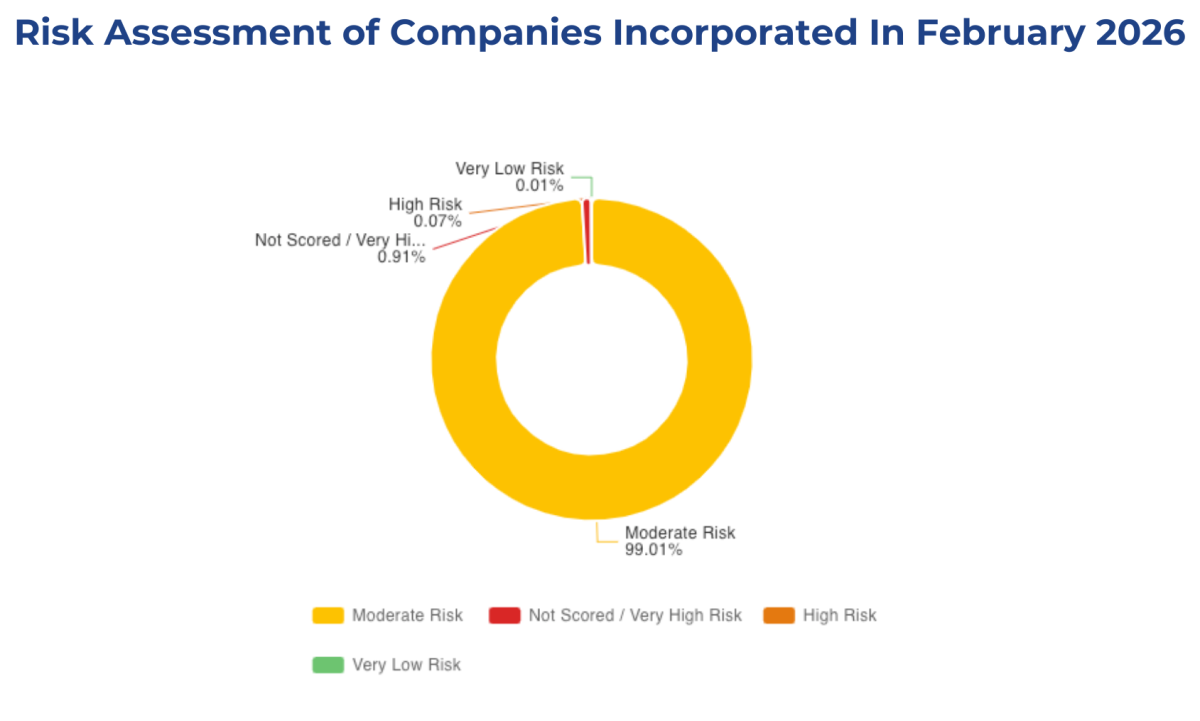
The vast majority of companies, 99.01%, fall under the Moderate Risk category, indicating cautious yet confident market participation. Only 0.07% were classified as High Risk, while a minimal 0.01% achieved a Very Low Risk rating, showcasing limited but solid financial strength among select firms. Meanwhile, 0.91% were Not Scored or considered Very High Risk, representing a small segment of entities with insufficient data or elevated uncertainty.
This distribution reveals that most new firms are balancing growth with prudence, adopting measured financial strategies and risk management practices as they position for the year ahead.
Were there changes in company charges registered?
In February 2026, more than 13.4K outstanding charges were registered, compared to 11.3K in January 2026.
This increase aligns with accelerated lending and investment activity as businesses begin executing their Q1 strategies and securing financing for planned growth and operational expansion. It is a clear signal that while incorporation activity has moderated, the appetite for financial commitment and business development is rising.
What about County Court Judgements (CCJs)?
CCJ filings showed a notable decrease, with over 8.4K filed in February 2026 compared to 12.5K in January 2026.
This reduction points to a post-January normalisation of credit disputes. January typically sees a spike in CCJ activity following year-end financial pressures. February’s lower figures suggest that many of those disputes have been resolved or deferred and that UK businesses are maintaining balanced credit control practices as they progress through Q1.
How are female founders performing?
In February 2026, more than 6.7K companies were registered as female-owned, a decrease from 11.6K in January 2026.
Despite the seasonal slowdown, the data reflects steady female entrepreneurial participation across industries.
Top 3 industries for female-owned businesses:
Top 3 regions for female-owned businesses:
While there has been a decline from January, female founders continue to represent a vital and resilient segment of the UK’s entrepreneurial base, particularly in retail, professional services, and real estate.
Conclusion: What does February 2026 tell us about the UK business landscape?
February 2026 paints a picture of deliberate momentum and strategic confidence. New company formations remain robust, charges are rising as businesses secure Q1 funding, and risk profiles across newly incorporated companies reflect a market that is stable and considered.
Entrepreneurs are still building, investors are committing capital, and the data signals that businesses entering 2026 are doing so with clear intent and measured financial discipline.
As the year progresses, one thing is clear:
Businesses that combine data-driven insight with strategic timing will be best positioned to seize the opportunities that 2026 presents.
All insights are sourced from DataGardener’s February 2026 UK Business Insights dataset.
For deeper analysis, API access or customised dashboards, visit DataGardener.
Want the Full Picture?
Download the complete UK Business Insights February 2026 report here.