

Supplier diversity data UK procurement teams rely on has fundamentally changed in 2026. It now sits at the operational core of how organisations manage risk, compliance, and long-term value creation not at the edges of procurement strategy.
The Procurement Act 2023, now fully in force, has accelerated this shift. Procurement teams are no longer simply encouraged to consider diversity. They are expected to evidence it with accurate supplier diversity data UK standards demand, measure it against defined targets, and defend it within broader commercial and regulatory frameworks.
This makes supplier diversity less about intent and more about execution. The question is no longer why it matters, but how the right data infrastructure makes it implementable in a way that stands up to scrutiny.
For procurement teams wanting to understand how supplier diversity data is captured and monitored in practice, DataGardener’s Responsible Procurement module provides the intelligence infrastructure designed specifically for this purpose.
What Is Supplier Diversity Data and Why Does It Matter for UK Procurement?
Supplier diversity refers to the proactive practice of engaging businesses owned by individuals from underrepresented groups, including ethnic minorities, women, veterans, people with disabilities, and members of the LGBTQ+ community.
Beyond the social case, supplier diversity creates commercial value. Diverse supplier networks reduce concentration risk, introduce new perspectives into procurement decisions, and support the supply chain resilience that procurement teams now treat as a strategic priority.
For UK procurement teams in 2026, the question is not whether to prioritise supplier diversity but whether the supplier diversity data UK teams hold is accurate, current, and usable at the moment procurement decisions are made.
What Has Changed for Supplier Diversity Data UK Procurement Teams Use in 2026?
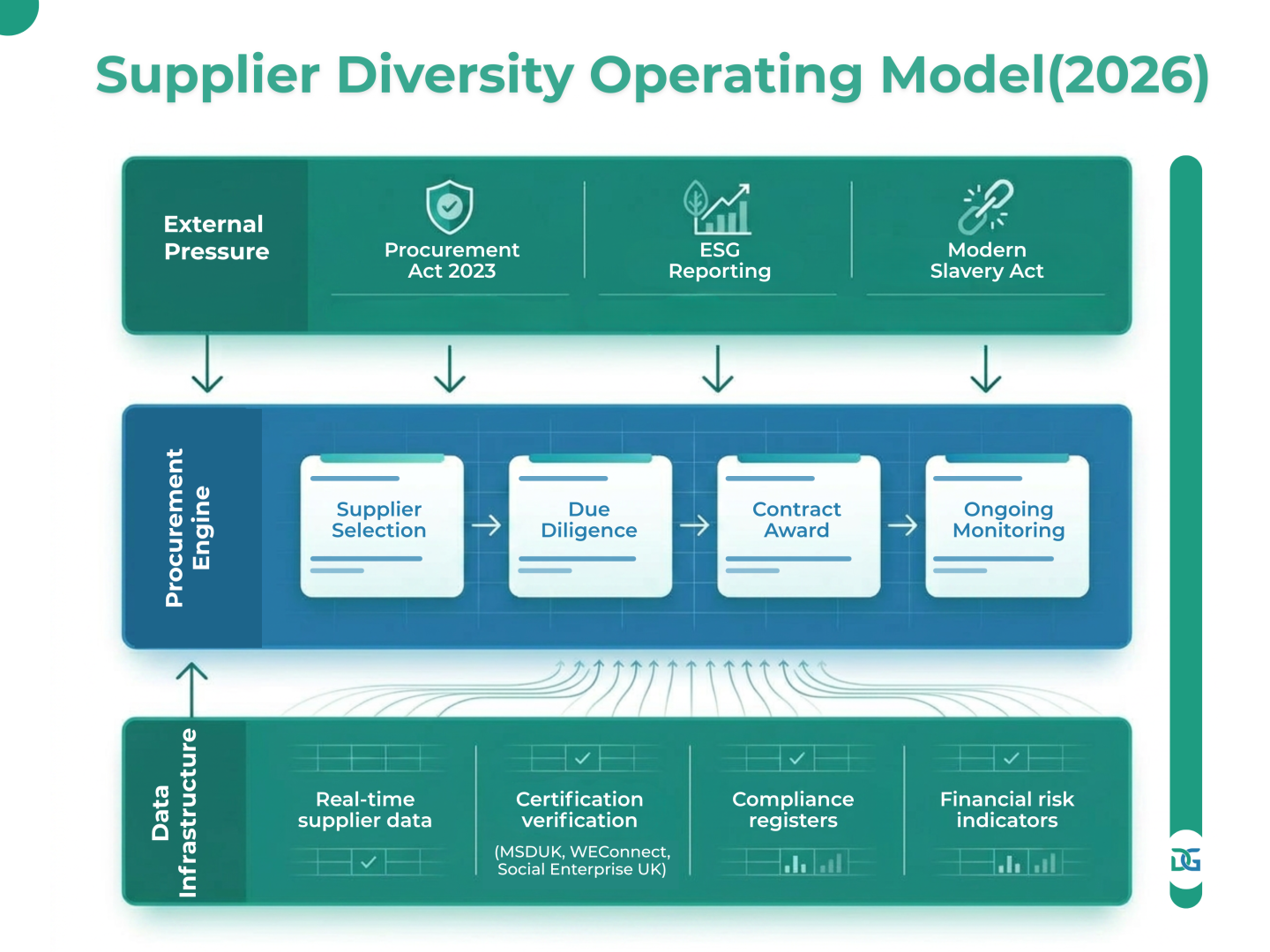
Three structural forces have reshaped how supplier diversity data is gathered, used, and reported across UK procurement.
Regulation. The Procurement Act 2023 has introduced a more transparent and accountable procurement environment across public sector spending, which exceeds £300 billion annually according to Cabinet Office figures. Supplier selection is now more visible, more auditable, and more closely tied to broader social value outcomes. The quality of supplier diversity data UK procurement teams hold directly determines whether decisions can withstand audit and challenge.
Reporting pressure. Supplier diversity is increasingly tied to ESG frameworks, where organisations must demonstrate social impact across their supply chains. Diverse supplier engagement sits alongside climate reporting, gender pay gap disclosure, and Modern Slavery Act obligations as a measurable component of that expectation.
Data availability. Procurement teams now have access to platforms that identify, verify, and monitor diverse suppliers in real time. What was previously a manual and time-consuming process can now be automated across thousands of suppliers simultaneously.
These shifts collectively change supplier diversity data UK teams manage from a discretionary record-keeping exercise into a structured operational function.
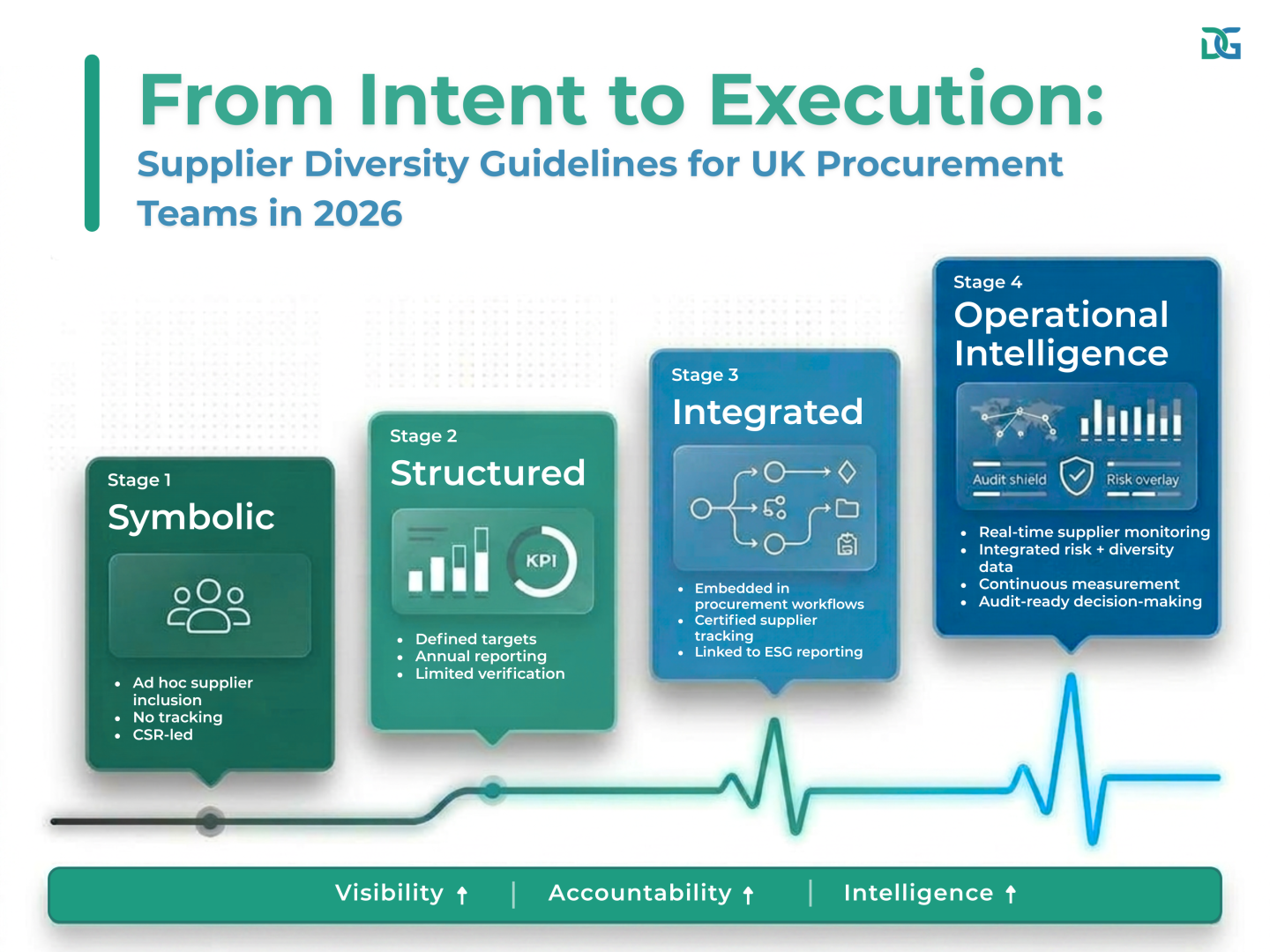
Supplier Diversity Guidelines for UK Procurement Teams in 2026
1. Set Measurable Diversity Targets Backed by Verified Data
Setting targets is no longer about signalling intent. In 2026, supplier diversity data UK procurement frameworks require targets to be defensible within both internal governance and external reporting obligations.
Rather than broad commitments, procurement teams are moving towards clearly defined spend allocations directed towards diverse suppliers, segmented by category where possible. This allows organisations to track progress across supplier types including women-owned businesses, ethnic minority-owned enterprises, social enterprises, and disability-owned firms.
Static annual reporting is giving way to continuous tracking, where supplier diversity data is updated in line with changes in ownership, certification, and financial status. A target met in January can be undermined by supplier changes in March if the underlying data is not maintained.
For public sector organisations, real-time supplier diversity data allows Procurement Act compliance to be demonstrated with verifiable, time-stamped evidence rather than retrospective estimates.
2. Build Active Supplier Pipelines Supported by Reliable Data
Many diverse suppliers remain excluded not because they are unknown to procurement teams, but because procurement processes are not designed to accommodate the operational realities of smaller businesses.
High-performing procurement teams are moving beyond directories towards actively maintained supplier pipelines backed by verified supplier diversity data UK certification bodies recognise. This involves identifying suppliers through MSDUK, WEConnect, and Social Enterprise UK, integrating them into live sourcing workflows, and maintaining relationships over time rather than engaging only at the point of a specific tender.
For many diverse suppliers, particularly smaller businesses, onboarding complexity remains a significant barrier. Simplifying this process is one of the most impactful levers available to procurement teams working with supplier diversity data.
3. Embed Supplier Diversity Data Within Procurement Systems, Not Around Them
Supplier diversity initiatives lose effectiveness when they operate as parallel processes to mainstream procurement. The focus has shifted clearly towards embedding supplier diversity data UK procurement systems can action directly within decision frameworks.
This includes integrating supplier diversity data into sourcing platforms, enabling procurement teams to filter and evaluate suppliers using diversity attributes alongside cost, performance, and risk indicators as part of a single workflow.
Platforms are capable of cross-referencing suppliers against certification databases in real time, monitoring compliance registers including the Prompt Payment Code and Science Based Targets initiative, tracking financial stability indicators, and flagging changes in supplier ownership or compliance status automatically.
Drawing on over 40 verified UK sources, DataGardener’s Responsible Procurement module enables procurement teams to identify, verify, and monitor diverse suppliers across WEConnect and MSDUK certifications simultaneously, cross-reference against six compliance registers, and receive live alerts when supplier status changes.
4. Measure Impact Beyond Spend Data
Spend allocation remains the most visible metric in supplier diversity data reporting, but it is no longer sufficient on its own. Procurement teams are increasingly expected to demonstrate broader outcomes including jobs created within diverse supplier businesses, regional economic development in areas of deprivation, and the knock-on effects of diverse supplier spend within local communities.
Public reporting requirements, driven by ESG disclosure frameworks and growing stakeholder expectations, mean that reported figures must be supported by verifiable, auditable supplier diversity data UK standards will stand up to scrutiny not estimates or directional statements.
5. Use Supplier Diversity Data to Strengthen Supply Chain Resilience
Over-reliance on a narrow supplier base creates concentration risk, particularly when those suppliers operate within the same geography, sector, or ownership structure. Diverse supplier networks distribute that risk more effectively, reducing exposure to disruption and introducing alternative sourcing options when primary supply chains come under pressure.
Procurement teams now evaluate supplier diversity data UK supply chains hold not only as a social and regulatory obligation but as a structural indicator of supply chain resilience.
For further guidance on managing supplier financial risk alongside diversity data, see DataGardener’s guide to responsible procurement and the Procurement Act 2023 supplier risk article.
How to Verify Supplier Diversity Data in Practice
Verification remains a persistent operational challenge. Not all claims of diversity ownership carry equal evidentiary weight, and UK procurement teams require reliable methods of validation that hold up to audit.
Recognised certification bodies provide the most robust form of assurance. MSDUK, WEConnect, and Social Enterprise UK each operate with independent verification processes that procurement teams can reference with confidence as a primary source of validated supplier diversity data UK teams can trust.
A practical challenge arises with suppliers claiming diverse ownership without formal certification, which is common among smaller businesses. In these cases, requesting evidence of ownership structure, directorship documentation, or Companies House registration data provides a reasonable baseline. For higher-value contracts, formal verification through a certification body is warranted.
Procurement teams are increasingly relying on DataGardener’s Responsible Procurement module to aggregate and validate supplier diversity data UK-wide in real time, checking supplier status across multiple certification schemes simultaneously without manual cross-referencing..
Conclusion
Supplier diversity data UK procurement teams depend on has entered a materially different phase. It is shaped by the Procurement Act 2023, reinforced by ESG and Modern Slavery Act reporting requirements, and increasingly tied to demonstrable commercial and social outcomes.
For procurement teams, supplier diversity data must now operate as a structured, measurable, and integrated component of procurement strategy. Organisations that systematically build this supplier diversity data UK capability will develop supply chains that are more resilient, more representative, and better positioned to generate long-term value.
The next step is to operationalise supplier diversity data using the right systems and framework for measuring what matters. DataGardener’s Responsible Procurement module provides the data infrastructure to take that step. Find out more at datagardener.com/responsible-procurement