
Not every business intelligence platform is built for the same purpose. For UK organisations evaluating them, that distinction matters considerably.
Both DataGardener and Zint operate in the UK business intelligence space. Both draw on UK company data. But the problems each platform was designed to solve are fundamentally different and the gap between those outcomes has direct consequences for sales teams, lenders, procurement managers, and compliance professionals.
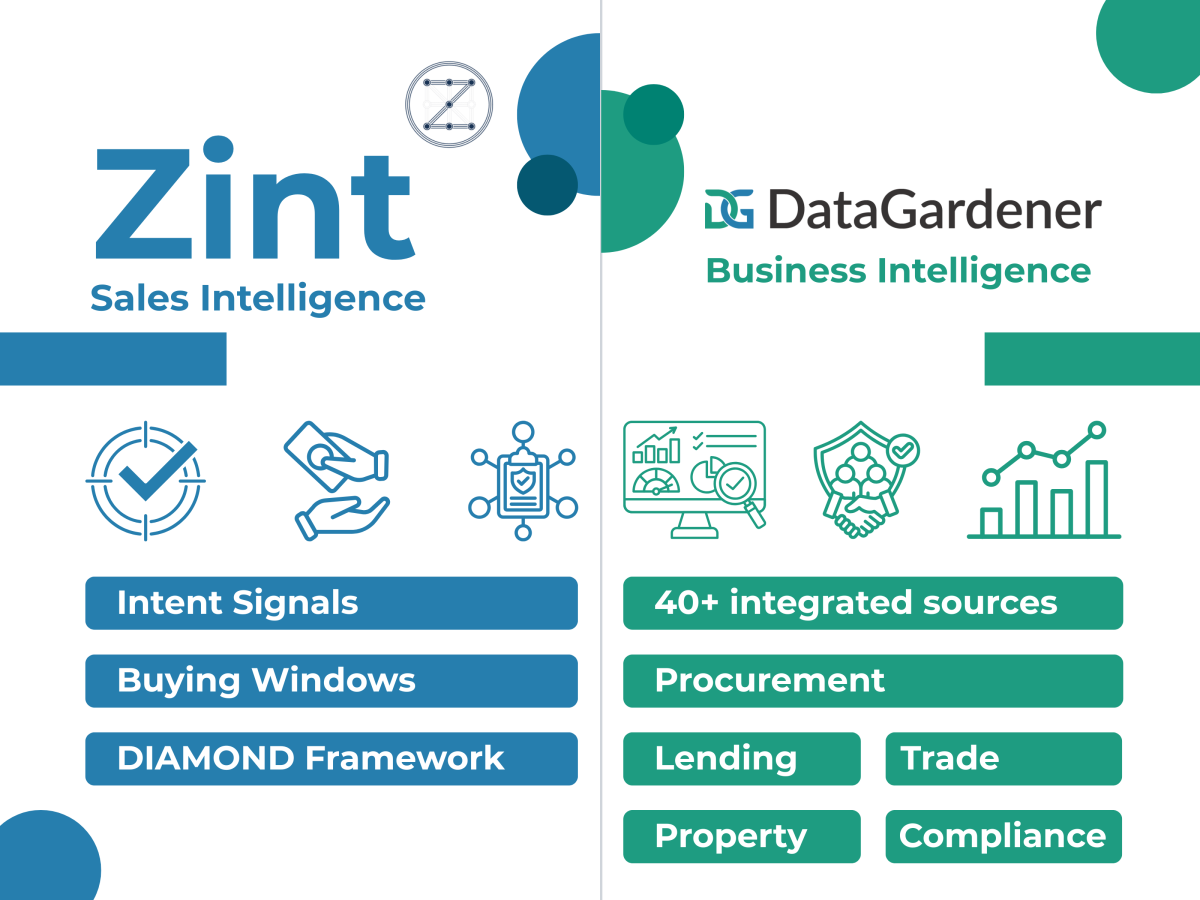
Zint is built to help revenue teams identify, prioritise, and win high-value accounts with greater precision. DataGardener is built to connect intelligence from over 40 verified sources across multiple business functions lending, procurement, sales, compliance, and investment into a single platform designed to support decisions before your competitors have even framed the question.
This is not a generalised overview. It is a practical breakdown of what each platform actually does, where each one falls short, and which one is the right fit depending on your team’s role and requirements.
Quick answer: DataGardener is the stronger choice for organisations that need intelligence across multiple functions lending, procurement, compliance, or investment. Zint is purpose-built for commercial teams focused exclusively on B2B sales prospecting and account prioritisation. If your organisation operates across more than one of these functions, the comparison is not close.
What Does Each Platform Actually Do in the DataGardener vs Zint Comparison?
The clearest starting point for any DataGardener vs Zint comparison is understanding the original design intent behind each platform.
Zint
Zint is a UK sales intelligence platform co-founded by Josh Bowyer and Fraser Atkins, headquartered in London. Its core purpose is helping commercial teams identify, prioritise, and convert high-value UK business accounts. The platform’s central intellectual property is the DIAMOND Framework, a proprietary account-scoring methodology that evaluates prospects across Deal Value, Intent, Alignment, Motivation, Opportunity, Network, and Decision Maker Access.
Beyond scoring, two capabilities define Zint’s proposition. Magic Insights (AIRA) compresses pre-call research into rapid company intelligence, surfacing financial signals, strategic language shifts, and buying context so that a sales representative walks into a conversation informed rather than guessing. Zint Grow, its real-time alert system, monitors trigger events and filing language changes so that outreach is timed to moments of genuine commercial change rather than based on static prospect lists.
Zint is used by clients across financial services, logistics, energy, and professional services. The platform integrates natively with Salesforce and HubSpot, and is most valuable for commercial teams with a focused, high-performance prospecting mandate.
DataGardener
DataGardener, based in Eastleigh, Hampshire, integrates over 40 distinct verified UK data sources into a single platform. These include Companies House, HMRC datasets, Land Registry records, the Trust Registry, Environment Agency data, ONS statistics, and international trade flows. The platform covers more than 17.2 million UK company records, refreshed regularly, with close to 100 advanced filtering variables.
The architectural difference between the two platforms is not simply a matter of data volume. When financial signals, ownership structures, legal stress indicators, and growth data are analysed together, the intelligence that emerges is qualitatively different from that of any single dataset in isolation. A lender assessing a CCJ wants to know whether it is part of a broader pattern of financial distress or an isolated historical event. That contextual judgement requires a multi-source architecture to support it.
DataGardener’s eight modules – Business Intelligence, Lending Intelligence, Responsible Procurement, Data Enrichment, Contract Finder, M&A Intelligence, Property and Land Intelligence, and International Trade Intelligence reflect an intent to serve the whole organisation rather than a single function within it.
How Do DataGardener vs Zint Serve the Four UK Audience Segments?
The most practical lens for any DataGardener vs Zint evaluation is how each platform performs for the teams using it daily. For the four segments most likely to assess this comparison, the differences are pronounced.
Financial Services and Lending
DataGardener’s Lending Intelligence module tracks registered charges, surfaces CCJ data at the company level, enables borrower risk profiling, and delivers portfolio monitoring with live alerts. Named clients include Allica Bank, Bibby Financial Services, Star Asset Finance, and Clear Asset Finance, each using the platform to identify lending opportunities before applications arrive and to monitor borrower portfolios for real-time risk changes.
For a financial services organisation where the timing of a credit decision or the early identification of borrower distress determines commercial outcomes, this distinction matters. Zint does not publicly document equivalent lending-specific capabilities, and no named clients are referenced in a lending or credit context.
Procurement
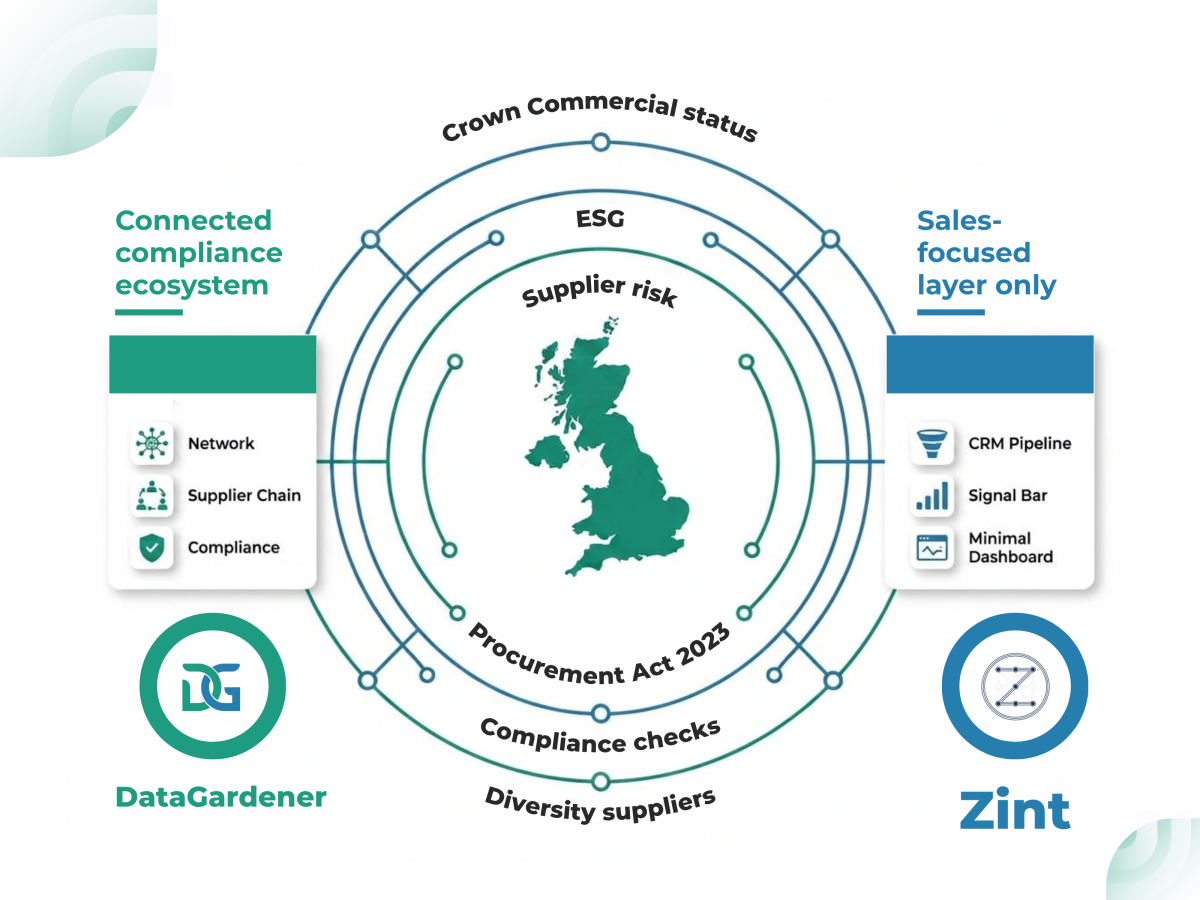
The Procurement Act 2023 came into force on 24 February 2025, governing approximately £300 billion in annual public sector spending and creating formal compliance requirements that extend well beyond financial risk assessment.
DataGardener’s Responsible Procurement module tracks supplier intelligence across B Corp.-certified, women-owned businesses, MSDUK-certified ethnic minority firms, veteran-owned enterprises, and disability-owned businesses. DataGardener holds Crown Commercial Supplier status and is listed on the BlueLight Commercial ICT Framework.
Zint does not offer a procurement-specific module and does not document coverage of the Procurement Act 2023 requirements. For organisations operating in or supplying to the public sector, this is a structural gap that determines platform eligibility rather than a feature preference.
Sales and Business Development
This is the segment where the DataGardener vs Zint comparison is most genuinely competitive. Both platforms serve sales teams with real capability.
DataGardener provides an ICP Builder, lead qualification scoring, verified contact data, and close to 100 advanced filters across more than 17.2 million UK company records. The Future Factor framework enables teams to prioritise outreach toward companies showing active expansion signals, preventing effort from being distributed uniformly across an undifferentiated prospect list.
Zint’s DIAMOND Framework approaches the same problem from a different angle. Rather than volume filtering, it scores accounts across seven commercial dimensions to identify which prospects deserve attention and when. Its filing language analysis, surfacing strategic signals and priority shifts from annual reports, is a differentiated capability that DataGardener does not appear to replicate with the same specificity. For a sales team running a high-value, complex B2B sales process, Zint’s methodology may offer a more structured prioritisation approach than a broader intelligence platform provides.
The honest answer for this segment is that the choice depends on what the sales team actually needs: broad prospecting infrastructure across the full UK company universe, or a tightly structured account prioritisation system optimised for precision over volume.
Risk and Compliance
DataGardener provides tier risk scoring, CCJ and charge monitoring, PEP and sanctions screening, and Ultimate Beneficial Ownership analysis. The platform holds ISO 27001, ISO 9001, and Cyber Essentials Plus certifications and is GDPR-compliant with end-to-end encryption throughout. Its B Corp certification and Crown Commercial Service accreditation provide additional documented assurance for regulated and public sector buyers.
Zint does not publicly document a dedicated compliance module, independent security certifications, or a risk scoring methodology. For regulated financial services organisations or public sector procurement teams where platform certification is a contractual requirement, buyers should request documentation directly from Zint before committing to a purchase.
Data Freshness and What It Actually Costs You
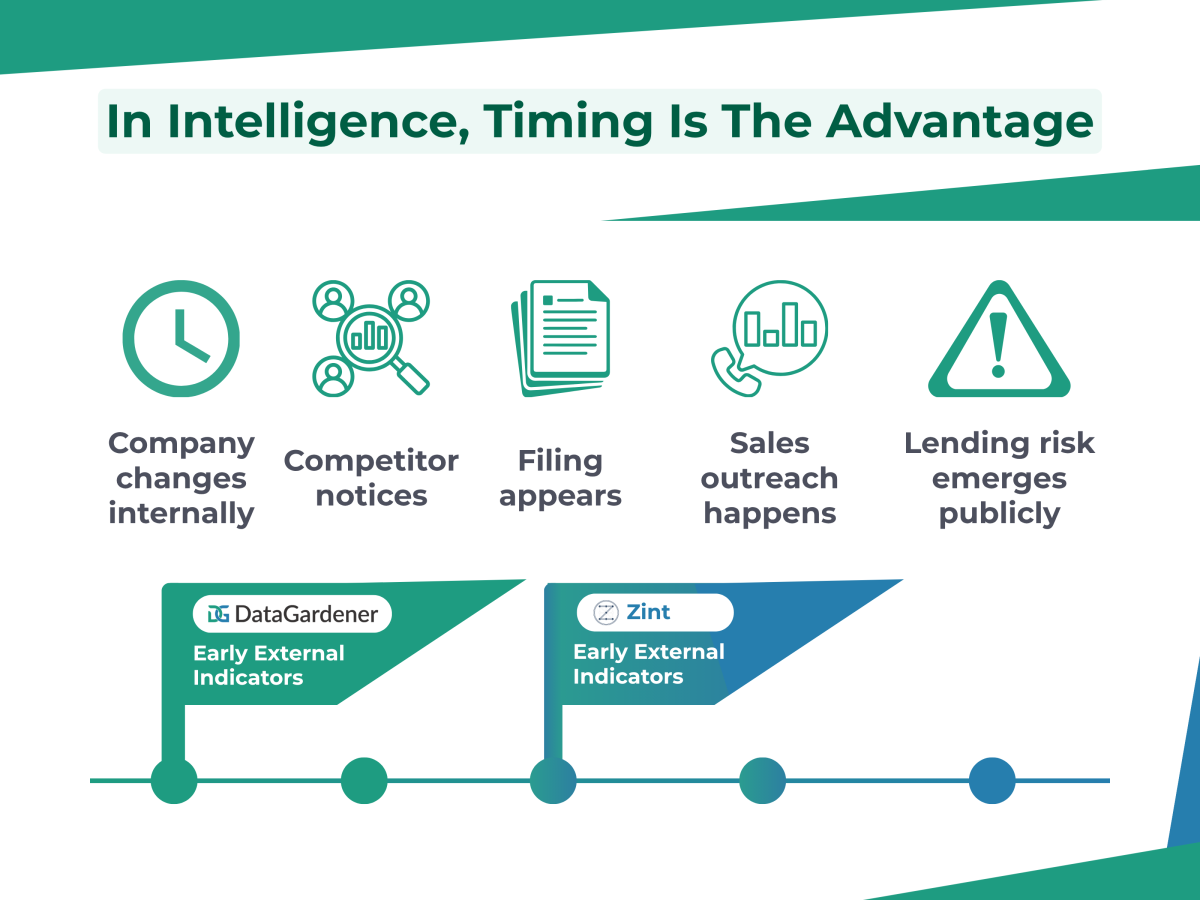
Any platform that draws primarily from Companies House filing cycles inherits a structural constraint. Financial accounts can reflect performance from some months prior to appearing on any platform. Director changes appear only once formally recorded, introducing a delay between real-world events and data visibility.
For verification tasks where confirming established facts is the objective, this cadence is workable. For organisations where the timing of a decision determines its commercial value, that lag introduces meaningful risk.
DataGardener addresses this through a regular refresh cycle combined with multi-source ingestion from over 40 external datasets. New charge registrations, property transactions, and director appointments are captured from external signals as they occur, rather than being tied exclusively to annual filing cycles.
Zint’s Zint Grow system monitors trigger events and filing-language shifts on an ongoing basis, providing meaningful recency for the sales use case. Its data architecture focuses on company filings and economic data rather than the breadth of external datasets DataGardener draws from. For a B2B sales team, contacting a prospect at the point of expansion rather than months after it can determine whether a deal will be originated at all. For a lender or compliance team, near-real-time charge and director data is not a convenience feature; it is an operational requirement.
Where Does Predictive Intelligence Separate DataGardener vs Zint?
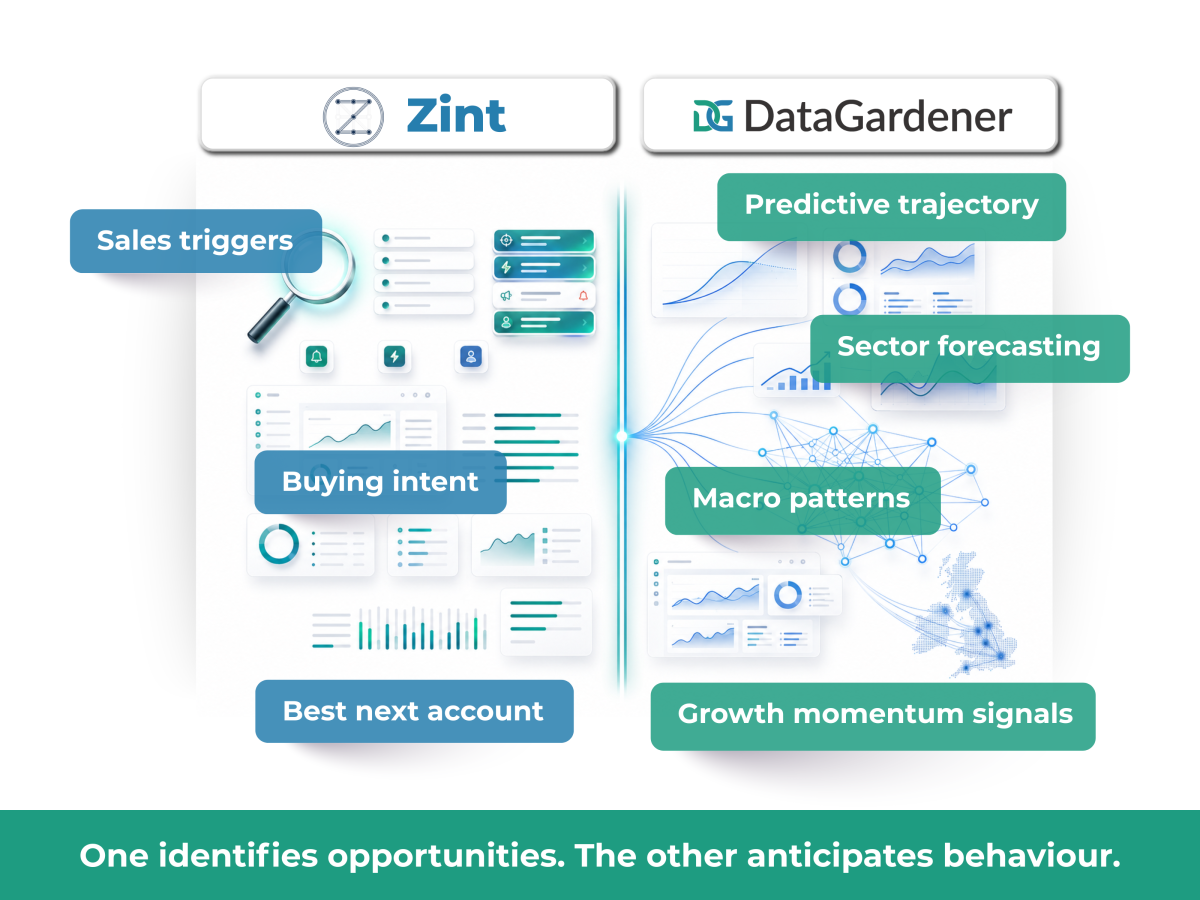
One of the most significant dimensions in the DataGardener vs Zint comparison is forward-looking capability. It is here that the two platforms occupy genuinely different market positions.
Zint’s approach to prediction is signal-driven. Its DIAMOND Framework and Zint Grow alerts identify intent, buying windows, and strategic shifts from company filing language. This is a legitimate and commercially effective approach for revenue teams, it identifies that a company is in a period of change and likely to be receptive, based on what its filing language and structural signals suggest.
DataGardener introduces a broader predictive dimension through its proprietary Future Factor framework. By analysing patterns across its multi-source ecosystem financial trends, structural indicators, behavioural markers, and directional momentum, Future Factor classifies UK companies by predicted trajectory rather than simply by what they have filed. For a lender, this means identifying a company’s borrowing appetite before the company applies. For an investor, it means surfacing growth signals before they are widely visible. For a sales team, it means prioritising companies on an upward trajectory before that expansion becomes apparent to the market.
The IS-8 Sector Framework adds contextual depth by mapping companies across eight strategic sectors, including FinTech, HealthTech, CleanTech, and GovTech, enabling sector-level trend analysis alongside individual company assessment.
One platform is designed to identify the right sales window. The other is built for anticipating commercial behaviour before it becomes observable. The right choice depends on the time horizon and scope of the decisions your organisation needs to make.
Integration: Where Day-to-Day Platform Value Is Won or Lost
Integration is a dimension of the DataGardener vs Zint comparison that often determines day-to-day platform value more than any feature specification. Intelligence is only as useful as its ability to reach the teams and systems that need it.
Zint’s CRM integrations are built around its DIAMOND scoring workflow. Scores, buying windows, and next-best-action signals can be embedded directly into Salesforce and HubSpot using a credit-based consumption model. Zint’s architecture is designed to sit upstream of CRM and sequencing tools, the decision layer before the pipeline is built.
DataGardener’s native integrations with Salesforce, HubSpot, and Zoho CRM allow intelligence to flow directly into ongoing commercial processes across multiple business functions. The full API enables organisations to embed intelligence into proprietary platforms, enrichment pipelines, and automated workflows. For organisations where company data informs daily decisions across more than one team, this breadth of integration is a core part of the platform’s operational value.
What Does the DataGardener vs Zint Comparison Reveal About UK Business Intelligence?
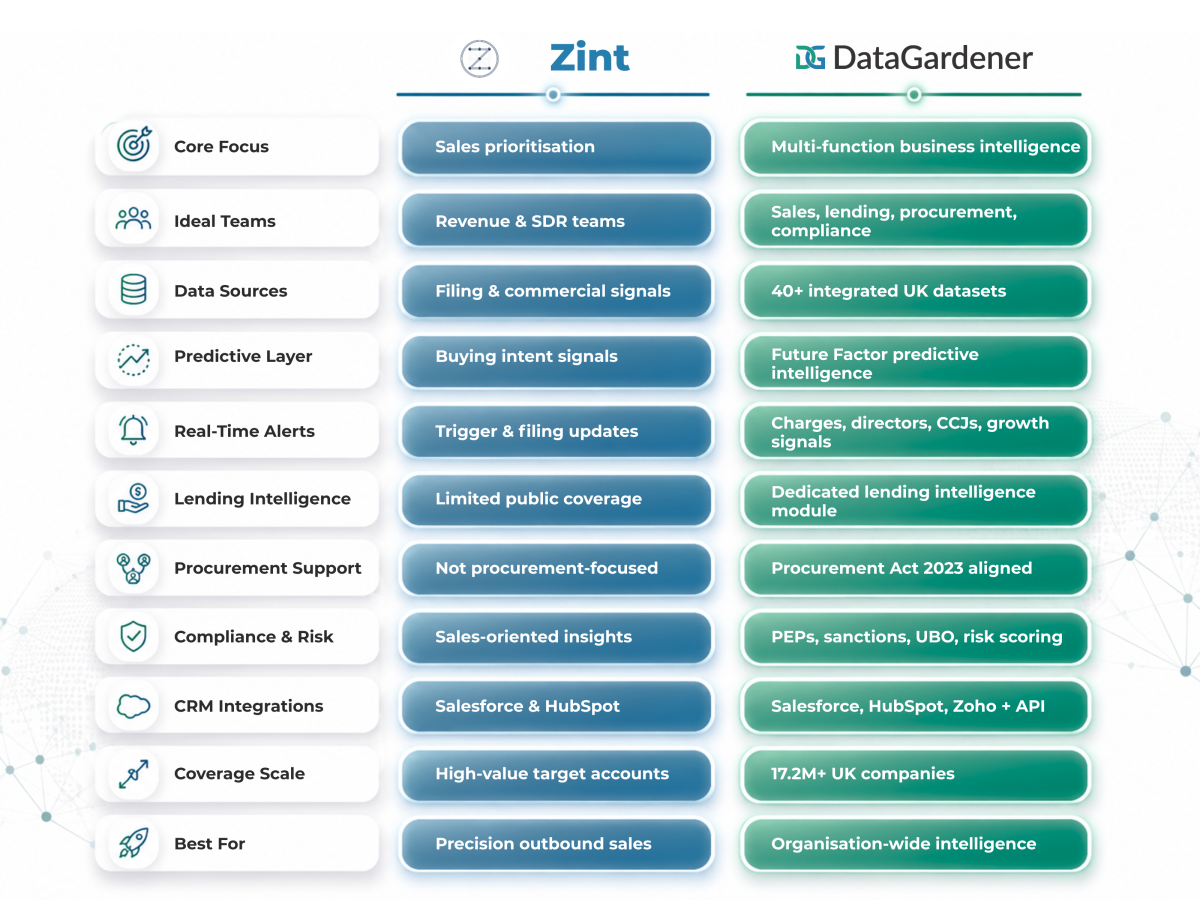
Zint’s focus on account prioritisation and filing language analysis addresses a genuine market need for revenue teams. Its DIAMOND Framework gives sales leaders a structured, repeatable methodology for directing effort toward the highest-probability accounts. For a dedicated commercial team with a single, focused prospecting mandate, Zint is a credible and well-designed tool.
DataGardener’s architecture is built to address a broader range of problems: connecting intelligence across over 40 verified sources, adding predictive classification through Future Factor, and embedding that intelligence into the systems that sales, lending, procurement, and compliance teams use every day.
The Procurement Act 2023 has increased compliance requirements across public-sector supply chains. Competitive windows in lending and B2B sales are narrowing. In this environment, the question is not which platform holds more data. It is the platform that turns data into decisions your organisation can act on, across the full range of decisions it actually needs to make.
For organisations with a single sales-focused use case, Zint’s methodology warrants serious evaluation. For organisations that need intelligence embedded across multiple functions, or where compliance, lending, procurement, or public-sector requirements are part of the picture, the DataGardener vs Zint comparison becomes considerably less close.
Explore how DataGardener serves your specific team book a guided platform walkthrough tailored to your use case.
Other Articles: