
DataGardener vs The Data City: The Quick Answer
Choose DataGardener if you need to find, vet and contact UK companies, with financials, credit risk scores, directors and verified contact data. Choose The Data City if you need to map and analyse whole sectors, especially emerging industries that standard SIC codes miss.
Both platforms cover UK company data, but they solve different problems. DataGardener is a company-level business intelligence platform for sales, lending, procurement and M&A teams. The Data City is a sector-intelligence platform, built around its Real-Time Industrial Classifications (RTICs), used mainly by government, universities and economic analysts.
This guide compares the two on data coverage, features, pricing, integrations and ideal users, so you can decide which fits your team.
What Is DataGardener?
DataGardener is a UK business intelligence platform that lets you search 17M+ UK companies, directors, financials and risk scores. Its data is sourced from Companies House records under the Open Government Licence and enriched with credit, ownership and contact information. It is GDPR compliant and used by organisations including the NHS, GDS and TfL.
The platform is organised into role-based products: Business Intelligence for sales, growth and investment teams; Lending Intelligence for lenders and brokers; and Procurement Intelligence for procurement, ESG and finance teams. Further modules cover data enrichment, international trade, property and land, M&A intelligence and an API.
What Is The Data City?
The Data City is a UK company intelligence provider whose Industry Engine platform tracks roughly 9 million UK companies and 100+ million companies globally, with 90+ data points per company. Its headline innovation is Real-Time Industrial Classifications (RTICs): 500+ AI- and expert-built sector definitions covering areas such as AI, life sciences, FinTech and clean technology, designed to replace the static SIC code system.
Its customers are mainly local and national government, universities, economic consultancies, think tanks, investors and trade associations. It also offers add-ons such as Lightcast jobs and skills data, Real-Time SIC Codes and cluster analysis, plus bespoke research through its Data Services team.
DataGardener vs The Data City: Side-by-Side Comparison
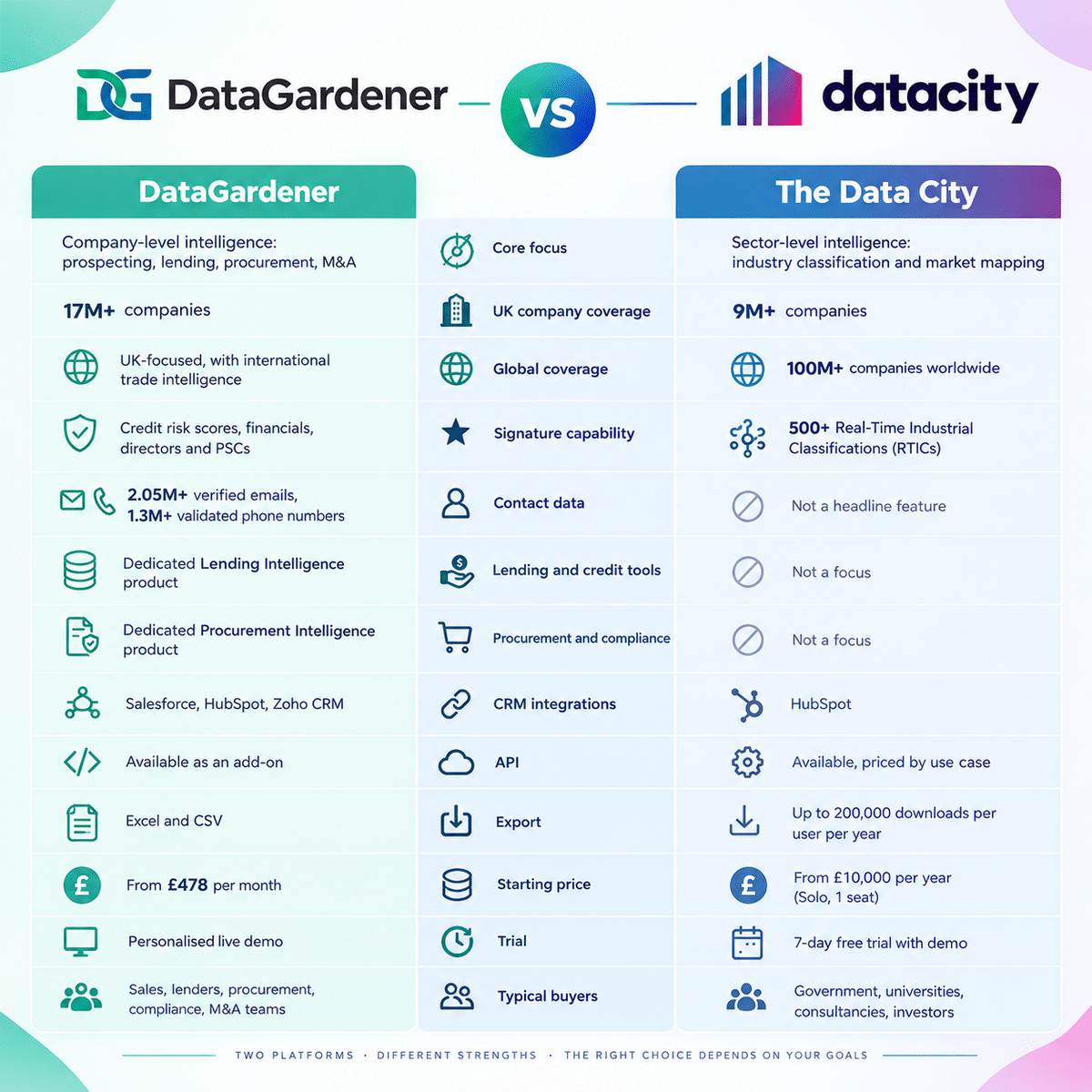
Figures are taken from each provider’s public website as at 30 September 2026. Confirm current details with each vendor before buying.
Data Coverage and Depth
DataGardener covers more than 17 million UK companies, with financials, director histories, ownership (PSC) data, charges, property intelligence and credit risk scores. The depth sits at the level of the individual company: who runs it, how it is performing, and how likely it is to default.
The Data City tracks around 9 million UK companies but adds global reach (100M+ companies) and a classification layer on top. Its strength is grouping firms into meaningful sectors using web-derived and AI-assisted signals, rather than relying on the SIC code a company chose at incorporation.
Sector Classification vs Company-Level Intelligence
This is the real difference between the two. SIC codes are widely criticised for lagging behind fast-moving industries, and The Data City’s RTICs are designed to fix that. If your question is “how big is the UK cyber security cluster in the North West?”, RTICs are built for it.
If your question is “which cyber security firms in the North West have turnover above £2m, low credit risk and a reachable finance director?”, you need company-level financials, risk scores and verified contacts. That is where DataGardener is strongest.
Risk, Lending and Compliance
DataGardener includes credit risk scoring, CCJ and charge data, director and PSC monitoring, and a dedicated Lending Intelligence product. That makes it a natural fit for lenders, brokers, insurers and compliance teams doing due diligence. The Data City is not positioned as a credit or underwriting tool.
Sales Prospecting and Contact Data
DataGardener lists 2.05M+ verified email addresses and 1.3M+ validated phone numbers (GDPR-compliant), and integrates with Salesforce, HubSpot and Zoho CRM. Teams can move from a filtered list to outreach quickly. The Data City supports list building through machine learning and HubSpot integration, but its main proposition is analysis rather than outreach.
Pricing and Value
DataGardener starts from £478 per month, with monthly and annual plans, and most customers go live within 24 to 48 hours of signing. Pricing is tailored for larger teams.
The Data City sells annual licences: Solo at £10,000 a year (1 seat), Team at £22,000 (5 seats) and Department at £35,000 (15 seats), with add-ons from £2,500 and a 10% discount for multi-year licences and charities. It offers a 7-day free trial.
In practice, DataGardener has the lower entry cost and suits commercial teams that want quick deployment. The Data City’s higher price reflects its analytical and public-sector focus.
Which Should You Choose?
Choose DataGardener if you are:
- A sales or marketing team building targeted UK prospect lists with verified contacts.
- A lender, broker or insurer assessing borrower risk and monitoring directors and charges.
- A procurement or compliance team vetting suppliers.
- An M&A or investment team screening acquisition targets.
Choose The Data City if you are:
- A local authority, university or government body mapping regional economies and industrial clusters.
- An economic consultancy or think tank that needs sector definitions beyond SIC codes.
- An investor tracking emerging industries such as AI, FinTech or clean technology.
Some organisations use both: a sector-intelligence tool to decide where to look, and a company-level platform to find, qualify and contact the right businesses.
Conclusion
DataGardener and The Data City are complementary rather than identical. If your priority is finding, vetting and contacting UK companies, with credit risk, directors and lending or procurement workflows, DataGardener is the stronger and more affordable starting point. If your priority is sector-level analysis and emerging-industry mapping for policy or research, The Data City’s RTICs are purpose-built for that job.