
Contents
- Who Is Each Platform Best For?
- What Sets DataGardener vs Cognism Apart in the UK Market?
- How Do Data Sources Differ Between DataGardener vs Cognism?
- Which Platform Offers Stronger Company Intelligence?
- How Does DataGardener vs Cognism Compare on Prospecting?
- How Does DataGardener vs Cognism Serve Different Industries?
- What Integrations Does Each Platform Support?
- What Does Compliance Look Like Across Both Platforms?
- How Do Intent Signals Work on Each Platform?
- Frequently Asked Questions
If you are evaluating DataGardener vs Cognism for your UK business intelligence needs, you are asking the right question at the right time. Both platforms are well established within the UK B2B data market, yet they are built around fundamentally different priorities. This comparison covers data sources, company intelligence, prospecting capability, integrations, compliance, and industry fit so you can make the right decision for your organisation.
Quick answer: DataGardener is built for organisations that need verified company intelligence, financial analysis, and due diligence capability. Cognism is built for outbound sales teams that prioritise high-volume contact prospecting across multiple geographies. The right choice depends entirely on what your organisation needs to do with data.
Who Is Each Platform Best For?
Before comparing features, the most useful starting point is intent. These two platforms are designed for meaningfully different jobs.
DataGardener is best suited to financial professionals, procurement teams, consultancies, recruiters, and lenders who need verified company intelligence before making decisions. If your work involves evaluating businesses rather than simply reaching them, DataGardener is built for that purpose.
Cognism is best suited to outbound sales teams and SDRs focused on high-volume prospecting across the UK, Europe, and the United States. If your priority is reaching decision-makers at speed with GDPR-compliant contact data, Cognism is designed around that workflow.
If you already use an outbound prospecting tool but lack a platform for deeper company evaluation, DataGardener operates as a powerful complementary layer. Many organisations use both in parallel, with Cognism handling outreach volume and DataGardener handling pre-engagement company evaluation and ongoing portfolio monitoring.
What Sets DataGardener vs Cognism Apart in the UK Market?
Both platforms operate within the UK B2B data ecosystem, though with notably different design philosophies. Cognism focuses primarily on enabling outbound sales teams to reach decision-makers at speed. DataGardener is built around structured company intelligence and analytical depth.
Cognism prioritises contact accuracy and outreach velocity. DataGardener prioritises verifiable intelligence that supports evaluation, risk assessment, and strategic targeting. Understanding this divergence is the starting point for any meaningful comparison. Everything that follows, from data architecture to individual features, flows from this difference in design intent.
How Do Data Sources Differ Between DataGardener vs Cognism?
Data integrity begins with the quality and traceability of its sources. DataGardener draws from over 40 verified UK data sources, anchored by Companies House, the UK’s official registrar of companies. Its database covers 17.2 million registered UK businesses and includes financial filings, director appointments, ownership structures, and company status records. Every data point is traceable back to an official regulatory filing.
Cognism uses a multi-layered acquisition model, combining proprietary datasets, third-party providers, and automated enrichment processes. Its database spans millions of global contacts with strong coverage across the United Kingdom, Europe, and the United States. Its Diamond Data feature focuses on manually verified mobile numbers to improve outbound connection rates.
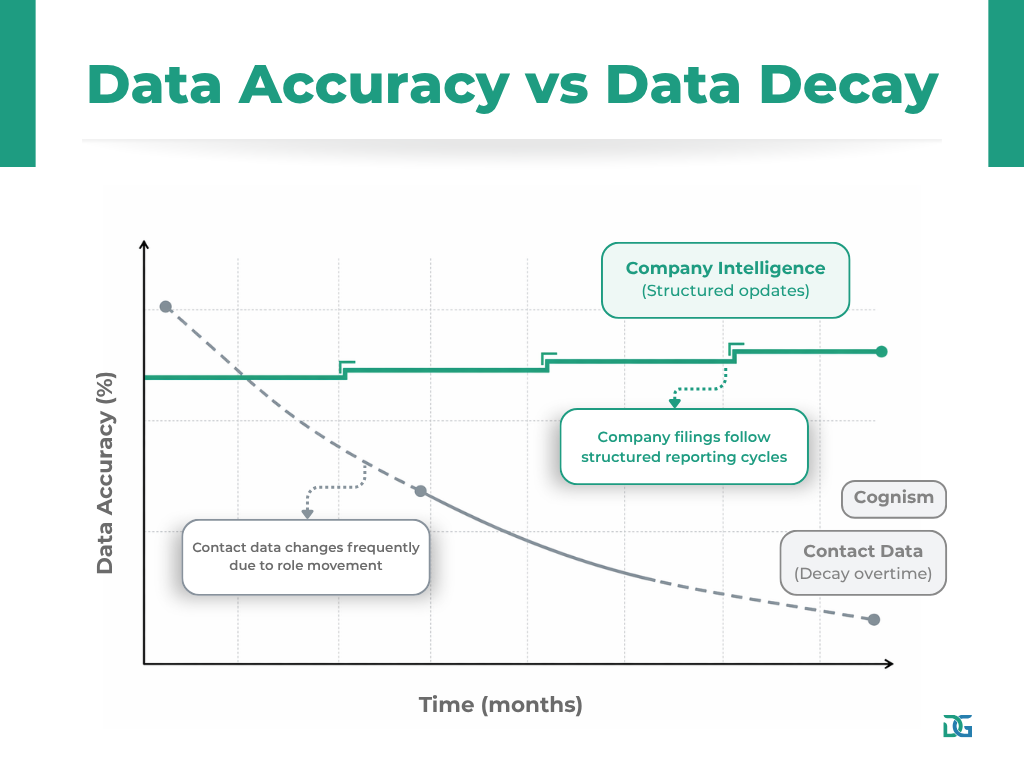
The practical distinction here is significant. DataGardener’s sourcing model enables every data point to be traced to an official filing. Cognism’s model delivers breadth and speed, though professional contact data is inherently dynamic. Role transitions and organisational changes mean contact records require continuous re-verification to remain accurate. Industry research suggests close to 30 per cent of B2B contact data changes annually.
For organisations where data provenance is a compliance or governance requirement, this distinction is material, not marginal.
Which Platform Offers Stronger Company Intelligence?
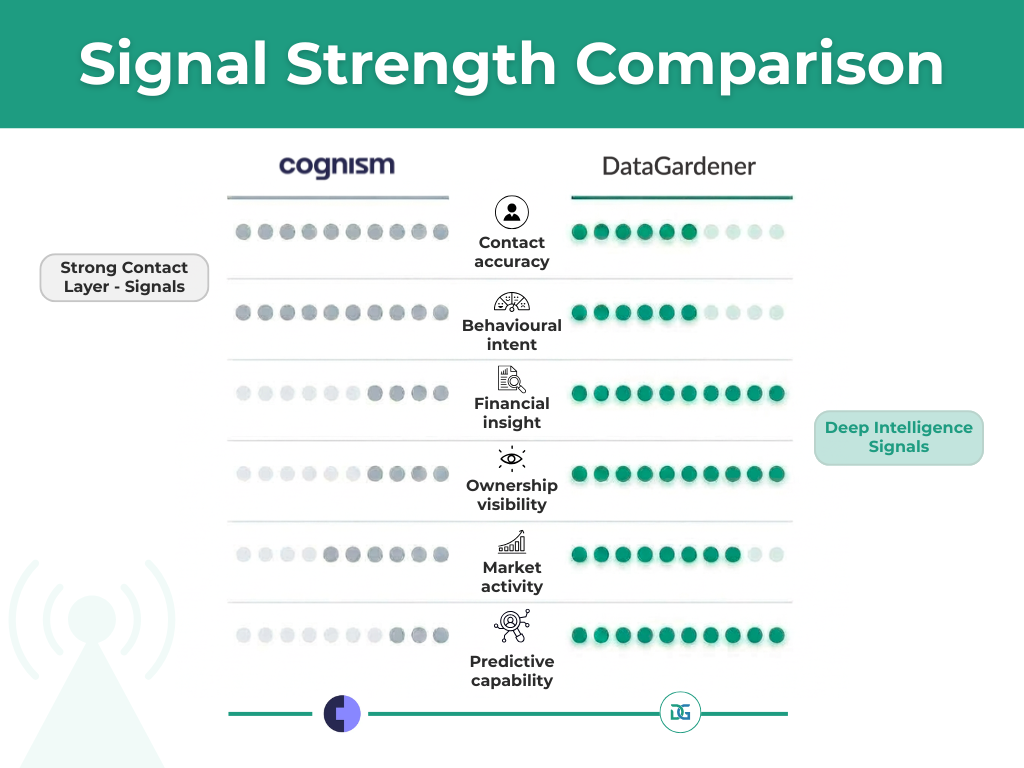
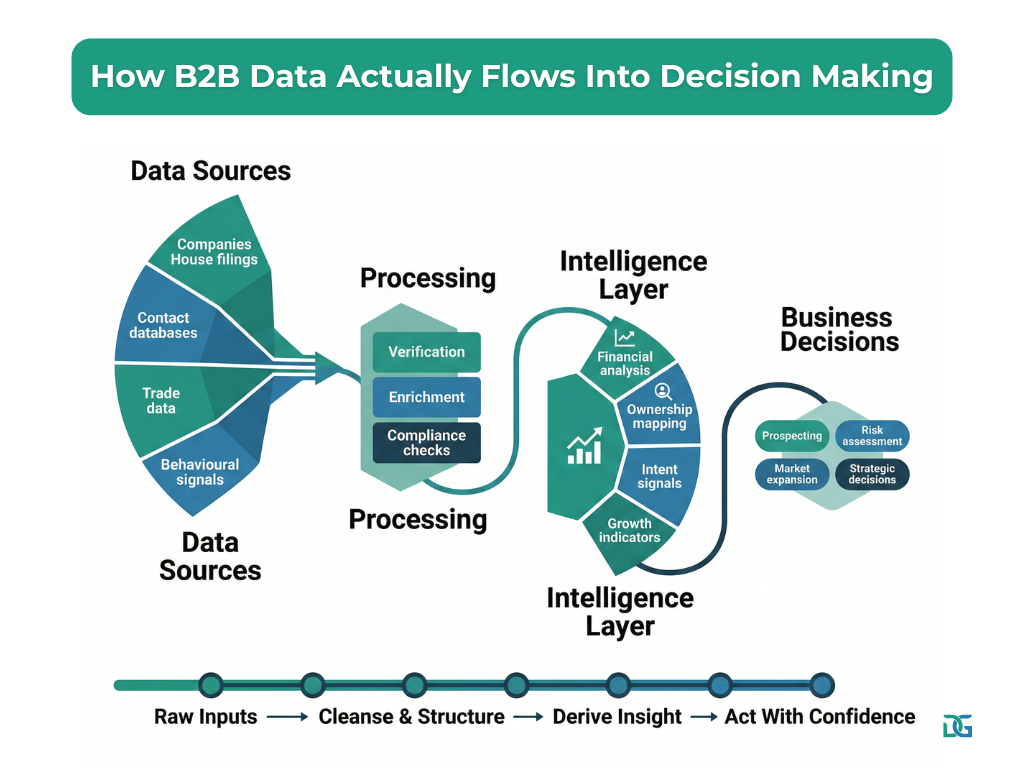
Company intelligence is where the DataGardener vs Cognism comparison diverges most clearly. Cognism provides strong firmographic filtering, allowing users to segment by job role, industry, company size, and geography. This supports efficient identification of decision-makers across multiple regions.
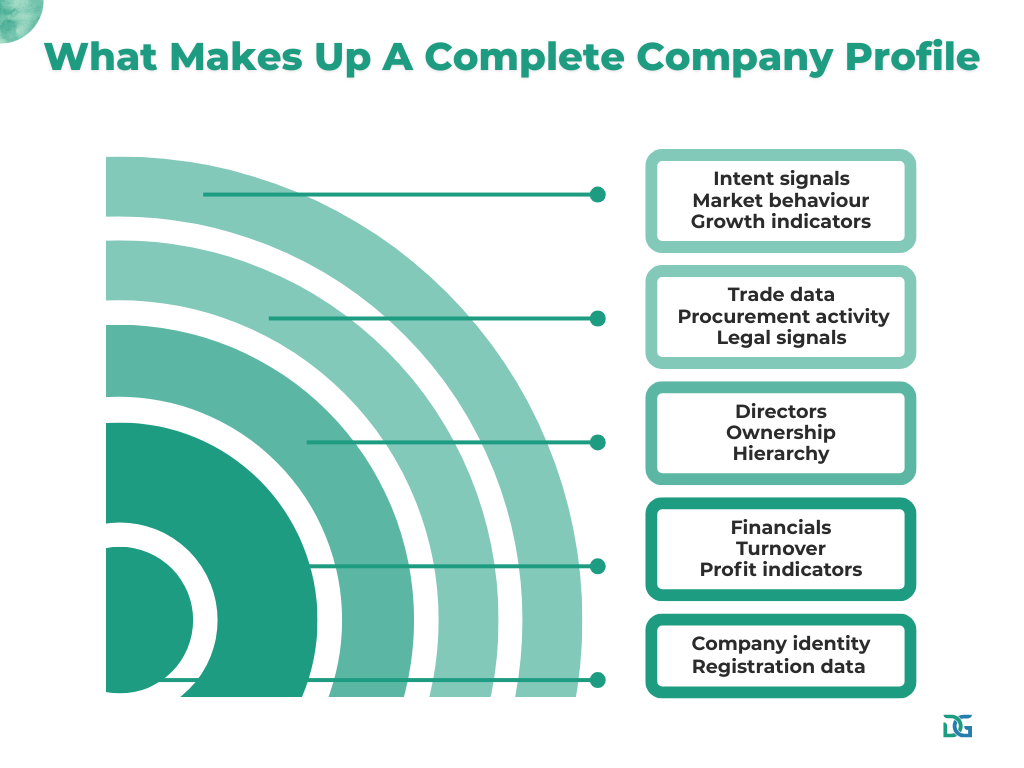
DataGardener goes significantly further. Financial metrics such as turnover trends and performance indicators sit alongside director histories, ownership structures, and filing activity. Company hierarchies allow users to understand how entities connect across corporate groups, which is particularly valuable in supplier evaluation and partnership assessment.
DataGardener also incorporates international trade data, procurement insights, and legal indicators. Rather than assessing a company through basic firmographic filters, users can interpret it across multiple evidence types simultaneously. This removes the need to switch between separate tools for financial data, company verification, and market insight, reducing analysis time and the risk of fragmented conclusions.
For a deeper look at the financial and structural data available within DataGardener, see DataGardener’s company intelligence features.
How Does DataGardener vs Cognism Compare on Prospecting
Both platforms support prospecting, though from fundamentally different angles. Cognism excels at enabling outreach at scale. Its verified phone numbers, email addresses, and GDPR-aligned data model make it effective for outbound sales teams. Behavioural intent signals drawn from Bombora and other third-party integrations help identify businesses actively researching relevant topics, supporting timely outreach.
DataGardener approaches prospecting with greater selectivity. Because it provides detailed company intelligence prior to engagement, users can assess financial stability, director longevity, and growth trajectory before making contact. This allows teams to disqualify businesses that appear active on the surface but lack underlying financial substance, reducing wasted outreach before it happens.
The choice often reflects a broader question about prospecting philosophy. Cognism supports high-volume, fast-moving outreach. DataGardener supports lower-volume, higher-precision targeting where each prospect is evaluated before being pursued. For teams whose pipeline quality matters more than pipeline volume, the latter model is materially more effective.
If your team is focused on building a verified, intelligence-led UK prospecting list, read our guide on 21 Sales Prospecting Techniques: Tips & Strategies for 2024
How Does DataGardener vs Cognism Serve Different Industries?
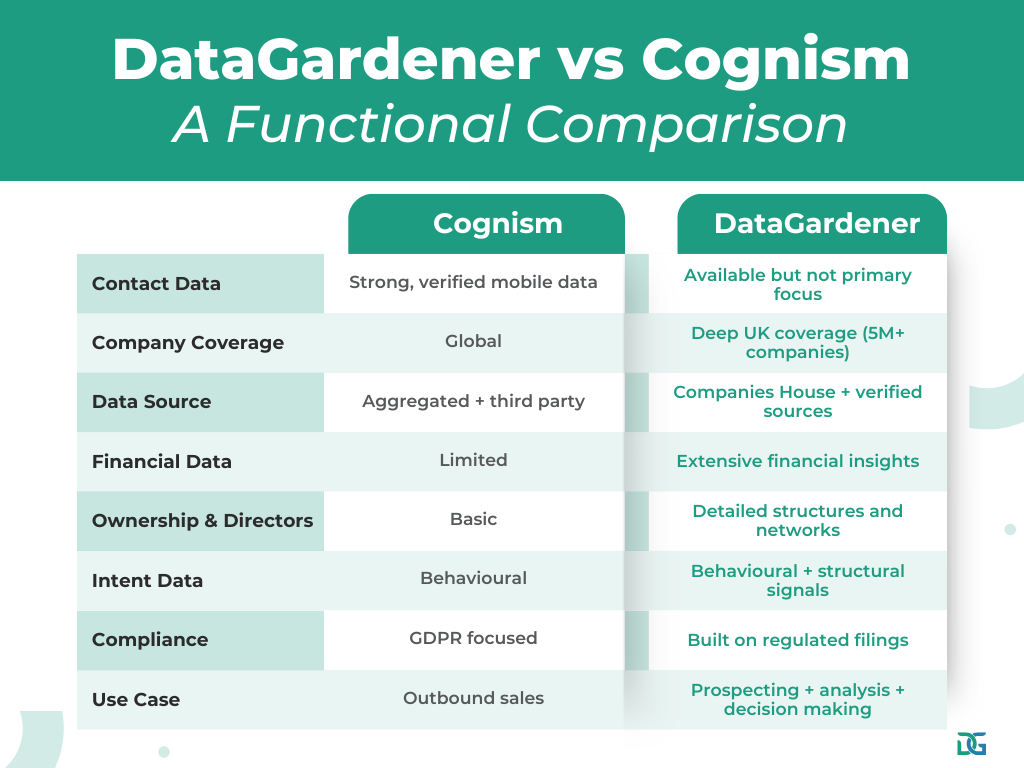
The most practical way to evaluate these two platforms is through the lens of what your organisation actually needs to do. Below is a breakdown by industry use case.
Recruitment
Recruiters using DataGardener can assess a company’s financial health, hiring patterns, and director stability before pitching. This reduces time spent pursuing businesses that lack the budget or stability to convert into clients. Cognism supports recruiters primarily through verified contact data for candidate sourcing rather than employer evaluation.
Financial Services and Lenders
Lenders and financial professionals benefit from DataGardener’s access to filed accounts, turnover trends, and ownership structures. These signals support credit assessment and risk evaluation within a single environment. This is a use case Cognism is not designed to serve. For more on this application, see our overview of UK credit risk data for financial services teams.
Procurement and Supplier Due Diligence
Procurement teams can use DataGardener to conduct supplier due diligence at scale, verifying financial standing, ownership, and compliance history before onboarding new vendors. For organisations with governance requirements around supplier risk, this structured access to official filings is materially valuable.
Sales and Business Development
Cognism serves sales teams that prioritise high-volume outbound activity, particularly SDR operations across multiple geographies. DataGardener serves sales teams that take an intelligence-first approach, researching a company’s financial profile and growth trajectory before investing time in outreach. Both are valid models. The choice depends on whether your sales motion is volume-driven or research-driven.
What Integrations Does Each Platform Support?
Integration capability is a practical consideration for any team evaluating a data platform, particularly where a CRM or sales engagement tool is already central to the workflow.
Cognism offers native integrations with Salesforce, HubSpot, Outreach, and Salesloft, as well as a Chrome extension that enables users to pull contact data directly from LinkedIn profiles and company websites. For SDR teams operating at volume within an existing sales stack, these integrations reduce friction considerably.
DataGardener offers native integrations with HubSpot, Salesforce, and Zoho CRM, as well as API access for teams that prefer a more flexible or custom setup. This means DataGardener can feed verified UK company intelligence directly into the CRM workflows your team already uses, without requiring a separate research environment.
For teams whose primary need is company evaluation, due diligence, or market analysis, DataGardener’s intelligence layers sit comfortably alongside existing sales and operations tooling. The platform delivers structured outputs usable across analyst, finance, and operations workflows, not only sales.
What Does Compliance Look Like Across Both Platforms?
Compliance is a central consideration for any UK data operation. Cognism places strong emphasis on GDPR compliance. Its processes for collecting and processing contact data align with regulatory standards across the UK and Europe, which is relevant for outbound campaigns spanning multiple jurisdictions.
DataGardener’s compliance advantage is structural. Its reliance on publicly available and officially filed information means every data point carries inherent traceability. This is particularly valuable in financial assessment, supplier due diligence, and partnership evaluation, where the provenance of data matters as much as its accuracy. Compliance is embedded within the data model itself rather than managed through a separate verification process.
In practice, both platforms offer compliant data. The distinction lies in the nature of that compliance. Cognism manages it through process and continuous verification. DataGardener’s compliance is built directly into its data model, which creates a higher level of inherent auditability. For organisations operating under strict governance frameworks, this difference is worth understanding clearly. The ICO’s guidance on lawful data processing provides useful context for evaluating both platforms against your specific obligations.
How Do Intent Signals Work on Each Platform?
Intent data has become an important component of modern B2B targeting, though its application varies considerably between platforms. Cognism incorporates behavioural intent signals drawn from digital activity and third-party integrations including Bombora. These help identify businesses actively researching relevant topics and support timely outreach.
DataGardener extends intent analysis further. Structural signals including financial growth trends, director appointments, hiring activity, and organisational changes are combined with behavioural indicators. A business demonstrating export activity, contract participation, and financial expansion alongside digital signals presents a far more compelling opportunity than behavioural data in isolation.
DataGardener enables this layered interpretation of intent, which is particularly valuable in competitive or complex markets where isolated signals can mislead. A business that appears to be researching a topic online but is in financial decline presents a categorically different opportunity than one showing structural growth signals alongside the same digital behaviour.
Start exploring DataGardener today
Access 17.2 million UK company records, financial filings, director data, and trade signals — all in one platform. See how verified intelligence from over 40 sources can sharpen the way your organisation identifies, evaluates, and pursues opportunities.
Visit datagardener.com to explore more