
Reliable company intelligence has become essential for organisations operating in the UK market, and nowhere is this more evident than in the growing conversation around DataGardener vs Beauhurst. Businesses today must understand far more than basic registration details. Financial health, ownership structures, and growth patterns all shape whether a partnership succeeds or fails.
In this environment, accurate insight makes the difference. Whether identifying potential clients, evaluating partners, or assessing risk, the right data leads to stronger decisions. For UK organisations weighing up DataGardener vs Beauhurst, the evaluation starts with one question: what was each platform built to do?
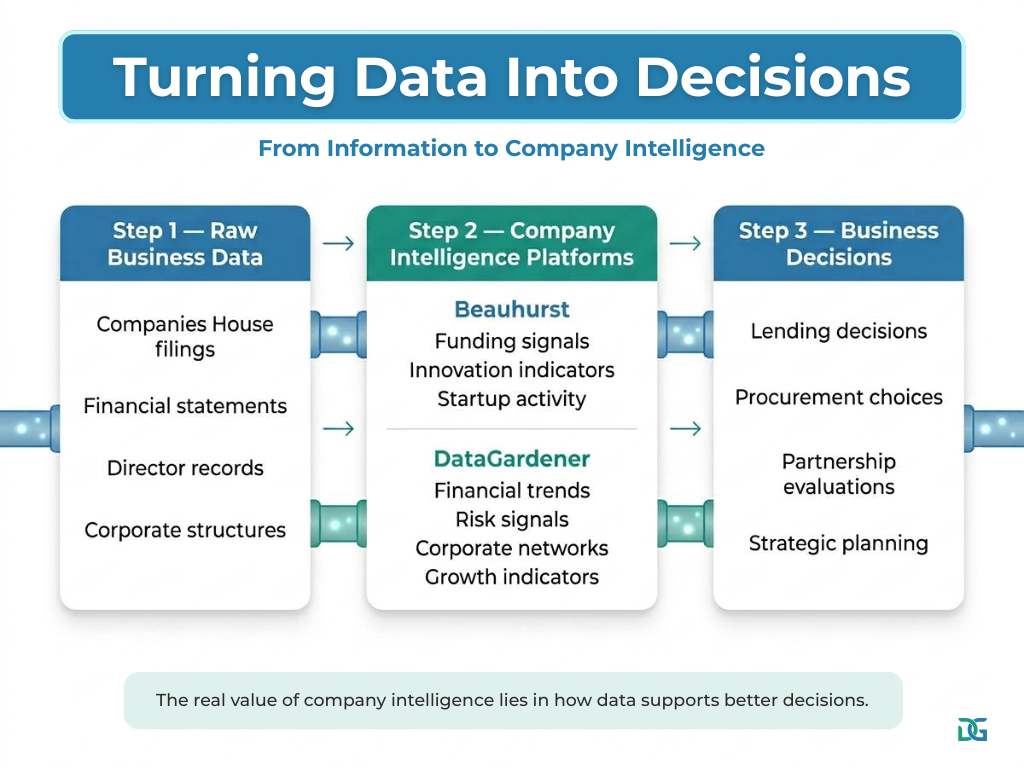
There is a well-known phrase that data is the new oil. However, that comparison only holds when data is refined. Raw filings and corporate records contain information. But they rarely deliver immediate clarity. Numbers without context can mislead just as easily as they inform.
This is where a company intelligence platform becomes valuable. These platforms organise large volumes of corporate records. Furthermore, they transform that raw data into structured insight. By combining multiple datasets with analytical tools, they help organisations understand how companies operate and evolve.
Within this space, DataGardener vs Beauhurst is a comparison that arises frequently. Both platforms aim to transform complex records into usable insight. However, their approaches differ in several important ways. Understanding those differences is essential before committing to either.
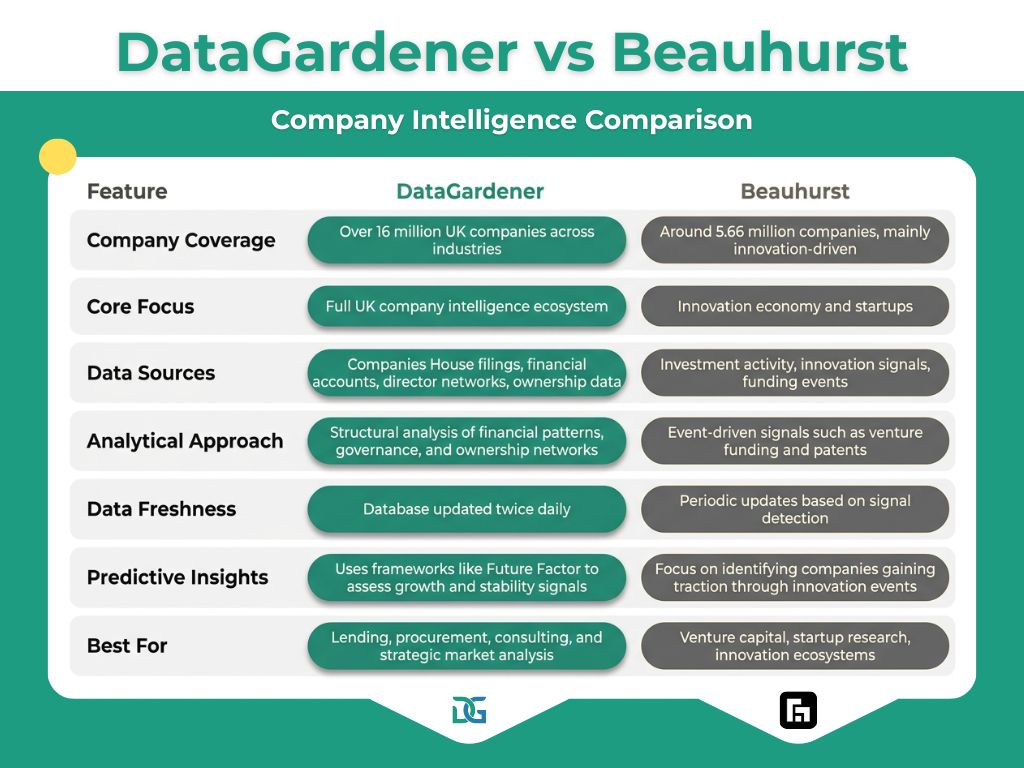
Key takeaway: In the DataGardener vs Beauhurst comparison, DataGardener covers more than 16 million UK companies across the full economy. Beauhurst, on the other hand, focuses on approximately 5.66 million companies with an emphasis on innovation and venture-backed activity. The right choice depends entirely on the breadth of insight your organisation needs.
What Makes DataGardener vs Beauhurst a Relevant Comparison for UK Organisations?
The UK corporate environment produces an enormous volume of publicly available information. Companies House filings, financial accounts, director records, and regulatory updates create a detailed archive of business activity. Yet access to information alone does not guarantee understanding.
Analysts face real practical challenges. Corporate data is scattered across different sources. Additionally, it is often presented in technical formats and updated at varying intervals. Reviewing these records manually quickly becomes time-consuming and prone to error.
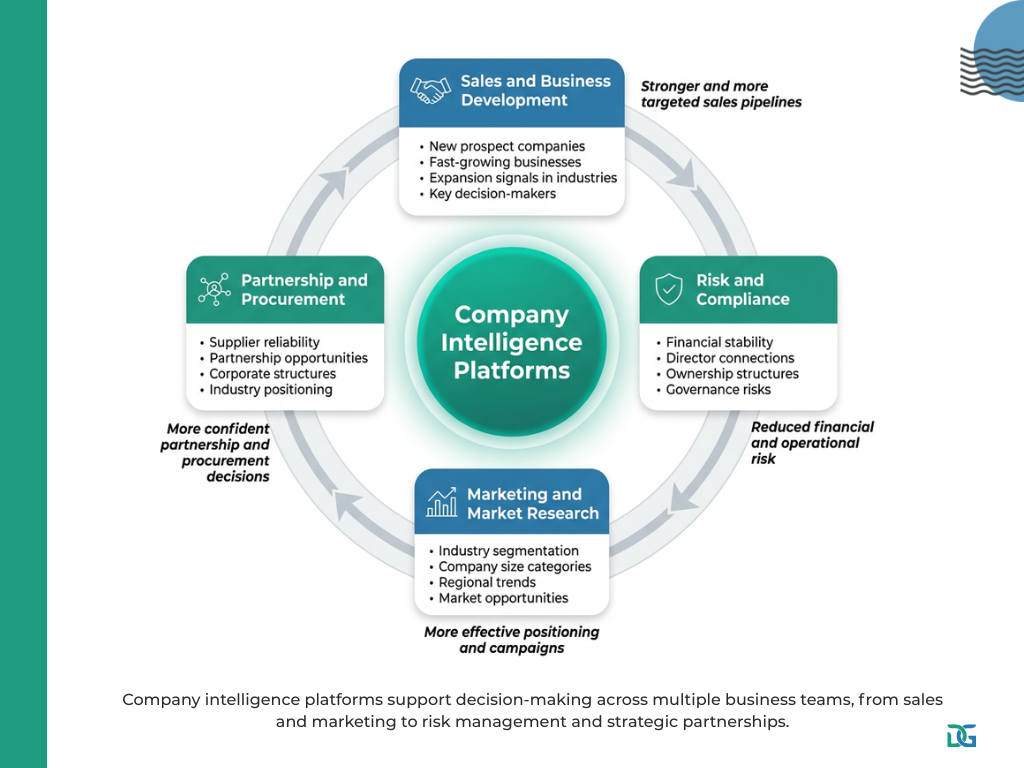
A company intelligence platform simplifies this process considerably. It collects information from multiple sources and presents it in structured formats. Moreover, many platforms apply analytical models that highlight patterns hidden within raw data. These insights can reveal financial trends, ownership relationships, or signals linked to growth and risk.
In simple terms, these platforms convert large volumes of corporate data into actionable insight. Consequently, organisations can guide decisions more confidently, whether in lending, procurement, investment, or commercial strategy.
Both DataGardener and Beauhurst operate within this field. However, each approaches company intelligence from a distinct analytical perspective. Understanding that distinction is at the heart of any meaningful DataGardener vs Beauhurst evaluation.
Platform Focus: Innovation Tracking vs Market-Wide Analysis
How Does Beauhurst Help UK Businesses?
Beauhurst has built its reputation around analysing the UK’s innovation economy. Specifically, the platform focuses on companies showing signals of technological development, investment activity, or rapid growth.
At the centre of this approach is the Signals framework. This identifies organisations associated with venture capital funding, patent activity, research grants, or accelerator participation. As a result, users can identify companies gaining momentum within emerging industries.
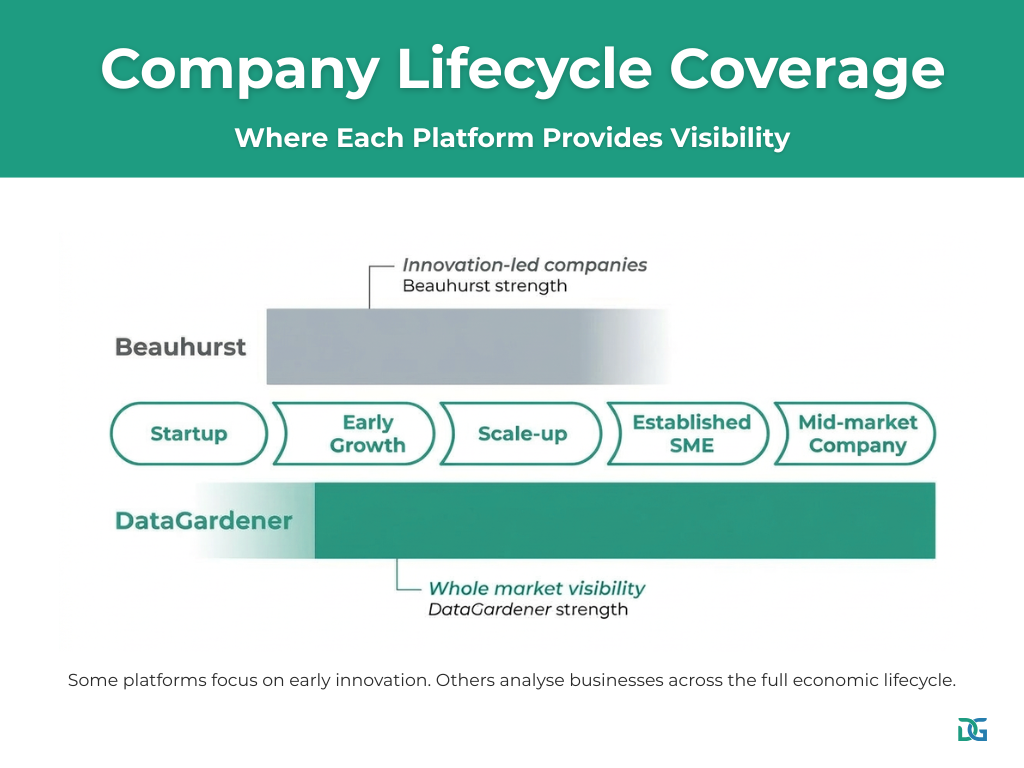
Beauhurst currently tracks around 5.66 million UK companies. Its particular emphasis is on organisations demonstrating innovation-related activity. Because of this, the platform is widely used by organisations connected to start-up ecosystems. Venture capital firms use it to identify investment opportunities. Universities track academic spinouts. Innovation agencies analyse how technology clusters develop.
For professionals studying entrepreneurship and investment trends, Beauhurst offers a focused lens into the innovation segment of the UK company intelligence landscape.
What Does DataGardener Do Differently?
DataGardener approaches company intelligence from a considerably broader perspective. Rather than concentrating on innovation signals, the platform analyses companies across the full spectrum of the UK economy.
The scale of coverage highlights this difference clearly. DataGardener tracks more than 16 million companies. This offers visibility across industries, regions, and stages of development. It includes SMEs, regional businesses, mid-market firms, and established organisations in manufacturing, logistics, retail, and professional services.
The platform integrates data from more than 35 trusted sources. These include Companies House filings, HMRC records, HM Land Registry data, financial accounts, and director histories. These datasets are then enriched with analytical indicators that reveal patterns in company behaviour. For a closer look at how this works in practice, see how DataGardener’s Business Intelligence module works.
Another important feature is data freshness. The DataGardener database is updated twice daily. Therefore, organisations always access insights that reflect recent corporate filings and structural changes.
Where Beauhurst highlights innovation signals, DataGardener provides a wider view of the entire UK business landscape. This makes it the stronger choice in the DataGardener vs Beauhurst comparison when breadth of coverage matters most.
How Does DataGardener vs Beauhurst Stack Up on UK Market Coverage
The difference in scope is perhaps the single most decisive factor in any DataGardener vs Beauhurst assessment. It becomes particularly clear when comparing market coverage directly.
What Beauhurst Covers
Beauhurst focuses on companies associated with innovation signals. Consequently, it helps users identify start-ups, scale-ups, and venture-backed firms developing new technologies. For analysts studying entrepreneurial ecosystems, this specialised perspective offers strong visibility into innovation-active sectors.
However, the UK economy extends far beyond the start-up environment. Millions of companies operate across traditional industries. These businesses form the backbone of everyday commercial activity.
Banks assessing lending risk must analyse established firms across every sector. Procurement teams evaluate suppliers in manufacturing, logistics, and professional services. Consultants examine companies across dozens of industries simultaneously. For these users, Beauhurst’s coverage can be limiting.
What DataGardener Covers
DataGardener’s datasets support this broader need directly. With coverage of more than 16 million businesses, the platform allows organisations to explore the full corporate ecosystem. This wider coverage provides a far more balanced understanding of market dynamics for the majority of commercial use cases.
In practical terms, many companies a lender or procurement manager would need to investigate simply do not appear within Beauhurst’s dataset. Not because they are unimportant, but because they have never attracted venture investment or filed a patent. DataGardener was designed precisely to fill that gap.
How Do DataGardener and Beauhurst Interpret UK Company Intelligence Differently?
Another meaningful distinction in the DataGardener vs Beauhurst comparison lies in how each platform interprets corporate information. It is not just about what each platform collects. It is about how each one transforms raw data into usable insight.
Beauhurst’s Event-Driven Approach
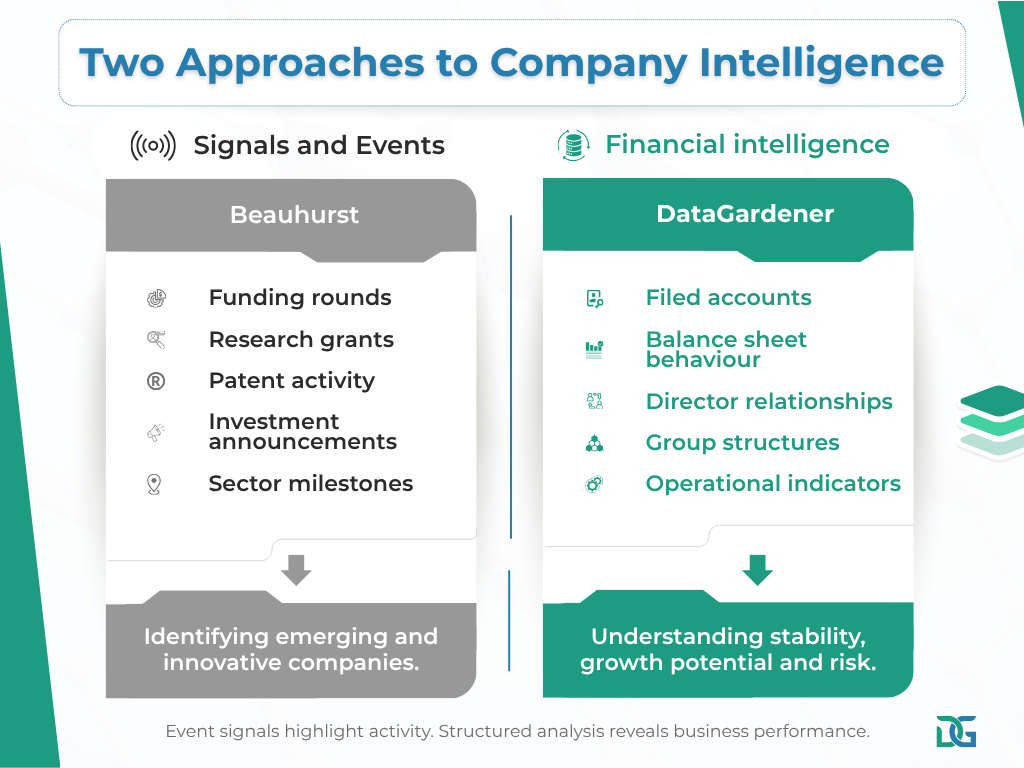
Beauhurst relies heavily on event-driven signals. When companies receive venture investment, register patents, or join innovation programmes, these events generate signals within the platform. As a result, users can identify businesses attracting investor attention or developing new technologies. For users focused on the innovation economy, this approach works well.
DataGardener’s Structural Approach
DataGardener, by contrast, follows a more structural analytical approach. Instead of focusing on discrete events, the platform analyses patterns within financial records, director relationships, and ownership networks across its 35 plus integrated data sources.
This method allows organisations to examine how companies operate beneath the surface. Financial behaviour over multiple years, charge registrations, CCJ histories, and director appointment patterns often reveal far deeper insight into long-term stability. A single funding event or patent filing rarely tells the full story.
In simple terms, Beauhurst highlights milestones. DataGardener, however, analyses the underlying structures that shape corporate performance. For organisations making lending decisions, procurement choices, or risk assessments, structural analysis tends to be more operationally useful.
Which Platform Offers Better Predictive Intelligence: DataGardener or Beauhurst?
Forward-looking analysis represents another important dimension of the DataGardener vs Beauhurst comparison. Here, the two platforms take meaningfully different approaches.
DataGardener’s Future Factor Framework
DataGardener incorporates a proprietary predictive framework called Future Factor. This evaluates companies using financial indicators, behavioural signals, and structural patterns drawn from across the platform’s 35 plus data sources. Consequently, businesses are classified according to likely trajectories. Some show signals associated with growth momentum. Others show characteristics linked to stability or potential difficulty.
Predictive analysis adds a genuinely forward-looking dimension to company intelligence. Historical filings explain what a company has achieved to date. Analytical indicators, on the other hand, help organisations consider how that company may perform in the periods ahead. Even a partial improvement in foresight can support materially stronger planning and risk assessment.
Beauhurst’s Innovation Signal Approach
Beauhurst’s predictive dimension is anchored primarily in innovation signals. When a company attracts new investment, secures a research grant, or joins an accelerator programme, these events signal potential future growth. This approach works well for identifying which start-ups are gaining traction. However, it is less applicable to the broader question of financial stability and operational risk across established companies.
Therefore, for organisations that need to understand both opportunity and risk across the full economy, DataGardener’s Future Factor provides a more practically applicable form of predictive intelligence.
Future Factor explained: DataGardener’s proprietary Future Factor framework applies financial indicators and behavioural signals to classify companies by growth potential and stability. It covers businesses across all UK sectors, not just those that have attracted venture capital. This is one of the features that most clearly distinguishes DataGardener vs Beauhurst for commercial users.
How Do Organisations Use Each Platform?
The analytical differences between the platforms translate directly into different use cases. This is arguably the most practical lens through which to view the DataGardener vs Beauhurst question.
Typical Beauhurst Use Cases
Beauhurst is most commonly used by organisations studying start-up ecosystems and innovation networks. Typical users include venture capital firms tracking funding activity, accelerators and incubators monitoring emerging companies, university technology transfer offices tracking academic spinouts, government innovation agencies analysing technology sector development, and journalists reporting on entrepreneurship trends and investment flows.
Typical DataGardener Use Cases
DataGardener is more frequently used by organisations requiring broader company intelligence to support operational and commercial decisions. You can read more about how this works in practice in DataGardener’s Lending Intelligence guide.
Typical users include commercial lenders and finance brokers assessing borrower stability and identifying prospects with active charge profiles. Procurement and supply chain teams evaluate supplier financial health, diversity credentials, and ESG compliance. These teams operate under the requirements of the UK Procurement Act 2023, which has introduced formal obligations around supplier diversity and responsible procurement. For a detailed breakdown of how DataGardener addresses these requirements, see DataGardener’s Responsible Procurement module.
Additionally, consultants and advisers use the platform for client identification, competitive landscape mapping, and due diligence. Corporate strategists study industry structures and track competitor activity. Property professionals analyse commercial property ownership and transaction history through Land Registry integration. Compliance and risk teams screen against FCA-regulated environments, monitor companies for adverse changes, and support AML and KYC processes.
Because its datasets span the full economy, DataGardener allows organisations to explore relationships between companies and identify opportunities across sectors. This capability is particularly valuable in the DataGardener vs Beauhurst comparison for users outside the venture and innovation ecosystem.
Is DataGardener or Beauhurst Easier to Use for UK Data Teams?
Ease of use often carries significant weight in platform selection decisions. Furthermore, it features in the DataGardener vs Beauhurst conversation more frequently than vendors tend to acknowledge.
Using Beauhurst
Beauhurst offers a research-oriented environment designed for analysts exploring innovation datasets in depth. For users already familiar with start-up ecosystems and venture activity, the platform provides detailed analytical insight. The learning curve is manageable for specialist users. However, it may feel narrower in scope for those whose questions extend beyond the innovation economy.
Using DataGardener
DataGardener places a strong emphasis on clarity and structured presentation. Corporate information is organised into analytical views that help decision-makers interpret data quickly. Moreover, the platform is designed to help users move from research to action without unnecessary complexity.
This design reflects a recognition that many users, including credit analysts, procurement managers, and senior advisers, are making time-sensitive decisions. They need clear, well-organised intelligence rather than raw data exploration. DataGardener has invested deliberately in building an interface that serves both specialist analysts and operational professionals equally well.
DataGardener vs Beauhurst: Which Should You Choose?
Choosing between DataGardener and Beauhurst ultimately depends on the type of company intelligence your organisation requires. The DataGardener vs Beauhurst question does not have a single universal answer. Instead, it has a context-dependent one.
Choose Beauhurst if…
Beauhurst is well suited to organisations whose primary focus is the UK’s innovation economy. If your work centres on identifying venture-backed start-ups, tracking funding rounds, or monitoring patent activity, Beauhurst’s Signals framework provides excellent targeted visibility. Organisations in venture capital, university technology transfer, government innovation policy, or start-up journalism will find Beauhurst’s focused dataset particularly useful.
Choose DataGardener if…
DataGardener is the stronger choice for organisations that require company intelligence across the full UK economy. If your decisions involve companies across manufacturing, logistics, retail, financial services, or professional services, DataGardener’s coverage of 16 million plus companies provides the breadth you need.
The platform is particularly well suited to the following use cases. Commercial lending and alternative finance benefit from its deep understanding of charge profiles, CCJ histories, and financial trends. Procurement and supply chain management benefit from its supplier diversity and ESG compliance tools. Consulting and advisory services benefit from its full-economy market mapping capability. Corporate risk and compliance benefit from its comprehensive monitoring, sanctions screening, and KYC support. Property and investment intelligence benefit from its Land Registry integration and ownership network analysis.
The core distinction in DataGardener vs Beauhurst: Beauhurst answers the question “which innovative companies are gaining momentum?” DataGardener, on the other hand, answers the question “what is happening across the full UK business landscape?” Both are legitimate questions. However, they simply belong to different organisations.
Why Do UK Organisations Choose DataGardener Over Beauhurst?
Both platforms provide meaningful insight into UK businesses. Both also occupy legitimate positions in the company intelligence market. However, when the DataGardener vs Beauhurst comparison is conducted on the basis of analytical scope, data breadth, and real-world applicability, DataGardener holds a significant advantage across the majority of commercial use cases.
Greater Coverage Across the Full Economy
DataGardener covers more than 16 million UK companies. Beauhurst, by comparison, covers approximately 5.66 million. Therefore, the vast majority of businesses an organisation might need to investigate are present in DataGardener’s dataset. Companies that have never attracted venture investment or filed a patent are nonetheless important commercial counterparties, suppliers, borrowers, and clients. DataGardener was designed to serve the organisations that work with them.
Deeper Data Integration
DataGardener draws on more than 35 integrated UK data sources. These include Companies House, HMRC records, HM Land Registry, credit reference data, and sector-specific datasets. As a result, it provides a materially richer analytical foundation than platforms built primarily around innovation event signals. Furthermore, the twice-daily update cycle ensures that intelligence reflects the current state of the UK corporate landscape.
Specialist Modules for Operational Decisions
Beyond company discovery, DataGardener provides specialised capabilities built around specific operational needs. Business Intelligence offers advanced search and filtering across 16 million plus companies with over 100 filter parameters. Lending Intelligence provides AI-powered identification of lending opportunities and financial risk assessment. Responsible Procurement delivers supplier diversity analytics covering women-owned, minority-owned, and social enterprise classifications. Property Intelligence integrates Land Registry data for commercial property ownership analysis. Investment Intelligence supports portfolio risk analysis, ESG scoring, and competitor benchmarking. International Trade Intelligence covers import and export data across 130,000 plus active UK traders. Data Enrichment and API provides a RESTful API with pre-built integrations for Salesforce, HubSpot, Microsoft Dynamics, and Pipedrive.
Together, these modules make DataGardener not merely a data platform but an operational intelligence tool. Consequently, organisations move from information to action more efficiently than a research-oriented platform allows.
Predictive Intelligence with Future Factor
DataGardener’s proprietary Future Factor framework provides a forward-looking dimension that is absent from Beauhurst’s toolkit for the broader economy. By combining financial indicators, behavioural signals, and structural patterns, Future Factor helps organisations classify companies by growth potential and stability. This enables more informed decisions in lending, procurement, and strategic planning.
Enterprise-Grade Security and Compliance
DataGardener holds ISO 27001 and SOC 2 Type II certifications alongside Cyber Essentials accreditation and full UK GDPR compliance. These certifications matter particularly for financial services organisations and public sector buyers. For organisations in regulated industries where data security is not optional, these credentials represent a meaningful differentiator in the DataGardener vs Beauhurst evaluation.
Conclusion
The DataGardener vs Beauhurst comparison ultimately reflects two distinct visions of what company intelligence should do.
Beauhurst has built a genuinely useful platform for organisations studying the UK’s innovation economy. If your primary need is to track venture-backed start-ups, monitor funding rounds, and identify companies gaining traction within emerging technology sectors, Beauhurst delivers focused, well-curated intelligence for that specific purpose.
DataGardener, on the other hand, has been built for a broader mandate. With coverage of more than 16 million UK companies, data drawn from 35 plus integrated sources, twice-daily updates, and specialist modules for lending, procurement, property, and trade intelligence, the platform serves organisations whose questions extend across the full UK economy.
For the majority of commercial organisations, including lenders, procurement professionals, consultants, risk and compliance teams, and corporate strategists, the DataGardener vs Beauhurst decision will favour DataGardener. The reasons are breadth, analytical depth, and operational applicability.
Both platforms have their place. The right choice depends on the insight your organisation needs most.
Explore how DataGardener can support your organisation’s strategic decisions at datagardener.com