
The 20 biggest companies in the UK are not just the largest, they are the most consequential. Their strategic decisions in 2025 are already shaping the contracts, partnerships, supply chains, and investment flows that will define 2026.
Understanding where these businesses are heading, not just where they have been, is the difference between reactive intelligence and the kind of forward-looking insight that creates commercial advantage.
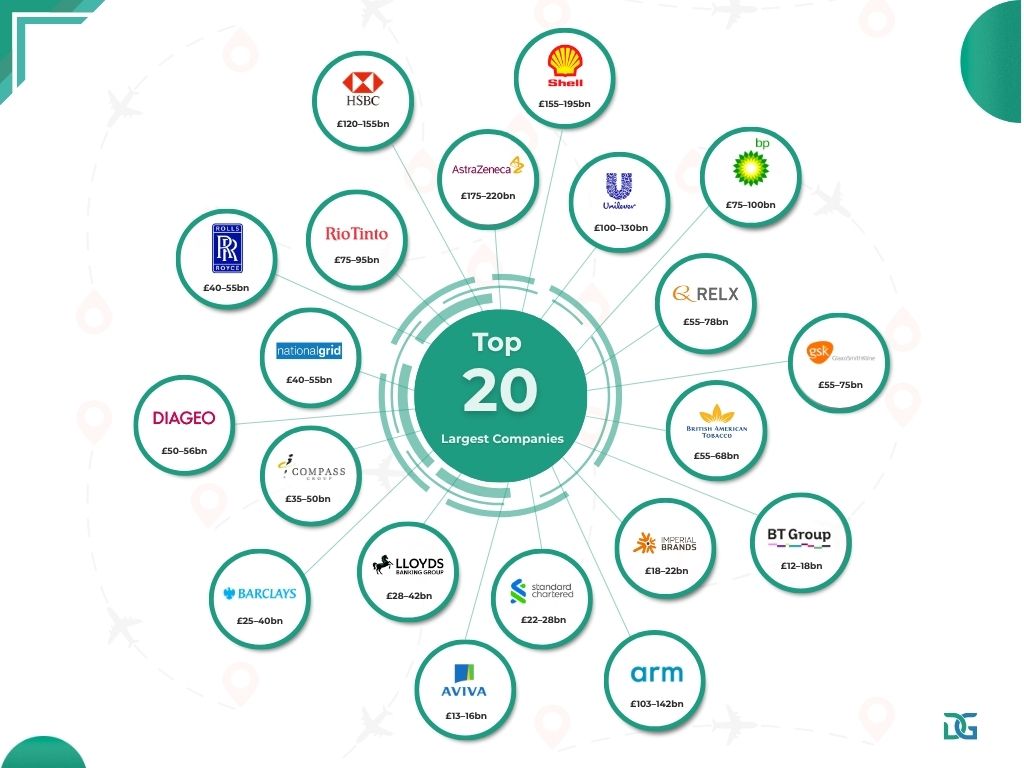
This guide ranks the 20 largest UK companies by market capitalisation, with verified financial data and the strategic context that matters most to anyone positioning themselves intelligently for 2026.
What Makes a Company One of the Largest in the UK?
Market capitalisation is the most widely used measure of corporate size for listed businesses. It is calculated by multiplying a company’s share price by the number of shares in issue.
All companies ranked here are constituents of the FTSE 100 and are headquartered or have their primary listing in the United Kingdom. The exception is Arm Holdings, which is addressed separately at the end of the list.
Market capitalisation ranges are estimates based on available data as of late 2024 and early 2025. These figures should be treated as approximate and verified against live market data prior to any investment or commercial decision.
1. AstraZeneca
Market cap: £175–220bn | Sector: Pharmaceuticals | HQ: Cambridge
AstraZeneca sits at the top of the FTSE 100 and is one of the world’s most valuable pharmaceutical companies. Revenue grew approximately 18 per cent in FY2024 to around $54 billion, driven by an oncology portfolio that includes Tagrisso, Imfinzi, and Enhertu.
The company is investing over £2 billion to expand its Cambridge campus and deploy AI in drug discovery at scale.
2. Shell
Market cap: £155–195bn | Sector: Energy | HQ: London
Shell remains one of the world’s largest companies by revenue, with FY2024 sales estimated at approximately $280–290 billion. Under CEO Wael Sawan, the company has moved decisively away from renewable energy ambitions toward shareholder returns. It is running a $3.5 billion quarterly buyback programme and refocusing on liquefied natural gas and oil production.
3. HSBC
Market cap: £120–155bn | Sector: Banking | HQ: London
HSBC is one of the largest companies in the UK and is conspicuously absent from many published rankings. It is one of the world’s largest banking groups by assets, with dominant positions across Asia, the Middle East, and Europe.
Any ranking of the largest UK companies that omits HSBC is immediately incomplete.
4. Unilever
Market cap: £100–130bn | Sector: Consumer Goods | HQ: London
Unilever’s most consequential decision of 2024 was to announce the separation of its ice cream division, including Magnum and Ben & Jerry’s, as a standalone business. The Growth Action Plan under CEO Hein Schumacher refocuses the company around 30 Power Brands.
Volume recovery has already been delivered after years of price-led growth.
5. BP
Market cap: £75–100bn | Sector: Energy | HQ: London
BP’s trajectory in 2024 was defined by retreat. New CEO Murray Auchincloss scaled back emissions-reduction targets, sold renewable energy assets, and increased oil and gas production commitments amid sustained pressure from activist investor Elliott Management.
Underlying profits fell to an estimated $8–10 billion from $15.2 billion the prior year.
6. Rio Tinto
Market cap: £75–95bn | Sector: Mining | HQ: London and Melbourne
Rio Tinto’s $6.7 billion acquisition of Arcadium Lithium, announced in October 2024, positions the mining giant as one of the world’s largest lithium producers. It links the company directly to the electric vehicle supply chain.
The Simandou iron ore project in Guinea continues its build, representing one of the most significant new mining developments globally.
7. RELX
Market cap: £55–78bn | Sector: Information and Analytics | HQ: London
RELX is perhaps the most overlooked business on this list – a consequence of its classification as an information services company rather than a technology platform. That perception has been shifting rapidly. Its share price roughly doubled between 2022 and 2024 as the market recognised its analytics business as an AI-powered growth engine.
Operating margins of 33–35 per cent are among the highest in the FTSE 100. The Risk division, which provides AI-driven fraud detection and identity verification, is growing fastest.
8. GSK
Market cap: £55–75bn | Sector: Pharmaceuticals | HQ: Brentford
Following the separation of Haleon, GSK now operates as a focused biopharma business. Revenue growth of 8–10 per cent in FY2024, excluding COVID products, was driven by Shingrix, the Arexvy RSV vaccine, and the HIV franchise.
The Zantac litigation remains the primary valuation overhang for the business.
9. British American Tobacco
Market cap: £55–68bn | Sector: Consumer Goods | HQ: London
BAT generates adjusted operating margins of 38–42 per cent, among the highest of any FTSE 100 company. The transition strategy centres on Vuse vaping, glo heated tobacco, and Velo oral nicotine pouches.
New CEO Tadeu Marroco, appointed May 2024, is accelerating the shift away from combustible tobacco products.
10. Rolls-Royce
Market cap: £40–55bn | Sector: Aerospace and Defence | HQ: London and Derby
Rolls-Royce’s share price rose approximately five to six times under CEO Tufan Erginbilgic, who took over in January 2023 and described the business as a burning platform. Underlying operating profit is expected to reach £2.0–2.5 billion in FY2024.
Dividends have been reinstated and the company is developing Small Modular Reactors with government backing.
11. National Grid
Market cap: £40–55bn | Sector: Utilities | HQ: London
National Grid’s market cap of £40–55 billion is approximately double many published estimates, making this one of the most commonly misstated figures in UK corporate rankings. A £7 billion rights issue in May 2024 funds a £60 billion five-year investment plan in electricity transmission infrastructure.
This investment is positioned to underpin Britain’s clean energy transition over the next decade.
12. Diageo
Market cap: £50–56bn | Sector: Beverages | HQ: London
The world’s largest premium spirits company experienced an organic sales decline of approximately one per cent in FY2024 due to inventory destocking in Latin America. CEO Debra Crew is stabilising performance while managing a portfolio of over 200 brands, including Johnnie Walker, Guinness, and Don Julio, across 180 markets.
13. Compass Group
Market cap: £35–50bn | Sector: Food Services | HQ: Chertsey
Compass Group employs approximately 550,000 to 600,000 people globally, making it one of the world’s largest employers by headcount in the private sector. FY2024 revenue of approximately £37–39 billion grew organically at 10–12 per cent.
This reflects both post-COVID recovery and a structural trend toward outsourcing food services to corporate and public-sector clients.
14.Barclays
Market cap: £25–40bn | Sector: Banking | HQ: London
Barclays announced a major restructuring into five operating divisions in February 2024 alongside a target of £2 billion in cost savings by 2026. The acquisition of Tesco Bank’s retail banking operations added meaningful scale.
A commitment to £10 billion in shareholder returns over 2024–2026 underscores management’s confidence in the execution plan.
15. Lloyds Banking Group
Market cap: £28–42bn | Sector: Banking | HQ: London
As the UK’s largest retail bank by customer base, Lloyds holds approximately 20 per cent of the UK mortgage market. The FCA motor finance mis-selling investigation, which widened significantly after an October 2024 Court of Appeal ruling, has led to provisions of £450 million, with further exposure possible.
16. Standard Chartered
Market cap: £22–28bn | Sector: Banking | HQ: London
Standard Chartered’s share price rose over 30 per cent in 2024, partly driven by reports of interest from First Abu Dhabi Bank. FY2023 pre-tax profit grew 16 per cent year on year.
The bank is pivoting toward wealth management and has pledged to mobilise $300 billion in green and transition finance by 2030.
17. Imperial Brands
Market cap: £18–22bn | Sector: Consumer Goods | HQ: Bristol
Imperial Brands delivers operating margins of approximately 40 per cent and maintains a share buyback programme exceeding £1.1 billion annually. The UK Tobacco and Vapes Bill 2024 represents a long-term regulatory headwind.
The Blu vaping brand is its primary vehicle for next-generation product growth.
18. BT Group
Market cap: £12–18bn | Sector: Telecommunications | HQ: London
BT appointed its first female CEO, Allison Kirkby, in February 2024. The Openreach division has passed approximately 14 million premises with full-fibre broadband, aiming to reach 25 million by 2026.
Plans to cut 40,000 to 55,000 jobs through AI and automation represent one of the largest workforce transformations in UK corporate history.
19. Aviva
Market cap: £13–16bn | Sector: Insurance | HQ: London
Aviva made its most significant strategic move in years with a £3.7 billion offer for Direct Line Group. CEO Amanda Blanc has sold eight international businesses since 2020, raising over £7.5 billion and refocusing entirely on the UK, Ireland, and Canada.
The bulk purchase annuity market has been a particular area of strength for the business.
20. Arm Holdings
Market cap: £103–142bn | Sector: Semiconductors | HQ: Cambridge
Arm Holdings is not an FTSE 100 constituent as it is listed exclusively on NASDAQ. However, it is headquartered in Cambridge and is unambiguously one of the largest UK technology companies by value.
Its chip architectures power billions of devices globally, and its market cap surged to approximately $130–180 billion by late 2024 as AI demand for energy-efficient processing accelerated.
What the 20 Biggest UK Companies Are Signalling for 2026
Several themes emerge from this ranking that reflect the broader direction of the UK economy as it heads into 2026.
Pharmaceuticals are leading Britain’s market value. AstraZeneca’s position at the top of the FTSE 100 reflects two decades of disciplined investment in oncology and immunology. GSK’s transformation post-Haleon is following a similar trajectory toward a focused biopharma model.
The energy sector is pulling in opposite directions. Shell and BP are retreating from renewables, whilst National Grid is making one of the largest clean energy infrastructure investments in British history. The UK’s energy transition is being driven by utilities and grid operators, not the oil majors.
Banking is navigating significant regulatory headwinds. Motor finance mis-selling, capital requirements, and digital transformation are reshaping the sector simultaneously. Lloyds and Barclays are both investing heavily in digital infrastructure whilst managing legacy obligations at scale.
The AI re-rating is real but selective. RELX has been the FTSE 100’s clearest beneficiary of the AI investment theme, rewarded for embedding machine learning into analytics products that generate genuinely high margins. Other companies are deploying AI operationally, but few have seen the same valuation impact.
The 20 biggest companies in the UK are each navigating structural transformation at scale. Their decisions – on energy, capital allocation, technology, and talent – are already in motion.
For investors, procurement teams, and commercial organisations, the question is not whether these shifts will affect your business. It is whether you have the intelligence to see them clearly enough to act ahead of them.
The companies on this list are your market. Understanding their direction is the starting point for every strategically sound decision you make in 2026.
Stay Ahead of the Shifts
Track the financial health, ownership structures, and strategic developments of the UK’s largest companies with real-time business intelligence.
Explore DataGardener’s company data platform
Other Resources:
- How to Spot a Financially Unstable Business Before It’s Too Late
- What If You Could See Any Company’s Turnover in Few Clicks?
- IS-8: What the UK’s Modern Industrial Strategy Means for You